

1) Executive summary
GMX $GMX is a perpetual DEX that launched in September 2021 on Arbitrum with V1, which used a multi-asset liquidity pool (GLP). GMX established its multi-chain presence with a deployment to Avalanche in January 2022. In August 2023, GMX V2 launched, which introduced more robust markets and more capital-efficient liquidity positions. It also made GMX the launch partner for Chainlink Data Streams, an industry-leading Oracle that enhances the trading experience with high-precision pricing and market data.
Since then, GMX has continued to ship product improvements. GLV vaults introduced liquidity rebalancing across markets based on trader demand, and Chaos Labs' Risk Oracles enabled real-time market optimization and effective risk management. By 2025, GMX achieved its goal of supporting users across leading blockchains, adding support for Solana, Bitcoin-secured Botanix, Base, BNB Chain, and Ethereum Mainnet. This report covers GMX's Arbitrum and Avalanche deployments, which represent the project's longest-standing and most established markets.
🔑 Key metrics (Q3 2025)
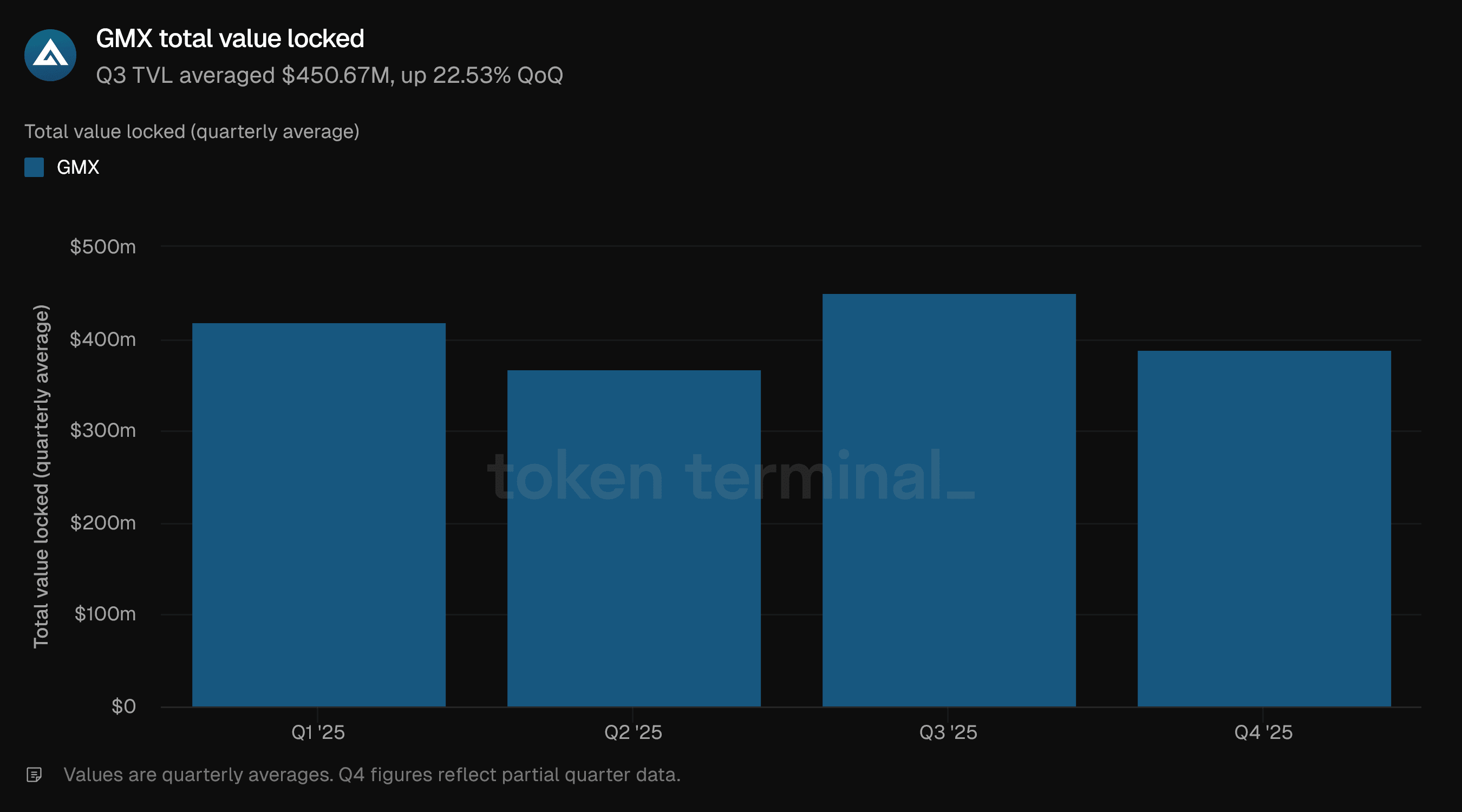
Total value locked: $450.67M (+22.53% QoQ)
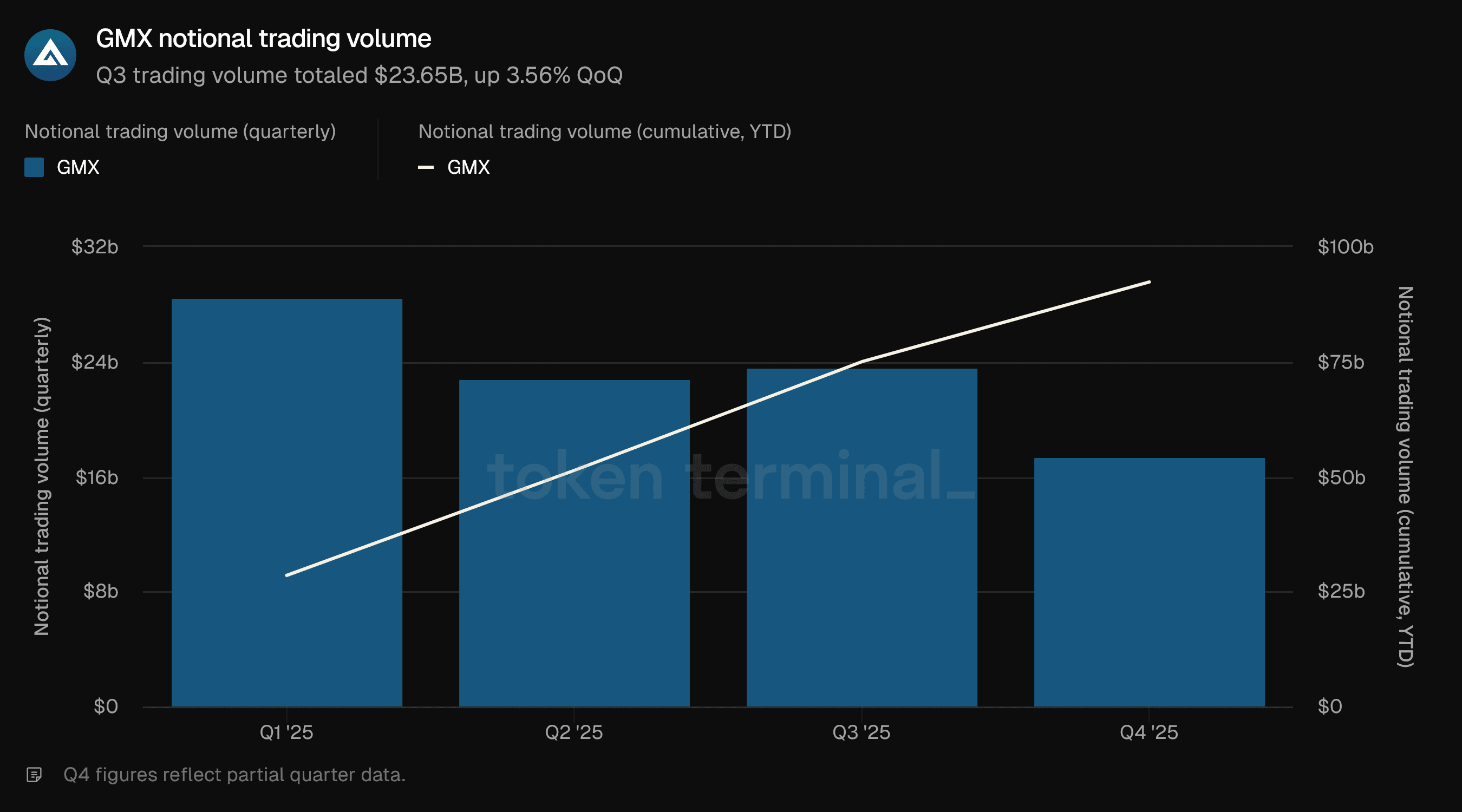
Notional trading volume: $23.65B (+3.56% QoQ)
Fees: $23.66M (-25.31% QoQ)
Revenue: $7.38M (-30.05% QoQ)
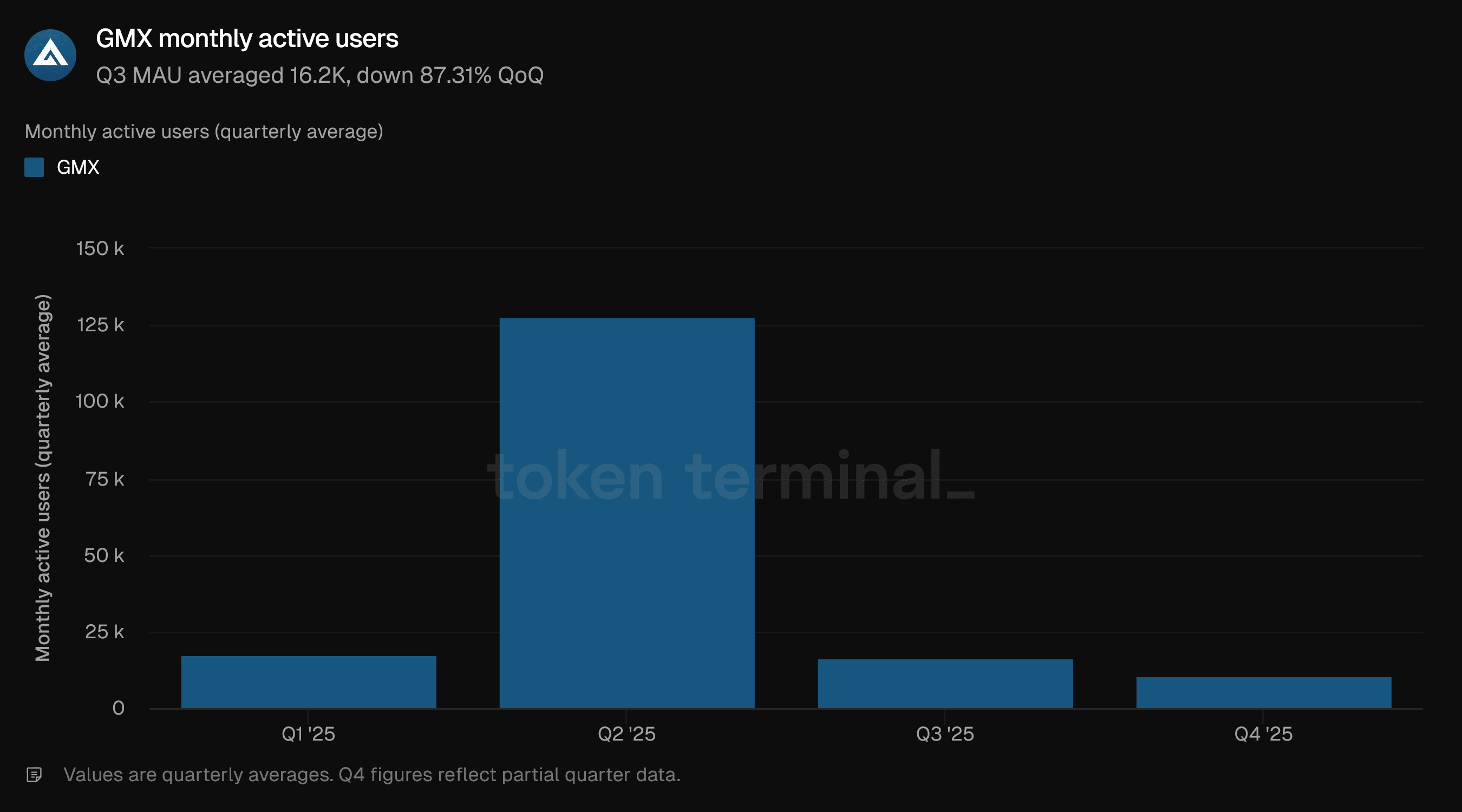
Monthly active users: 16.20K (-87.31% QoQ)
2) Total value locked
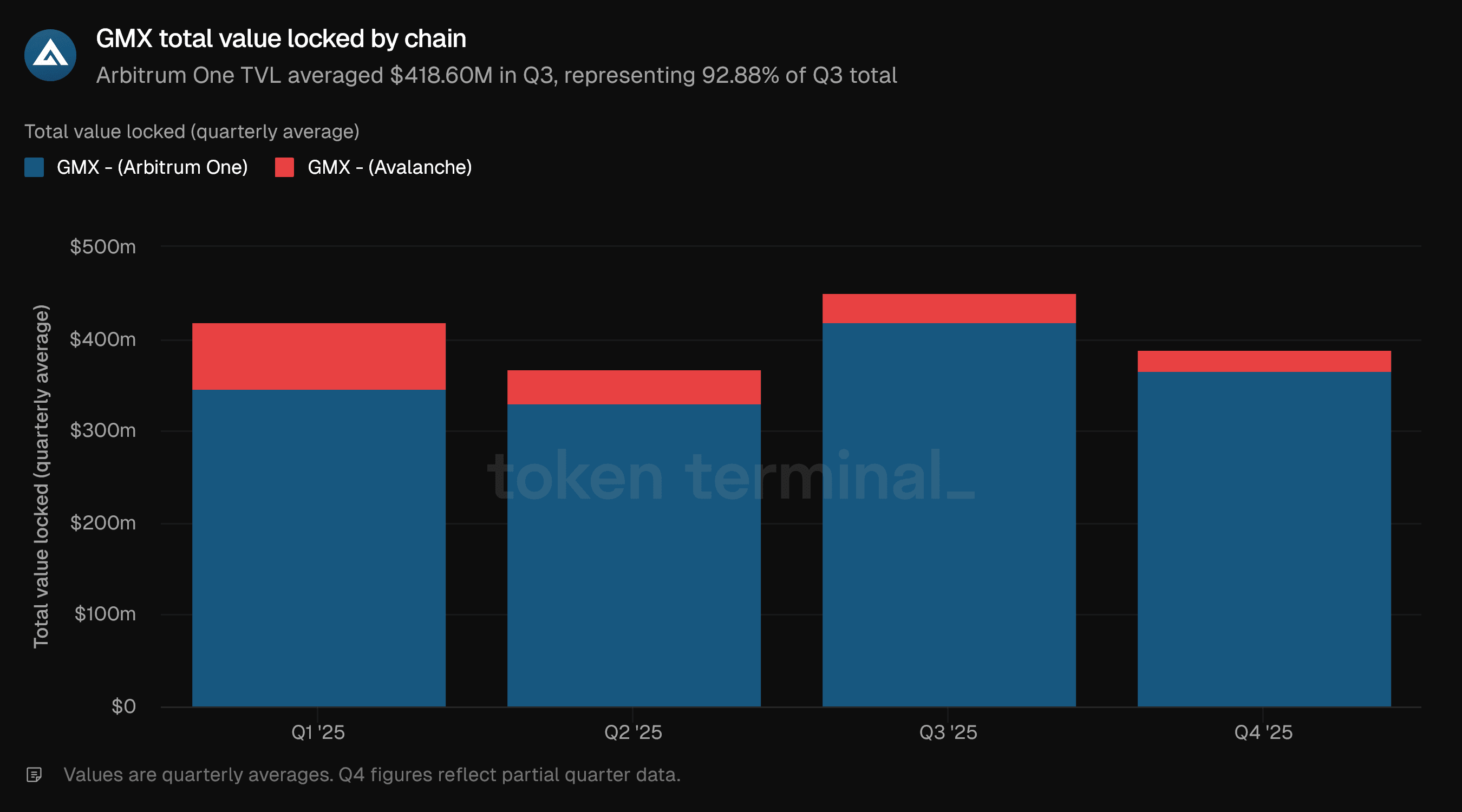
Total value locked (TVL) measures the total USD value of assets deposited into GMX’s liquidity pools across V1 and V2. Q3 TVL averaged $450.67M, up from $367.84M in Q2. Arbitrum One accounted for the majority of deposits at $418.60M, while Avalanche contributed $32.07M.
👥 GMX team commentary
"This crucial metric reflects the deep liquidity made available to traders, through GMX’s ‘peer-to-pool’ model. More than 40,000 liquidity providers earn rewards on the GMX V2 trading platform by providing liquidity to its diverse crypto and, newly introduced, non-crypto markets. The 22.5% quarter-over-quarter increase in TVL pushed GMX’s liquidity to its highest level of the year. This surge was fueled by the market’s bullish sentiment, as well as users' reinforced confidence in GMX’s professional reputation and its composable, highly competitive GM and GLV liquidity products."
3) Notional trading volume
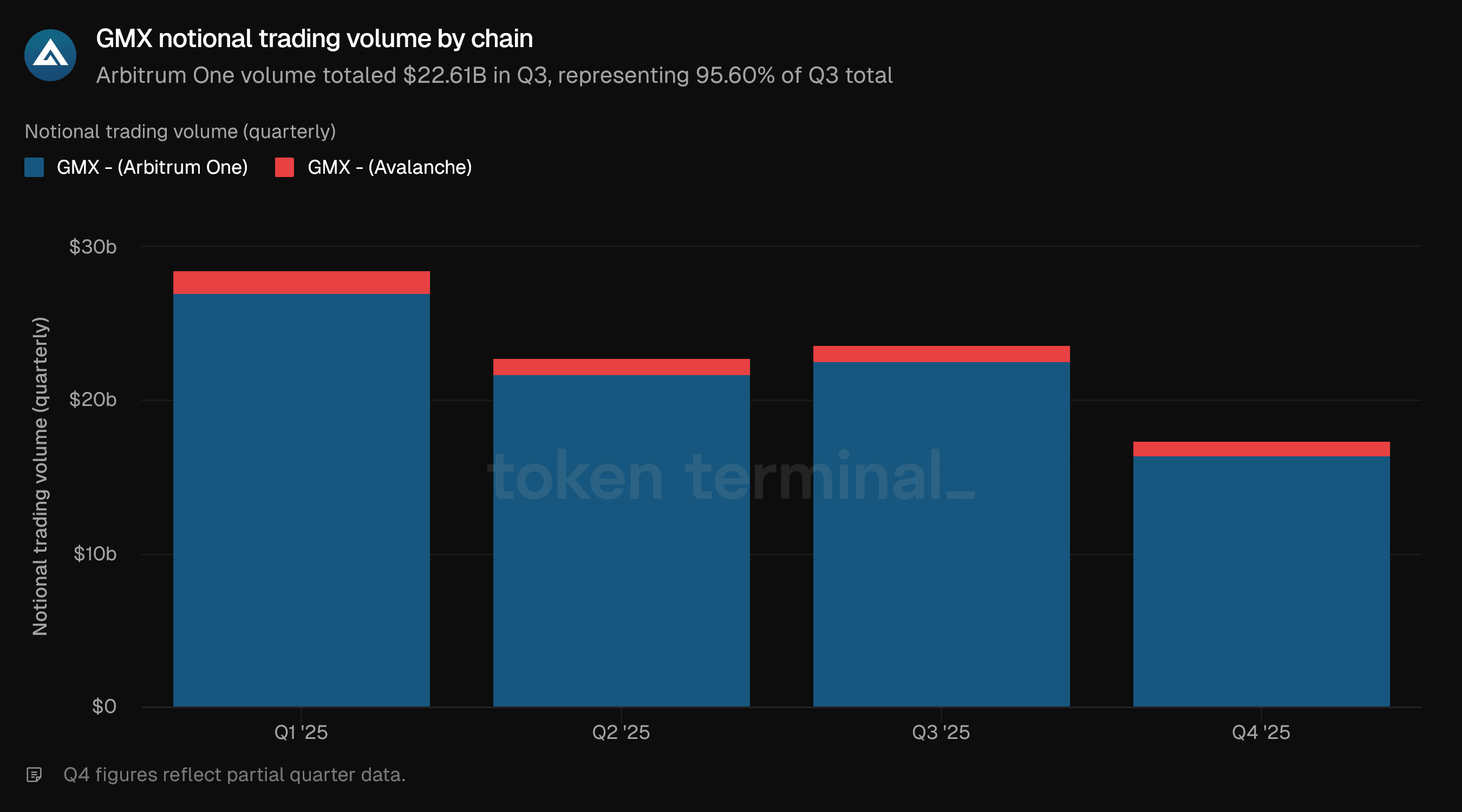
Notional trading volume measures the total USD value of all trading activity across GMX’s decentralized exchange, including perpetual futures trading, spot token swaps, and the minting and burning of liquidity tokens. Q3 trading volume totaled $23.65B, up from $22.84B in Q2. Arbitrum One generated $22.61B, while Avalanche contributed $1.04B.
👥 GMX team commentary
"Total trading volume on GMX grew from $22.84B to $23.65B in Q3 2025, representing a moderate but significant 3.56% increase from the 2nd quarter. Avalanche’s share of the total trading volume has remained stable at around 5%, with traders on the blockchain contributing just over $1 billion in both of the last two quarters of the year.
This increase in volume from one quarter to the next demonstrates how GMX—faced with a growing number of competing Perpetual trading platforms built on fast but siloed blockchains—has kept refining its product offering and enhancing the user experience for traders across the leading public blockchains. The pioneer Perp DEX has successfully positioned itself as the go-to permissionless trading platform for all Perp traders on public, decentralized chains."
4) Fees
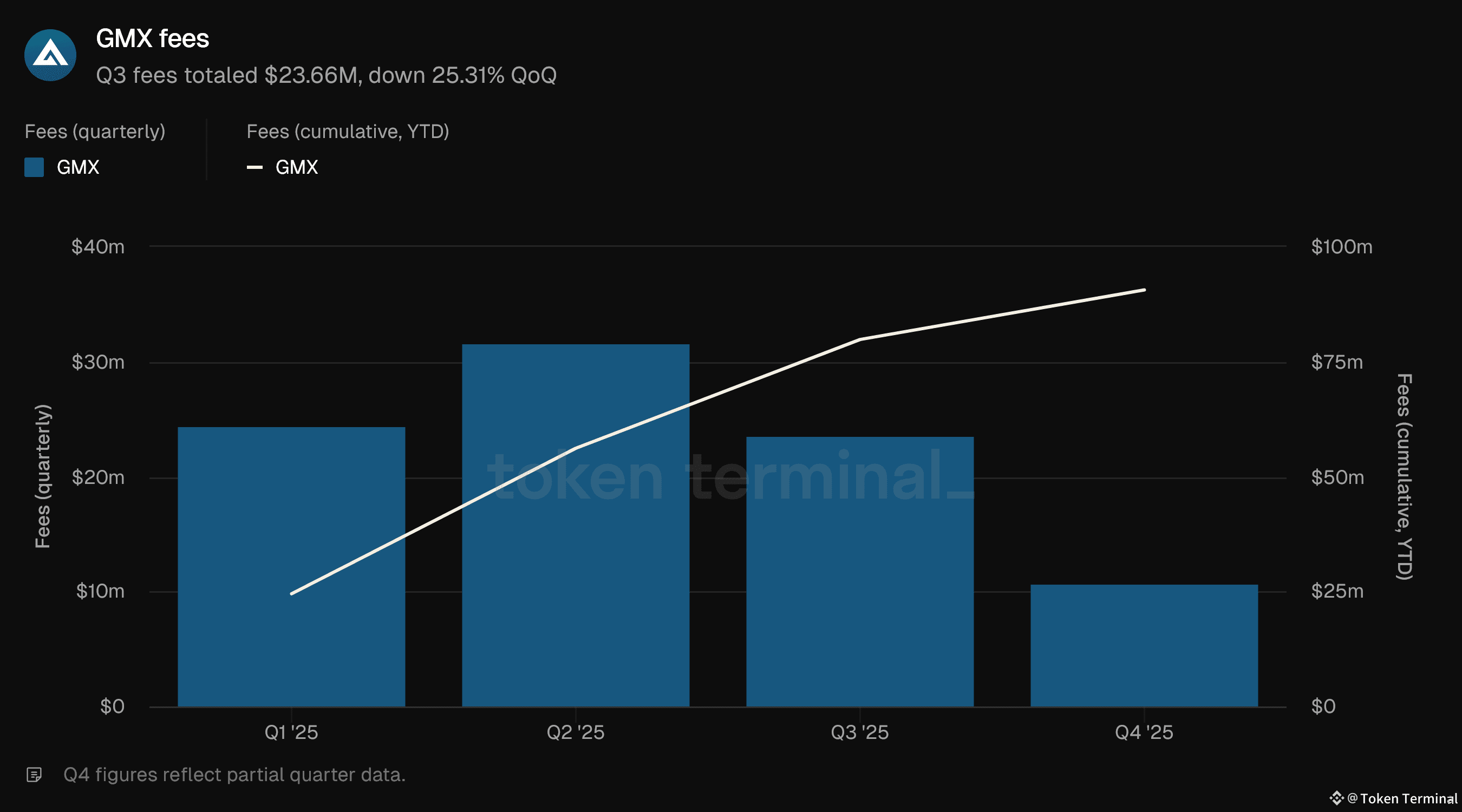
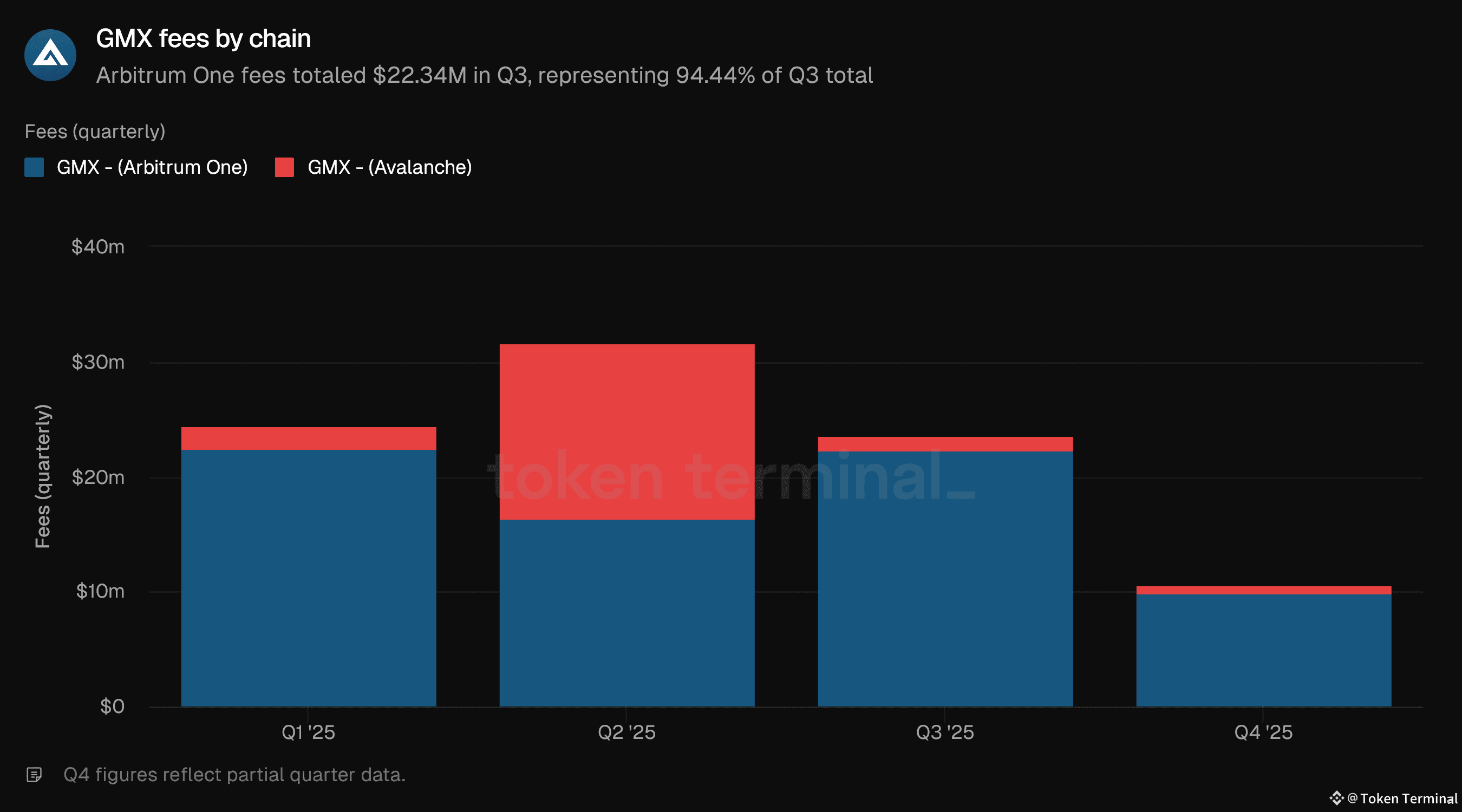
Fees measure the total USD value of fees paid by users across GMX’s decentralized exchange, including perpetual trading fees, spot trading fees, and price impact mechanisms. Q3 fees totaled $23.66M, down from $31.67M in Q2. Arbitrum One generated $22.34M, while Avalanche contributed $1.31M.
5) Revenue
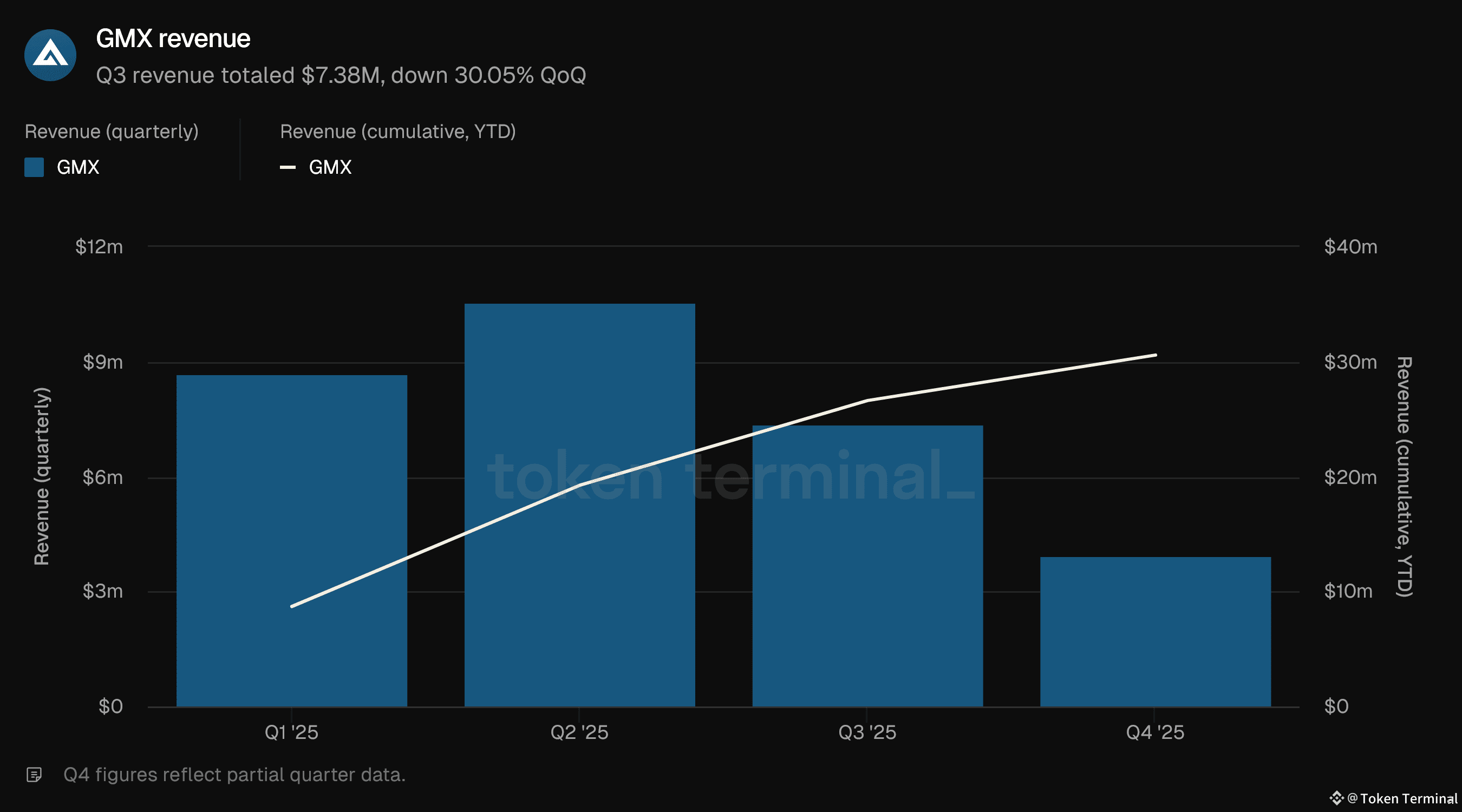
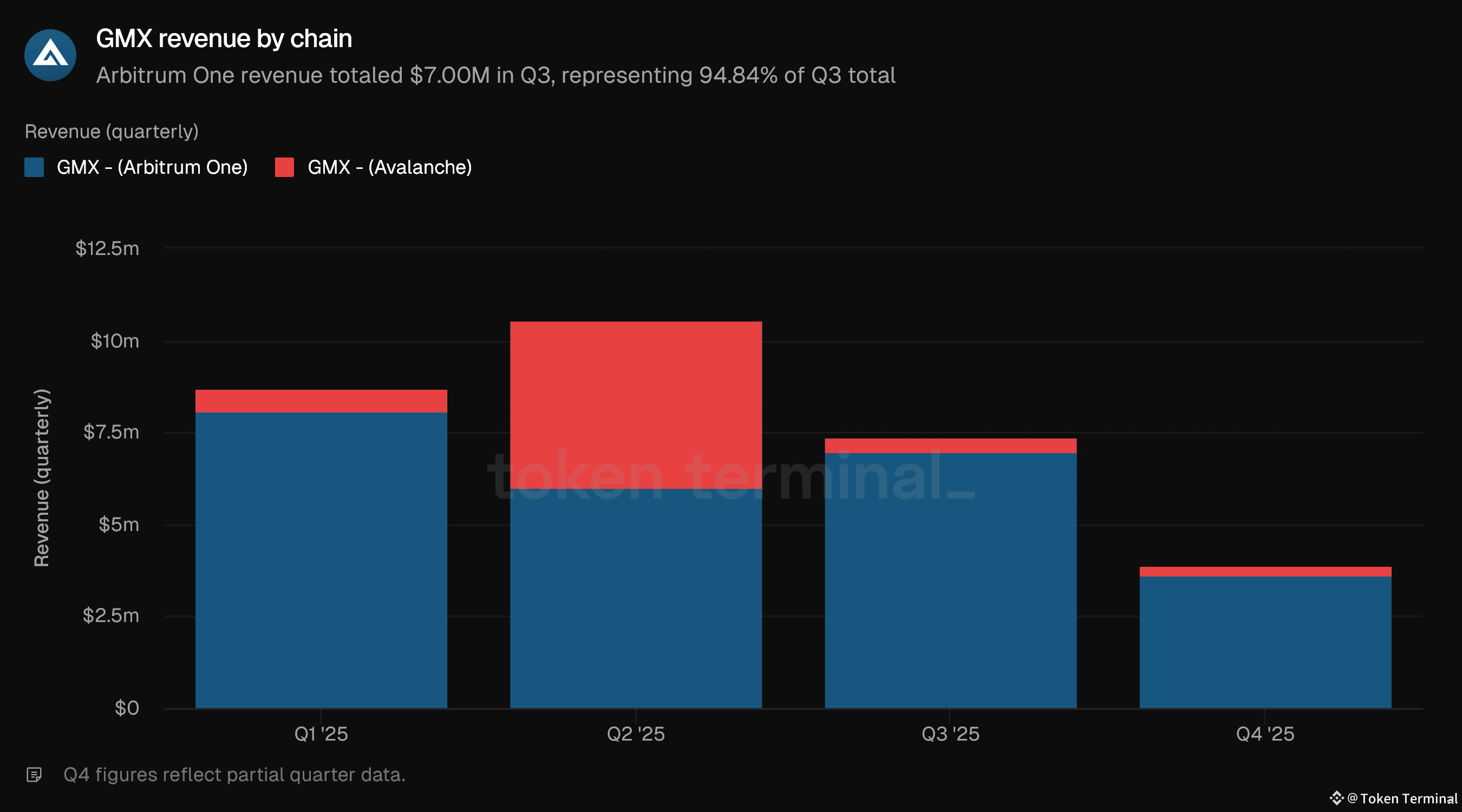
Revenue measures the total USD value of trading fees retained by GMX. Q3 revenue totaled $7.38M, down from $10.55M in Q2. Arbitrum One accounted for $7.00M, while Avalanche contributed $0.38M.
👥 GMX team commentary
"Over the past 4 years, markets on GMX have generated $467 million from over 730,000 users, facilitating over $340B in trading volume for its user community. These impressive metrics underscore how Perpetual DEXes have a unique product-market fit, excelling at user acquisition and revenue generation. Notably, 27% of all generated fees are allocated to GMX token buybacks, which are then distributed as rewards to GMX Stakers.
Trading volume increased by 3.56% from Q2 to Q3. However, fees and revenue appear not to show similar growth. The main reason for this discrepancy is that fees in Q2 were boosted by a single large liquidation on Avalanche, which skews the data. Excluding this outlier, fees and revenue in Q3 show growth in line with the increase in trading volume.
The overall picture for GMX in Q3 and into 2025 is one of strength and consolidation: despite the growing number of competitors in this popular market segment, the Perp DEX has successfully retained its traders, liquidity providers, and exceptional business fundamentals."
6) Monthly active users
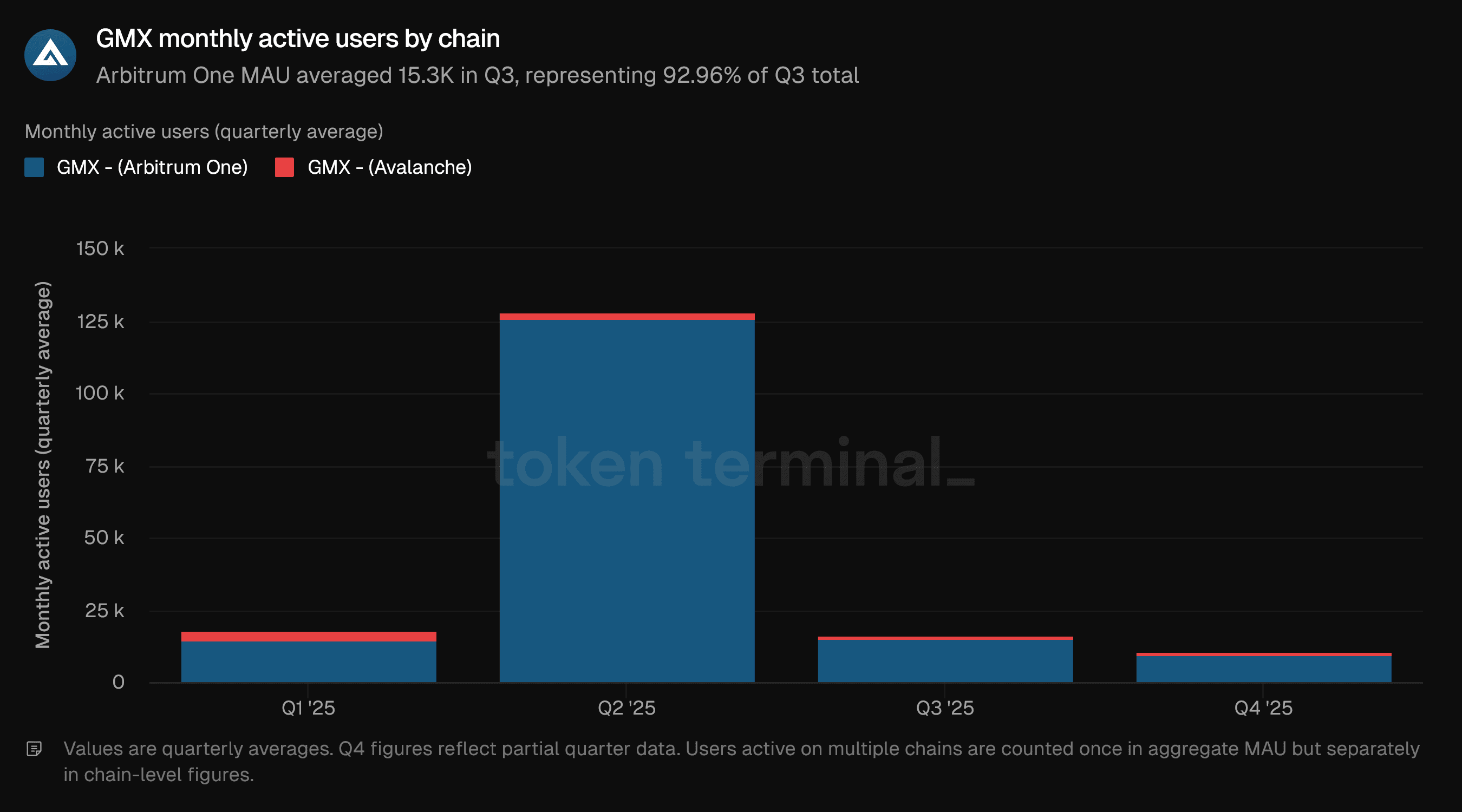
Monthly active users (MAU) measure the count of unique wallet addresses that interact with GMX’s decentralized exchange within any 30-day rolling window. Q3 MAU averaged 16.20K, down from 127.70K in Q2. Arbitrum One accounted for 15.30K users, while Avalanche contributed 1.20K. The 87.31% quarterly decline should be contextualized against Q2’s unusually elevated activity levels.
👥 GMX team commentary
"In Q2, the number of active users on Arbitrum One was indeed unusually elevated, due to an activation campaign on a popular quest platform that was ‘Sybilled’ by airdrop hunters. This Arbitrum partner campaign, which included GMX-related tasks, led to this spike in monthly active users.
When comparing Q1 to Q3 instead, we see an increase in monthly active users on Arbitrum from 14,600 to 15,300, while Avalanche user numbers decreased from 3,400 to 1,200. These stats highlight that the Avalanche blockchain has struggled to retain engagement, while trader activity on Arbitrum has remained strong and continues to grow, even amidst competition from many new L1 and L2 blockchains. As the leading trading platform on Arbitrum, GMX is well-positioned to benefit from these positive growth trends."
7) Outlook
👥 GMX team commentary
"The Q3 data reveals a clear trend: GMX is experiencing renewed growth across liquidity, trading volume, and revenue. In an increasingly competitive Perp DEX landscape, the original perpetual exchange that pioneered oracle-based trading continues to thrive.
What drives this performance? Traders keep coming back to GMX for predictable execution costs, fair pricing, unruggable liquidity, and excellent trade execution at size. Liquidity providers stay because GMX couples highly competitive yield with solid risk management. User incentives are aligned with platform design.
GMX's value proposition is straightforward: decentralized infrastructure, reliable oracle-based pricing, and transparently fair markets that don't rely on opaque market makers or fragmented order books.
In Q4, GMX introduces further UX optimizations and accelerates its horizontal Multichain scaling strategy. This expansion brings GMX to Base, BNB Chain, Ethereum Mainnet, and other major EVM ecosystems. The goal is to enable users to trade and provide liquidity from their preferred blockchain, while maintaining the same execution quality and capital efficiency that define the platform."
8) Definitions
Products:
GMX V1: the original version of GMX, launched in September 2021. V1 used a unified multi-asset liquidity pool (GLP) where LPs collectively acted as counterparty to all traders. Trading on V1 has been phased out since July 2025.
GMX V2: the upgraded version of GMX, launched in August 2023. V2 introduced isolated GM pools and GLV vaults, enabling liquidity providers to customize their market exposures.
GLP pools: multi-asset liquidity pools used in GMX V1, comprising assets such as ETH, BTC, and stablecoins. LPs deposited assets into GLP and collectively acted as counterparty to all traders.
GM pools: isolated liquidity pools introduced in GMX V2. Each GM pool backs a specific market, allowing LPs to choose their market exposure rather than participating in a unified pool.
GLV vaults: liquidity vaults introduced in GMX V2, built on top of GM pools. GLV vaults automatically allocate liquidity across multiple GM pools to optimize returns.
Metrics:
Total value locked: measures the total USD value of assets deposited into GMX’s liquidity pools across V1 and V2.
Notional trading volume: measures the total USD value of all trading activity across GMX’s decentralized exchange, including perpetual futures trading, spot token swaps, and the minting/burning of liquidity tokens.
Fees: measure the total USD value of fees paid by users across GMX’s decentralized exchange.
Revenue: measures the total USD value of trading fees retained by GMX.
Monthly active users: measures the count of unique wallet addresses that interact with GMX’s decentralized exchange within any 30-day rolling window.
9) About this report
This report is published quarterly and produced leveraging Token Terminal’s end-to-end onchain data infrastructure. All metrics are sourced directly from blockchain data. Charts and datasets referenced in this report can be viewed on the corresponding GMX Q3 2025 Report dashboard on Token Terminal.


