

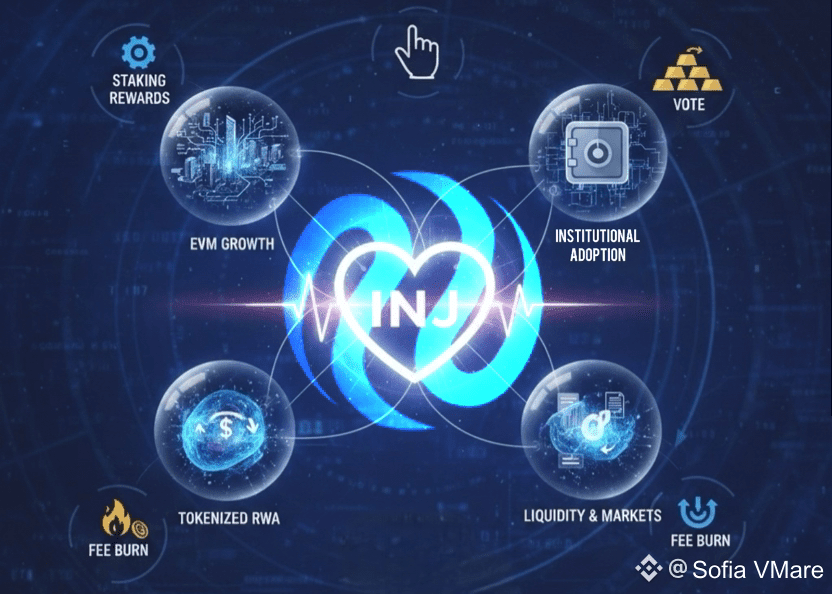
$INJ isn’t just a technical token anymore. It’s the heartbeat of Injective, syncing three big things: EVM growth, institutional adoption, and tokenized real-world assets (RWA). If a blockchain wants to matter, it needs more than code — it needs ecosystem magic. That’s where INJ shines.
Staking? Not your usual reward.
Forget standard block rewards. Stakers get a slice of all the fees. Every new user, every dApp, every trade pumps the ecosystem — and the stakers feel it directly. Your wallet grows when the network grows. Cool, right?
Institutions get a voice.
Money talks, but on Injective, INJ holders vote. New RWA listings, risk parameters, EVM module integrations — these decisions live in token hands. Holding INJ isn’t just a “feature.” It’s owning a piece of the infrastructure. Stake more, vote more, influence more.
Burn, baby, burn.
Up to 60% of fees collected are used to buy back and burn INJ. More activity in EVM and RWA = more tokens burned = deflation and rising value. Simple math, huge effect. It’s like every ecosystem success hits the “value accelerator.”
Liquidity is the lifeblood.
A shiny token doesn’t mean much without liquidity. INJ acts as universal collateral and fuels launches of new markets, especially in RWA. No deep liquidity = no real growth. Period.
Here’s the thing:
INJ isn’t a bunch of separate utilities. It’s a living organism.
It secures the network through stakers’ rewards.
It gives institutions a voice.
It turns network activity into economic value via burning.
It powers new markets.
Every trade bumps the system. Every new asset shakes it a little. Every vote? Yeah, it matters — even more than you think. This isn’t just numbers on a page, it’s alive. So tell me… is INJ really paving the way for DeFi’s future, or are we just tinkering with toys?
