
 A recent comparison between the price history of XRP and the initial trajectory of major tech companies has reignited the debate about investor expectations. The argument suggests that many XRP holders may be getting discouraged too quickly, even as the asset continues to underperform despite significant institutional participation.
Revisiting Amazon's long-term growth pattern
The discussion gained momentum after the market analyst 24hrscrypto1 mentioned the growth of Amazon's stock price during its early years.
He pointed to data showing that Amazon's shares were trading at only $0.09 at the end of the 1990s, before gradually rising to over $229 over an extended period. According to the numbers he shared, this represents an accumulated increase of over 250,000%.
The analyst emphasized that Amazon did not receive widespread recognition immediately and spent many years in periods of slow growth before registering significant gains. He argued that this trajectory demonstrates how large returns often require constant patience, especially in sectors involving new technologies or emerging markets.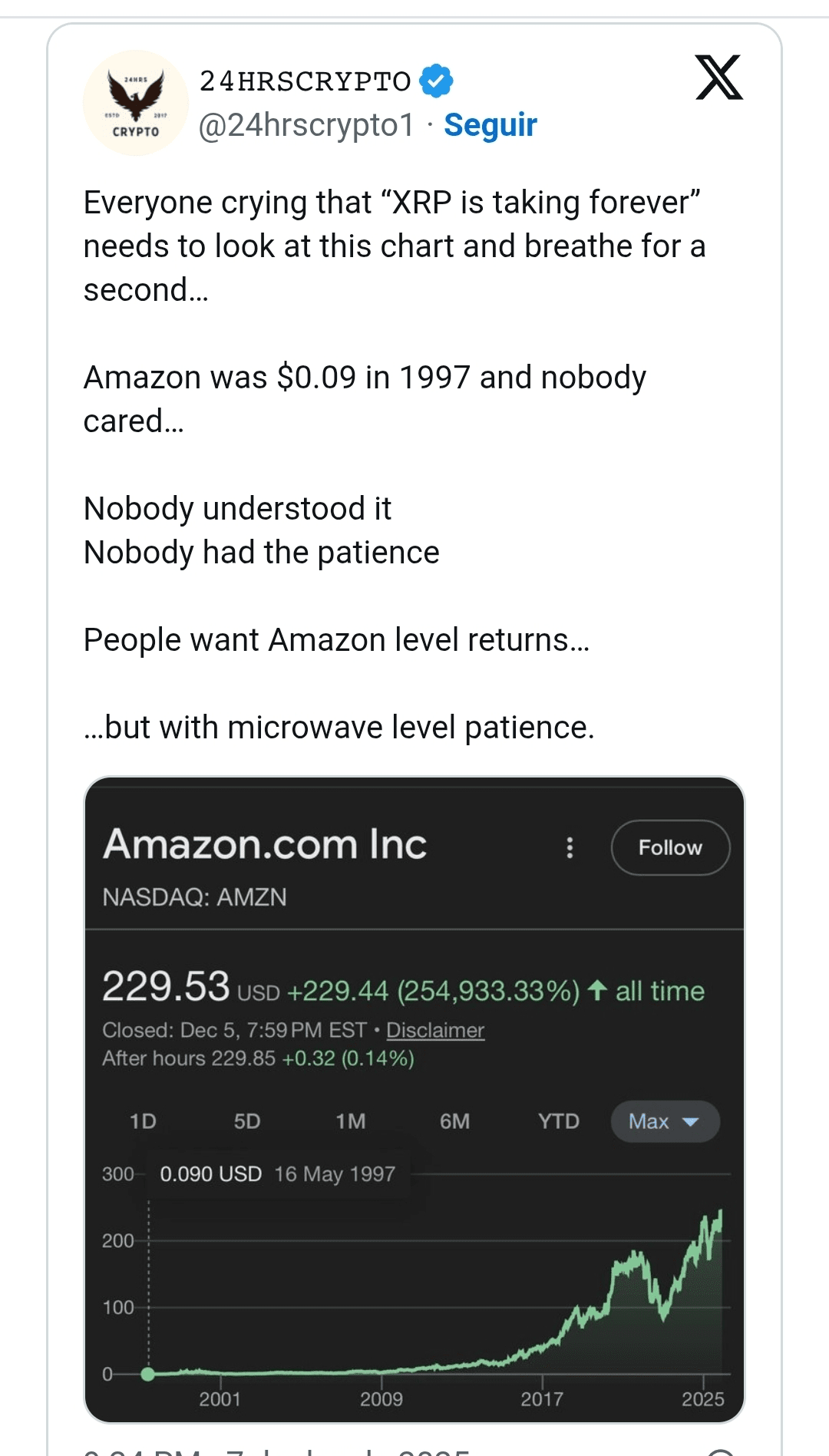
Concerns are growing within the XRP community.
The comparison arose amid growing frustration among XRP holders. The asset has shown slow growth, even with the occurrence of several important developments.
Ripple allocated $2.5 billion this year to various initiatives, and exchange-traded funds (ETFs) focused on XRP reportedly accumulated nearly $1 billion in their first month of activity. Despite these notable events, the price of XRP has fallen more than 26% in the last two months.
The prolonged consolidation has led many investors to express concern about XRP's performance relative to other digital assets. According to 24hrscrypto1, the dissatisfaction reflects a broader trend where many traders expect substantial gains in short periods but are reluctant to endure prolonged phases of low price volatility.
He argued that this mindset ignores the time it can take for the underlying technologies to develop and for market participants to fully understand their value.
Mixed reactions from market observers
The comparison with Amazon generated diverse reactions. Some commentators stated that the analogy does not hold when analyzing long-term charts. A user, Mortimer, argued that Amazon's price history shows a steady progression over time, while XRP's chart exhibits frequent stagnation for several years. He maintained that the patterns are fundamentally different.
In response, 24hrscrypto1 said that the appearance of Amazon's growth curve is influenced by hindsight. He suggested that looking at Amazon's early chart without knowledge of its future success would show slow progress, similar to what XRP is currently experiencing. He stated that XRP may still be in the early stages of realizing its potential.
Another participant noted that historically, XRP's appreciation from its recorded lows to its previous highs still reflects strong accumulated gains. Nevertheless, some analysts argue that the asset may have already surpassed its most significant growth phase.
While some community members use Amazon's history to support optimistic projections for XRP, others warn that equating a cryptocurrency with a long-established corporation can lead to unrealistic assumptions.
A critic pointed out that Amazon's value is tied to a business that generates revenue, while XRP functions as a digital asset without the same type of financial underpinning. He warned that drawing parallels between the two could create a misplaced confidence.
Remember folks, that what is said here does not represent a recommendation to buy, sell, or hold assets.
Thank you all!
