


Injective has reached a turning point—one shaped not by a single headline-grabbing upgrade, but by a steady sequence of developments that now form a clear, unified direction. For years, the project described itself as a finance-focused Layer-1 designed for speed, predictability, and institutional scale. But the ecosystem wanted proof that this vision ran deeper than branding. Over the past months, that evidence has become undeniable. A new architectural base, a broader developer foundation, institutional-grade upgrades, and accelerating ecosystem momentum have transformed Injective from a specialized trading chain into one of the most structurally complete platforms for next-generation on-chain markets.
This evolution did not begin with hype—it began with a fundamental shift: Injective’s embrace of a fully native EVM environment. Until recently, building on Injective required developers to port contracts to a non-EVM execution layer, which limited how many teams would commit resources. Only the most determined attempted it. With the launch of inEVM, everything changed. The world’s largest smart contract developer community can now deploy to Injective using their existing EVM tooling. Instead of asking teams to overhaul their architecture, Injective opened the door for frictionless migration. This was not trend-chasing—it was the removal of the single biggest barrier to adoption.
But Injective’s momentum cannot be explained by EVM compatibility alone. Many chains support Solidity. Very few combine EVM execution with a high-performance architecture built specifically for finance. Injective still holds its defining advantage—an optimized order-book engine, deterministic execution, ultra-fast finality, and modules crafted for derivatives, structured products, tokenized markets, and multi-asset collateral systems. Now developers can access all of this while retaining the composability and familiarity of the Ethereum ecosystem. Injective is no longer forcing teams to choose between speed and compatibility. It is delivering both, and that dual capability has become the core of its acceleration.
To match this architectural expansion, Injective has also delivered some of the most meaningful upgrades in its history. Updates like Nivara and Altaris were engineered with institutional expectations in mind. These enhancements strengthened permission controls, made bridging logic more secure, improved oracle behavior for real-world asset feeds, and refined validator-execution interactions. Retail users often focus on token price or new dApps, but institutions evaluate something entirely different: execution guarantees, data integrity, custody-safe environments, predictable settlement, and cross-chain reliability. Injective spent the year strengthening exactly those components. These upgrades position the network for a future where liquidity does not only come from crypto-native traders, but from traditional firms requiring enterprise-level reliability.
Another strategic move went almost unnoticed but signals a major cultural shift: the launch of Injective Research. Major financial networks succeed when their economic design, architecture notes, and technical frameworks are easy to evaluate. For years, many blockchain projects scattered documentation across posts, PDFs, and community forums. Injective chose a different path—centralizing its research, architecture insights, token models, and proposals in a unified public resource. This improves clarity, reduces uncertainty, and elevates trust. Serious builders assess ecosystems based on documentation maturity and transparency. Injective’s new research hub positions the chain as a platform ready for institutional diligence and developer scrutiny.
Liquidity mobility has become another powerful indicator of Injective’s momentum. The chain has steadily attracted new bridge partners, liquidity routes, cross-chain partners, and gateway providers. Strong on-chain markets require more than technology—they require seamless capital flow. A chain that cannot import liquidity becomes isolated. Injective is doing the opposite: creating a frictionless environment where assets can move in and out of specialized markets with minimal effort. This is exactly what market makers, arbitrage teams, and structured-product builders need. Efficient capital mobility widens trading opportunities and deepens liquidity across the ecosystem.
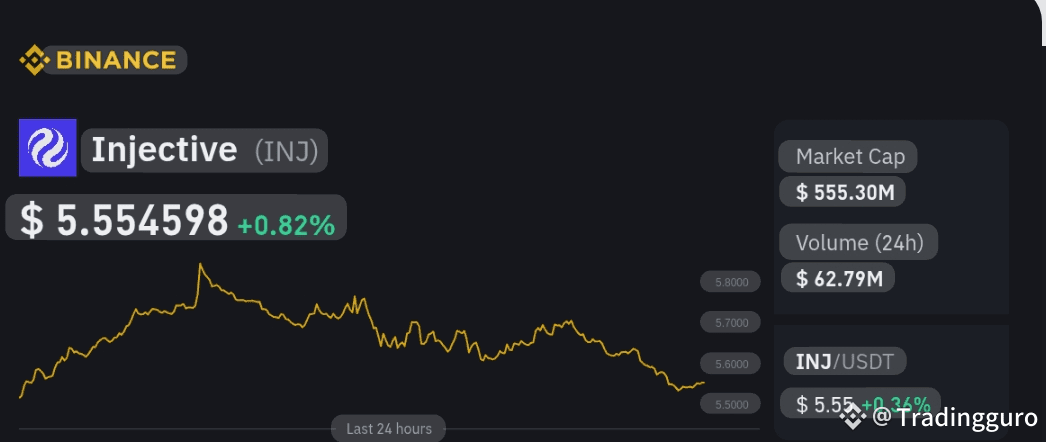
Market turbulence recently created noise when certain exchanges adjusted Injective margin pairs. But such adjustments reflect normal market recalibration, not foundational weakness. Exchanges routinely update margin frameworks based on volatility or concentration. Injective is in a growth phase where new dApps, liquidity sources, and volume channels are emerging quickly. Temporary adjustments are common during expansion. What matters long-term is whether Injective’s improvements translate into stronger on-chain liquidity, broader exchange support, increased derivatives depth, and a more active market maker base. These are the indicators that determine whether a network is advancing structurally—and Injective’s trajectory points upward.
Injective’s token model is also entering a more impactful stage. Fee-burning and auctions have always been part of its identity, but their significance increases as real usage grows. A deflationary design carries economic weight only when sustained fee generation exists. Injective’s strategy is clear: enhance the execution environment, support builders, expand liquidity pathways, and accelerate real usage. As transaction activity grows, the burn mechanism becomes a genuine economic force rather than a symbolic feature. The flywheel is straightforward: more builders → more usage → more fees → stronger token scarcity.
What comes next is even more significant. Injective is positioning itself for a wave of new financial products that require exact execution, robust tooling, and institutional-grade reliability. Fully on-chain order book systems, perpetual markets, structured vaults, synthetic markets, AI-driven execution engines, and tokenized assets all thrive on deterministic settlement and high throughput. Most chains can support AMM-based swaps. Very few can support these advanced financial structures natively. Injective’s architecture was engineered for them from day one. The next generation of dApps launching on Injective are expected to take advantage of these primitives to create products that cannot be easily replicated elsewhere.
Equally important is the cultural transformation happening around Injective. The ecosystem is no longer dominated by a niche group of high-frequency trading enthusiasts or infrastructure engineers. Developers from multiple ecosystems, market makers from centralized venues, liquidity providers, quant teams, RWA projects, and Web3 builders are expanding the community. Injective is becoming a financial environment with a diverse demographic—exactly what a maturing network looks like.
The coming year will be decisive. Injective now has the architecture, the tools, the research foundation, the EVM surface, and the institutional-ready components. The question is no longer whether Injective is capable—it is whether builders, liquidity providers, institutions, and users will scale into the environment. Real ecosystems grow through tangible usage, consistent liquidity, meaningful applications, and sustainable revenue—not speculation. Injective is entering the phase where adoption becomes the only metric that matters.
But current momentum suggests a strong path forward. The upgrades feel coordinated, the execution feels intentional, the tooling feels more accessible, and the narrative feels grounded in real capability rather than hype. Injective is shaping itself into one of the few chains where financial applications can scale confidently, where performance is engineered rather than promised, and where both traditional and decentralized liquidity can coexist efficiently.
Injective is no longer talking about what could be built someday. It is demonstrating what can be built today. That shift—from potential to present reality—is what makes this moment so defining. As builders and institutions begin deploying capital and applications across Injective, the network is poised to become one of the core execution layers powering the next era of decentralized finance.
