

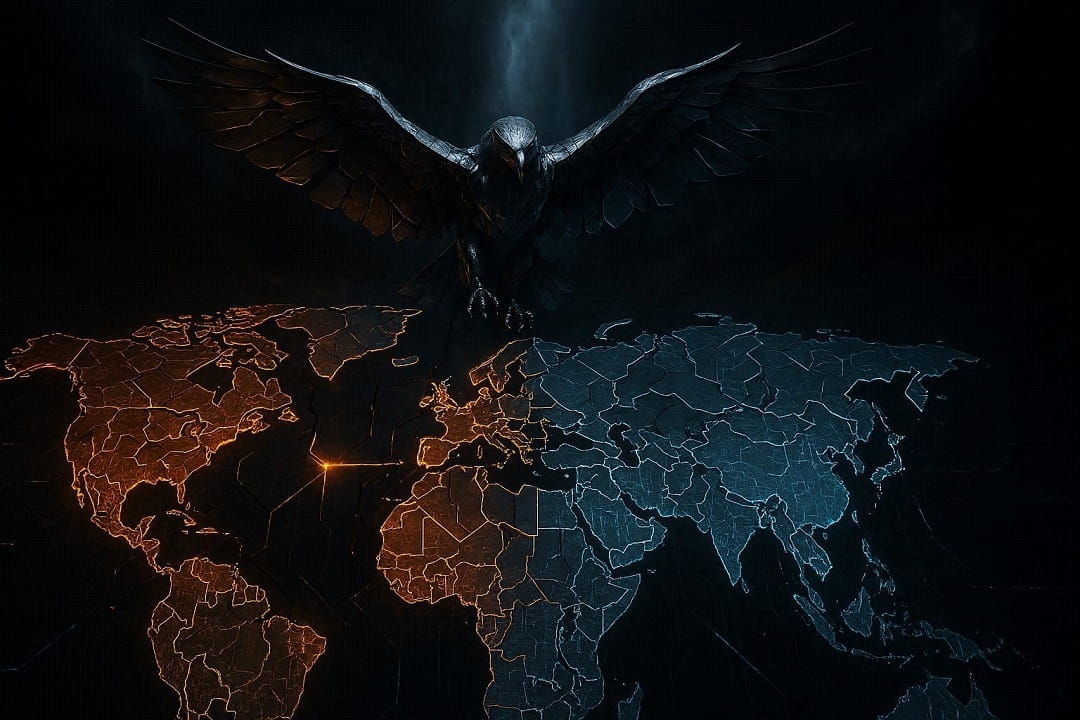
Global tensions no longer only affect trade or energy: they now shape liquidity, chains, and the systemic behavior of the crypto market. Falcon Finance emerges as an actor capable of navigating the new digital map.
In 2025, an unexpected chapter opened for the crypto ecosystem. What was once a market driven by internal cycles, halvings, innovation, institutional liquidity, is now directly influenced by geopolitical phenomena: competition among powers, trade tensions, technological disputes, and the consolidation of rival digital blocks.
This new context turns DeFi infrastructure into a ground where silent battles are fought: data routes, digital sanctions, capital restrictions, pressure on providers, dependence on foreign L2s, and reorganization of liquidity in the face of sudden geoeconomic movements.
In this scenario, Falcon Finance appears as a protocol built not only to optimize performance but to operate with resilience under global structural changes, those that alter the stability of entire chains, the availability of liquidity, and the trust in certain ecosystems.
While other protocols limit themselves to reacting, Falcon Finance incorporates a systemic reading of risk that allows it to position itself strategically before the impact is evident.
This article analyzes why geopolitics has become a central axis of the new crypto cycle and how Falcon Finance is prepared to become a critical piece of the decentralized financial architecture in a world that is no longer stable.
Geopolitics and crypto: the interdependence that no one wanted to admit
The crypto market used to be celebrated as an isolated space from political power. But the narrative has changed. Today, liquidity can feel affected by decisions made thousands of kilometers away:
Restrictions on data centers.
Technological financial sanctions.
Competition for chips.
Capital limitations in emerging markets.
Rearrangements of large sovereign funds.
Falcon Finance understands this interdependence and works on a key principle: in a geopolitically fragmented world, liquidity must be smarter, more mobile, and more preventive.
Signals of the new context:
Volatility no longer depends only on the market; it depends on global tensions.
Public networks can suffer indirect stress from regional conflicts.
Institutional liquidity withdraws faster than in previous cycles.
Cross-chain routes become sensitive to regulatory changes.
The protocol recognizes that efficiency is no longer a luxury: it is the only solid defense in cycles where risk moves faster than information.
Digital deglobalization: the direct impact on crypto infrastructure
Unlike past cycles, 2025 introduces a new phenomenon: digital deglobalization.
Great powers are raising technological borders, defining their own rules for data, energy, and connectivity. This directly affects:
Availability of validators.
Unexpected congestion in specific areas.
Amplified latencies.
Rising costs on certain RPC routes.
Drop in efficiency in some L1/L2 ecosystems.
Falcon Finance works to mitigate these effects through an architecture designed to divert from routes affected by external friction.
What Falcon Finance brings in this context:
Automatic alternative routes when a chain is compromised.
Intelligent rebalancing in the face of geopolitical shocks.
Anticipatory reading of stress in regions where networks tend to saturate.
Protection of the end user without the need for manual intervention.
A resilient infrastructure is not the one that withstands everything, but the one that knows how to reorganize quickly in an unstable global environment.
Global capital movements and the new logic of liquidity
Liquidity is not stateless. It moves following economic tensions, expectations, and systemic fears.
Since mid-2024, unprecedented patterns have been observed:
Flows migrating to more 'neutral' ecosystems.
Reconfiguration between chains due to regulatory risk.
Preference for protocols with transparent governance.
Structural volatility during trade conflicts.
Falcon Finance reads these movements as signals of reorganization, not as noise. Its systemic approach allows it to:
Redistribute liquidity toward more stable environments.
Avoid excessive exposure to chains under pressure.
Preserve capital during waves of international uncertainty.
Anticipate congestion caused by user migration.
Keys to this new global pattern:
Liquidity ceases to be linear: it now moves in geopolitical waves.
Shocks propagate more rapidly among interconnected chains.
The protocols that survive will be those with preventive relocation capacity.
Competition among digital blocks: how Falcon Finance operates in a multipolar world
We are entering a multipolar era where three dynamics impose themselves:
The decentralized block, which seeks resilience and neutrality.
The regulated block, which integrates crypto into traditional banking systems.
The sovereign block, where states create their own digital infrastructures.
In this map, Falcon Finance acts as a transversal infrastructure capable of interacting with all three without depending on any.
Essential contributions:
Adaptability to stricter environments without losing autonomy.
Neutrality to operate among ecosystems that do not trust each other.
Intelligence to manage liquidity where other protocols get trapped.
Robust design to withstand tensions that exceed the technological layer.
Multipolarity will not be an obstacle: it will be an accelerator for protocols with a systemic vision.
The next decade: why geopolitically prepared protocols will dominate the cycle
The markets of the future will be defined by infrastructures capable of surviving external shocks.
The thesis is clear: if an infrastructure cannot adapt to geopolitics, it will not dominate the next DeFi cycle.
Falcon Finance can.
The differential factors:
Autonomous liquidity.
Resilient routes.
Sensitivity to global risk.
Intelligent reading of flows.
Capacity for anticipation.
Flexible integration with multiple ecosystems.
What is coming is not a faster market: it is a more uncertain market.
And there, Falcon Finance stands out.
Conclusion
Geopolitics has ceased to be an external spectator to become a central actor in the crypto market.
Global tensions, restrictions, and reconfigurations directly affect chains, volumes, flows, and risks.
While many still operate with local lenses, Falcon Finance adopts a global vision, anticipating breaks, reorganizing liquidity, and creating adaptive defenses capable of operating in the least predictable scenarios.
The future will not be stable.
But it will require infrastructures capable of moving before reality changes.
And it is here where Falcon Finance is already positioning itself as an undisputed protagonist of the new digital map.
@Falcon Finance $FF #FalconFinance #falconfinance
⚠️ Disclaimer: This content is for educational and informational purposes only. It does not constitute financial advice. Do your own research (DYOR).

