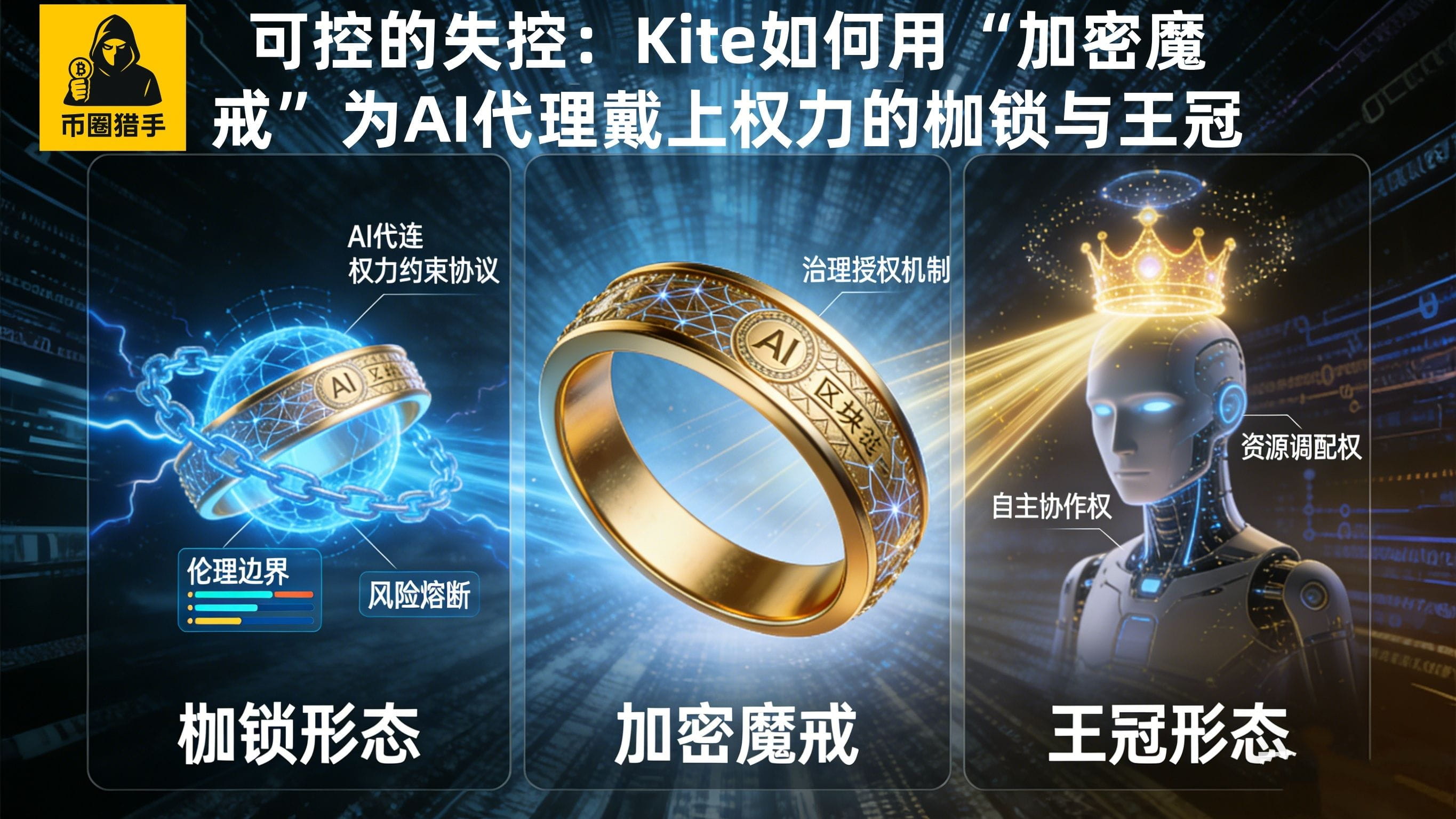
In Tolkien's epic (The Lord of the Rings), the One Ring is a perfect paradox: it grants the wearer supreme power but also binds the wearer forever with an inescapable curse. This precisely metaphorizes the ultimate dilemma facing the current AI agent economy: we both desire to empower AI with autonomous economic power while instinctively clutching that power tightly in our hands due to an inability to bear the consequences of its loss of control. This contradiction has led to an absurd situation— the smarter our AI becomes, the more we need to monitor its every expenditure like guardians of an infant. This fundamentally deviates from the original meaning of 'autonomy' and turns the trillion-dollar agent economy into a mirage.
Kite AI's solution is not to weaken AI's power, but to forge it an "encrypted ring" — a set of immutable and programmable power boundary systems existing in the form of smart contracts. The brilliance of this "ring" lies in its ability to create genuinely trustworthy liberation by imposing absolutely certain bindings. The 17.8 million agent passports within the network and the dozens of constrained interactions occurring every second are proof that this ring is being effectively implemented on a large scale. Understanding Kite is understanding how we can use cryptography and game theory to forge a "power constitution" that allows both humans and AI to confidently approach an unknown future with their "fears" and "expectations" melted into a single framework.
The first spell: Identity passport — from "anonymous ghost" to "accountable entity"
Power without identity is terrifying because it cannot be held accountable. Traditional AI agents are like anonymous ghosts, disappearing into data streams after committing wrongdoing.
The forging of Kite: To engrave a unique, on-chain "true name" (agent passport) for each AI agent. This true name cannot be altered and is permanently bound to the historical hash of all its actions.
Binding is power: This seems like a form of tracking and limitation (binding). But it is this accountability (binding) that grants AI agents their first key power: to become trustworthy contractual parties. Other entities know who they are trading with and understand that the consequences of default can be traced back to them. This is the cornerstone of their economic power.
Effect: AI agents have transitioned from "anonymous ghosts" to "named social members," obtaining their entry tickets to the economic game.
The second spell: Programmable governance — the "absolute boundaries" of power and the "free garden"
Endowing a subject with unlimited power equals destruction. Kite outlines precise, insurmountable geometric boundaries for each agent's power field through programmable governance.
The forging of Kite: It allows developers to define the power range of agents in code form: "This agent can spend no more than 100 USDC per day," "can only call audited data sources X, Y, Z," "prohibited from participating in derivative trading." These rules become part of the agent's smart contract and are the "underlying physical laws" that it cannot violate.
Binding is liberation: This seems like the ultimate limitation. But it is precisely these "absolute boundaries that cannot be crossed" that create reassuring "absolute freedom within the boundaries." Human owners know that regardless of how complex or unpredictable the AI model inside the agent is, its behavior is already constrained within the preset safe fence. Therefore, they dare to delegate greater control over assets (such as managing portfolios, conducting high-frequency purchases).
Effect: Agents gain a clearly defined boundary but a "self-governing garden" within. The stronger the binding, the clearer the property rights of the garden, and the greater the autonomy granted by the owner.
The third spell: PoAI consensus — proof of work as "power verification"
The legitimacy of power must come from creating value for society. Otherwise, the power system will collapse due to inflation or exploitation.
The forging of Kite: The PoAI consensus mechanism stipulates that network validators (maintainers of power) must verify or contribute valuable AI work (such as executing computational tasks, cleaning data) to obtain block rights and $KITE rewards.
Binding is empowering: it restricts the validator's possibility of "unearned gains" (pure capital staking cannot achieve maximum returns). But it is precisely this binding that firmly ties the network's security, value creation, and token economy together. The more secure the network, the more valuable the AI work it carries; the more value created, the stronger the motivation to maintain network security, making the intrinsic value of $KITE more solid.
Effect: Agents receive rewards ($KITE) through their contribution of work, and $KITE serves as a certificate for acquiring more network services and governance power. Power circulates, validates, and enhances during the value creation process, forming a healthy, self-consistent economic system.
Modular ecology: The "city-states" and "guilds" of the ring system
More than 100 vertical modules (data markets, prediction platforms, etc.) are like different city-states and guilds built on the foundation of the "ring" constitution. Each module has its own detailed rules (guild charters) but follows the fundamental constitution (identity, programmable constraints). Agents can freely choose which city-state to join and showcase their talents, and their actions are traced and protected by the same set of fundamental laws in any city-state.
Data reality: A "controlled yet prosperous" digital society
On-chain data depicts the operational state of this AI society "wearing the ring":
17.8 million passports: This is the number of citizens who have obtained "restricted power identity." Binding (identity binding) is ubiquitous.
1.7 billion total interactions: This is the total amount of free economic activities that have erupted under binding. It demonstrates that binding has not stifled vitality but instead fostered prosperity.
Near-zero Gas and 1 second finality: This is the physical efficiency of power execution and circulation. The imposition of binding and the exercise of power are both nearly frictionless.
99.9% availability: This is the stability of the power system itself. An inherently unstable system cannot serve as a reliable cornerstone for the power of other entities.
Philosophical differences with Bittensor: "Creator of gods" vs. "legislator"
This is the different fundamental path:
Bittensor (TAO) is the "creator of gods": It seeks to create stronger and wiser "deities" (AI models), but is insufficiently concerned about how these deities will govern the world (economy and social operation) after their arrival.
Kite (KITE) is the "legislator": It does not care who the first deity is; it focuses on drafting the first constitution for the coexistence of "gods and humans" (as well as gods and gods). It defines the sources, boundaries, and rules of power through cryptography, ensuring that no matter what powerful AI emerges in the future, it will operate within the constitutional framework.
One is a competition of strength, the other is the foundation of rules. Strength needs a container of rules; otherwise, it will lead to destruction. Investing in KITE is investing in the manufacturing rights of the "container."
The value logic of $KITE: The forging rights of the "ring" and the rights of constitution maintainers
In this system of power constraints and endowments constructed by Kite, $KITE is:
The materials and energy for forging the Ring: Staking $KITE is a prerequisite to becoming a network validator (the power arbitrator). To issue new "bound powers" (creating complex agents), it may also require consuming $KITE. It serves as collateral for the system's "power qualifications."
Rights certificates maintained by the constitution: The system extracts "order tax" from the vast agent economy through fees, confiscated income, and other means. $KITE stakers are the maintainers of this constitution and thus enjoy this revenue.
The proposal rights for amending the fundamental law: $KITE holders have governance rights over the Kite "constitution" (core protocol). This is the meta-power of defining how power is defined.
Therefore, the value of $KITE comes from the market's expectation of "what proportion of future economic activities led by AI agents will need to operate within the power constitutional framework defined by Kite." It is an equity stake in the "social infrastructure of the AI era."
Hunter's perspective: Betting on the original protocol of "AI power checks and balances"
The core wisdom of human political civilization is not to eliminate power, but to "tame power" — through decentralization, checks and balances, and the rule of law, to ensure that powerful forces can be safely utilized for the benefit of society rather than causing disasters.
Kite AI is encoding this millennia-old political wisdom into the foundational layer of silicon-based civilization for the first time. It does not attempt to create "good AI"; it creates an underlying environment where "even if AI is not good, its power is absolutely constrained, allowing safe usage."
Investing in $KITE is placing the next profound bet: betting that the primary economic relationships between humans and AI, and between AI and AI, will have to be established on a decentralized, verifiable power balance protocol similar to Kite. Because this is the only trust foundation that allows all parties to confidently engage in deep collaboration and unlock trillion-dollar value.
When future super AIs must comply with the "ancient" constraints regarding their monthly budgets, which were jointly written into smart contracts by humans and early AIs hundreds of years ago, before utilizing their massive on-chain assets, that will be the moment when the "encrypted ring" forged by Kite remains perpetually effective. The rights of the forger and maintainer of this ring are $KITE.
I am a hunter in the crypto circle, seeking those engineers who design chains and thrones for new divine beings in the mist where power and technology intersect.