
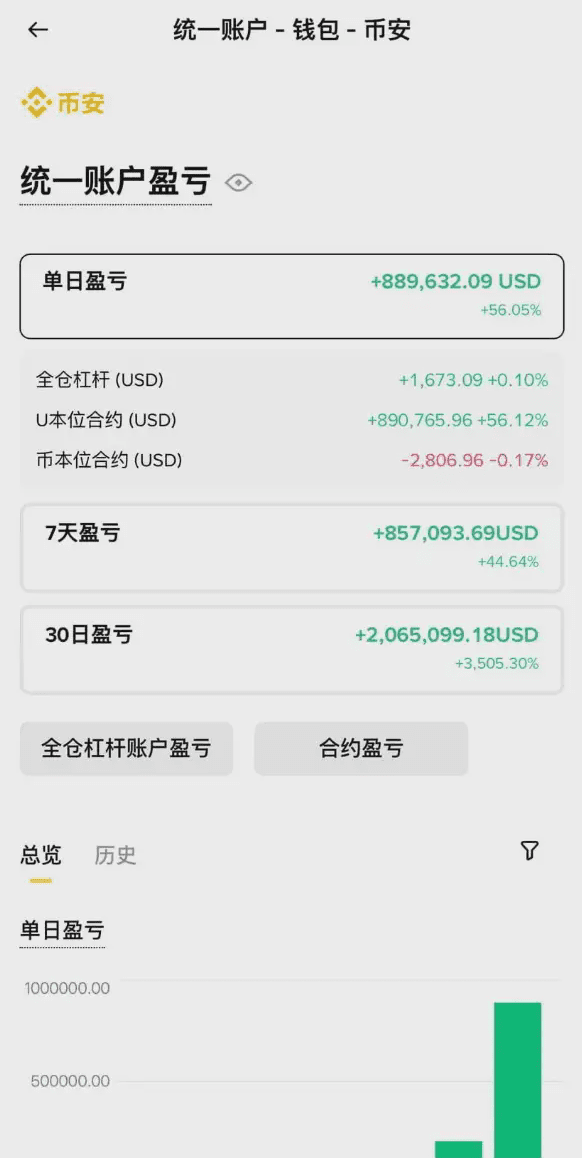
I am a living example; I entered the cryptocurrency market in 2013 during university, and I haven't worked since graduating. I've been relying on cryptocurrency for a living, trading full-time ever since!
In the first two years of trading cryptocurrencies, I made about 10 million with a principal of 10,000. I had never worked after graduating from university. I spent my days watching videos and recording data.
1. Starting with 10,000, I did projects in university, affiliate marketing, doing tasks, deliveries, and various small tasks, and saved 10,000.
2. Entering the cryptocurrency market + I feel BTC is too expensive, so I just keep playing with ETH +, which has leverage +, and then the altcoins +. Choosing coins...
Do good position management. Just execute the simple strategy consistently; if the market is bad, take a small loss; when the market comes, earn it back handsomely.
Why enter the circle?
To change your destiny, you must try the cryptocurrency market. If you cannot make money in this circle, ordinary people will never have a chance in their lives.
I’ll share my trading thoughts with everyone:
Many people start trading contracts with only 10,000 (about 1,400 USD), thinking 'the principal is small, just go for it.'
But the truth is: the smaller the fund, the more necessary position management becomes.
Large funds can rely on time, while small funds rely entirely on discipline. Otherwise, one liquidation can lead to having to recharge 'faith.'
The following method applies to contract players with a capital between 5000 and 20000 RMB; the goal is not to double in a day but to...
Low drawdown, steady growth.
 Treat trading cryptocurrencies like a job, clocking in and out every day.
In the early years of trading cryptocurrencies, I, like many others, stayed up late watching the market, chasing prices and making losses that kept me awake at night. Later, I gritted my teeth and stuck to a simple method, and surprisingly, I survived and slowly began to stabilize my profits.
Looking back now, this method, although simple, is effective: 'If I don’t see familiar signals, I won’t move!'
It’s better to miss a market opportunity than to place random orders. By adhering to this iron rule, I can stabilize my annual return rate above 50%, and I no longer have to rely on luck to survive.
Here are some suggestions for beginners, all based on my experiences from real trading losses:
1. Trade only after 9 PM.
During the day, news is too chaotic, with various fake positives and fake negatives flying around, causing the market to jump around like a wind-up toy; it’s easy to be misled into the market. I generally wait until after 9 PM to trade; by then, the news is stable, and the K-line is cleaner, making the direction clearer.
2. If you make money, take it immediately.
Don’t always think about doubling! For example, if you lose 1,000 today, I suggest you immediately withdraw 300 to your bank card, and keep playing with the rest.
3. Look at the indicators, not the feelings.
Don’t trade based on feelings; that’s blind. Install TradingView on your phone and check these indicators before making trades.
MACD: is there a golden cross or a death cross?
RSI: Is there overbought or oversold?
Bollinger Bands: is there a squeeze or a breakout?
At least two out of three indicators must give a consistent signal before considering entering the market.
5. Must generate profits weekly.
Non-withdrawn profits are just a numbers game! Every Friday, without fail, I transfer 30% of profits to the bank card, and the rest continues rolling. Over time, this way, the account will grow thicker.
6. There are tricks to reading K-lines.
For short-term trading, look at the 1-hour chart: if the price has two consecutive bullish candles, it is time to consider going long. If the market is stagnant, switch to the 4-hour chart to find support lines: consider entering when it drops near the support level.
7. Never step into these pitfalls!
Leverage should not exceed 10 times; beginners are best kept within 5 times.
Do not touch Dogecoin, shitcoins, and other altcoins; they’re easy to get harvested.
Max 3 trades a day, too many can lead to losing control.
Absolutely do not borrow to trade cryptocurrencies!
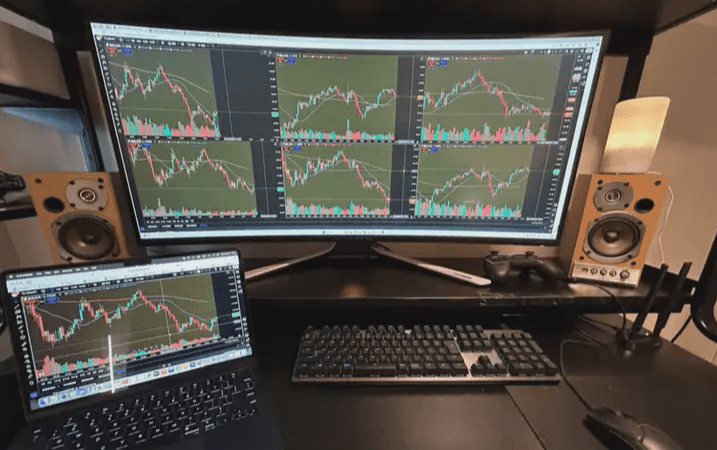 From nearly losing 500,000 to over 25 million! I relied on the '10-minute quick battle method' and won effortlessly in the fluctuating market for 4 years.
6 years ago, my account was down to 500,000. Chasing prices in the cryptocurrency market felt like being a headless fly, and I was about to lose my last savings when I stubbornly developed a set of '10-minute quick battle methods' — now with the major coin fluctuating between 100,000 and 110,000, this strategy is simply a 'lifesaver' for beginners in short-term trading.
Today I will lay bare the core logic I have developed over 4 years of practical experience, which is all hard-earned insights!
First, let’s highlight the key points: the current cryptocurrency market's short-term fluctuations are more thrilling than a roller coaster; determining buy and sell points within 10 minutes is the king of efficiency, but you must strictly adhere to the 3 rules for entering the market — miss even one and don’t trade!
First, when the RSI drops into the oversold range (below 30), it simply means it has dropped to the right level; the probability of further decline is lower than winning the lottery.
Second, effectively stabilize the short-term resistance line (for example, the major coin at the 105,000 mark); do not trust false breakouts; at least stabilize for 3 consecutive 10-minute K-lines to be reliable.
Third, the volume must explode to more than 3 times the usual + real money entering the market, not just retail investors entertaining themselves with small fluctuations.
As for leverage, I advise beginners to keep it strictly between 1-2 times! In 2022, I witnessed a brother use 20 times leverage, and after one small fluctuation in the early morning, he lost everything; I still remember the scene of his wife threatening divorce.
I turned 500,000 into 25 million in 4 years +, and my leverage never exceeded 2 times. For those who dare to go above 5 times, I suggest tattooing 'stop loss' on your forehead.
The signals for opening and closing positions are simple enough for an idiot to understand: in the 10-minute K-line, the lower Bollinger band + oversold RSI is the 'buy signal'; if you earn money, follow the rules: with a principal of 500,000 earning 50,000, the most you can add to your position is 15,000, and the principal must not be touched — last year, greed led me to hold on for an extra 10 minutes, losing 30,000 more, and I still regret it!
Be decisive with take profit: if you earn 15%, sell 20% to lock in profits. If RSI exceeds 70 (overbought), sell everything immediately; don’t think 'just a little more gain.' Those who are greedy in the cryptocurrency market end up as the harvested leeks.
Different markets have different strategies, don't be rigid: in the current fluctuating market (major coin at 100,000-110,000): split 500,000 in half, hold 250,000 as a stable base, and use the other 250,000 for trading (buy when it drops, sell when it rises). Accumulating small amounts is more reliable than blindly chasing price; when a bull market comes (for instance, a one-sided rise): hold 150,000 as a base and 350,000 to follow the trend, but never chase at the peak; withdraw if it falls below the 5-day moving average; in a bear market (one-sided fall): let 350,000 lie flat without movement, and use 150,000 for short trades to reduce costs; don't think about bottoming out halfway up; those who try to bottom out in a bear market often end up as 'bag holders.'
Finally, the survival iron rules: if these 3 are not achieved, no matter how great the strategy, it won’t work.
① Split 500,000 into 4 parts, using only 125,000 for each trade; don’t put all your eggs in one basket.
If a single loss exceeds 2% (which is 10,000), immediately cut your position; never hold a losing trade — I've seen too many people hold from a loss of 10,000 to 100,000, eventually losing their composure and making chaotic trades.
③ Never use your principal to increase your position! Profits can be played with, but the principal is the bottom line; if the bottom line is breached, you have completely lost.
What is left-side trading and right-side trading in the cryptocurrency market? An article to help you deeply understand, along with their pros and cons.
1. Left-side trading and right-side trading.
What is left-side trading and right-side trading? To understand this question, we first need to understand what 'left side' and 'right side' mean. Everyone in front of the screen first encountered these terms in high school while studying modern Chinese history, where the concepts were called 'leftist' or 'rightist.'
So why is it called left-side and right-side, not upper-side or lower-side? Their origins can be traced back to the French Revolution in the 18th century, where supporters of revolutionary change sat on the left side of the parliament, while conservatives supporting the status quo sat on the right. This division gradually evolved into today's concepts of 'left-wing' and 'right-wing.'
In simple terms: left-side is more aggressive, right-side is more conservative; left-side is more reformist, right-side is more conservative.
Therefore, 'What is left-side trading and right-side trading' and 'What are left-side traders and right-side traders' are completely different questions.
So what are left-side trading and right-side trading?
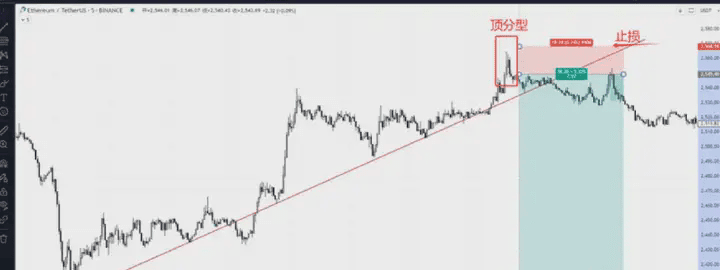
 First, what is left-side trading and right-side trading? If Zhang San clearly sees that the price is still on the left side of the trend line during the current trade and has not broken the trend line, but from the perspective of cyclical theory, he considers this a central point, with a divergence in the trend, and then sees a nice top pattern at position 1, he enters a short position with a stop loss at the top of the top pattern and a take profit at the previous low. We can say that Zhang San's strategy is left-side.
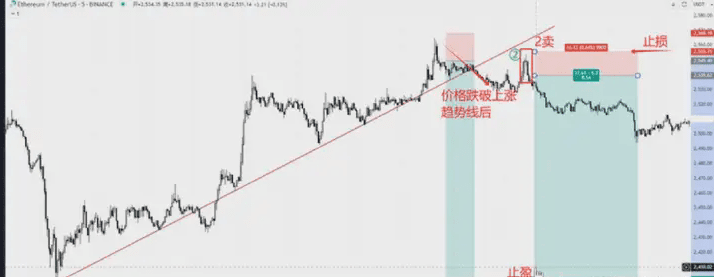
Similarly, if Li Si, when facing the current trade, firmly adheres to 'as long as the price does not break this upward trend line,' or says 'as long as there’s no signal for selling at 2 or 3,' he will resolutely not enter. Therefore, he will patiently wait for the price to break down through the upward trend line, and then enter a short position at position 2, which is the sell signal at 2. The stop loss would be at the top of the top pattern, and the take profit at the previous low. We can say that Li Si's strategy is right-side. We can see that the market subsequently also hit the take profit.
If you understand this case, you will understand why some people simply and crudely use a trend line to define left-side and right-side trading: 'Anyone entering on the left side of the trend line is called left-side trading; anyone entering on the right side of the trend line is called right-side trading.'
2. Left-side traders and right-side traders.
So what are left-side traders and right-side traders?
It's simple; if Zhang San's style is generally more aggressive, not so conservative, with a higher risk tolerance, willing to take greater risks for higher returns, and out of 10 trades, 8 are similar to the left-side trading strategy mentioned earlier, we can broadly define Zhang San as a left-side trader.
Conversely, if Li Si’s personality is more conservative, with a lower risk tolerance and is unwilling to take on higher risks but can accept lower returns, and out of 10 trades, 8 are similar to the right-side trading strategy mentioned earlier, we can roughly define Li Si as a right-side trader.
3. Left-side traders and right-side traders.
Now the question arises: is left-side trading better or right-side trading better? Should I be a left-side trader or a right-side trader?
The answer is: both are good.
Because the problem itself is problematic, it cannot be answered.
It’s like asking, 'Is it better to eat rice or noodles?' or 'Is salty tofu pudding better or sweet tofu pudding?' or 'Should I choose a manual or automatic car?'...
So similarly, the question of whether left-side or right-side is better cannot be easily categorized as good or bad, nor can it be simply judged as right or wrong. Taking the previous case as an example.
a. The return rate and profit-loss ratio are different.
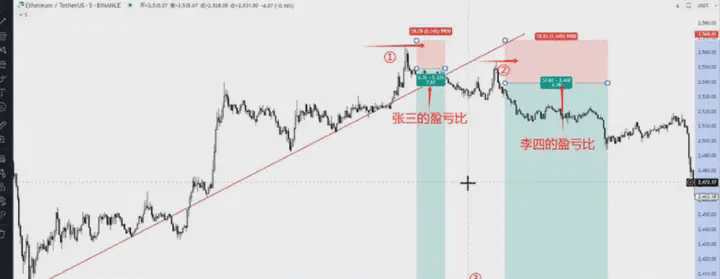 Zhang San entered at position 1 and profited at position 3, while Li Si entered at position 2 and also profited at position 3. However, it is clear that their earnings were not the same. Zhang San made 5.8%, while Li Si only made 5.5%. If Li Si had been a bit more conservative and had set his stop loss to match Zhang San's at position 1, Li Si's profit-loss ratio would only be 1:5, far lower than Zhang San's 1:8.
b. The win rate is different.
So can we say that Zhang San as a left-side trader is better and Li Si as a right-side trader is worse?
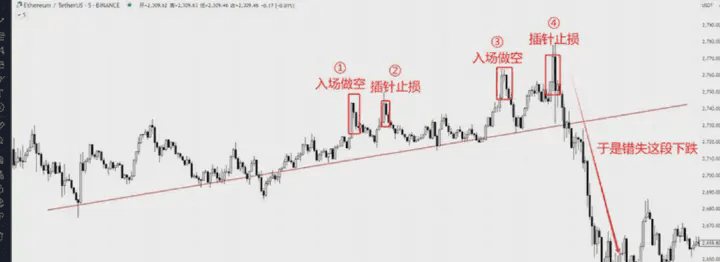 It’s not always like that. For example, let’s look at this case: in the context of a downturn, Zhang San decided to short this upward reversal when a strong top pattern appeared at position 1. Later, the market didn’t fall, and he hit his stop loss at position 2. Later, at position 3, the price gave him another chance, and Zhang San chose to enter again. But unexpectedly, at position 4, the price spiked again, hitting his stop loss. Although there was a chance to revenge-enter at position 4, Zhang San was hesitant after stopping out twice, and as a result, when the market fell sharply afterward, he missed the opportunity. Zhang San found himself crying and cursing the heavens and the market.
In summary:
Left-side trading indeed has higher returns and better profit-loss ratios compared to right-side trading; however, right-side trading has a higher win rate compared to left-side trading. Therefore, we cannot simply and bluntly declare whether Zhang San is better or Li Si is better.
c. The trading opportunities are different.
Moreover, aside from differences in return rate, profit-loss ratio, and win rate, left-side trading and right-side trading have many other distinctions.
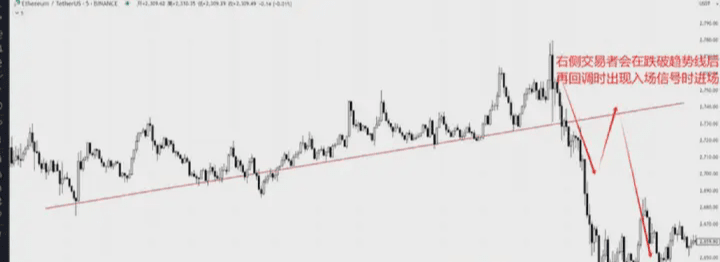 For instance, left-side trading has more opportunities, while right-side trading has relatively fewer. In the previous case, although Zhang San stopped out, this trade shows that only left-side traders could seize this opportunity, as the market did not give right-side traders a chance afterward.
d. Holding time and trading mindset are different.
Furthermore, there are differences in holding time and trading mindset.
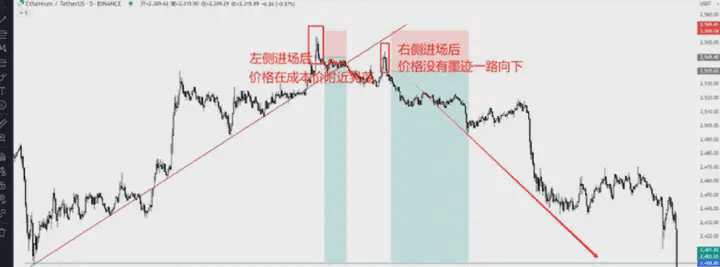 For example, in this case, after Zhang San enters on the left side, the market often fluctuates without significant movement, hovering around your cost price. If at any point you can't hold on any longer and decisively cut your position, the market may actually turn down. However, Li Si on the right side is different; once he enters, the market hardly hesitates and quickly hits the take profit.
We know that the holding time also affects the trading mindset. Those who prefer left-side trading are usually impatient, unable to tolerate prices fluctuating around their cost price. Therefore, left-side traders face greater psychological pressure, while right-side traders face less. So, which is better, left-side or right-side?
e. The difficulty of trading is also different.
Moreover, I don’t know if you’ve noticed, but many left-side traders around us share a common trait: many times they themselves can't clearly explain why they entered the market; they just feel it! They see the price about to drop, and if you ask them why, they will say: 'market feeling!'
This also explains why many bloggers advise you with conclusions like 'newbies should not consider left-side trading; it’s not suitable for you.' Generally, left-side traders sometimes enter based on subjective judgment or prediction, and when the market trend is not yet completely clear or confirmed, left-side traders rely on personal experience, technical analysis, or expectations of market reversals to enter early, making this approach very unsuitable for newcomers.
f. The market context is different.
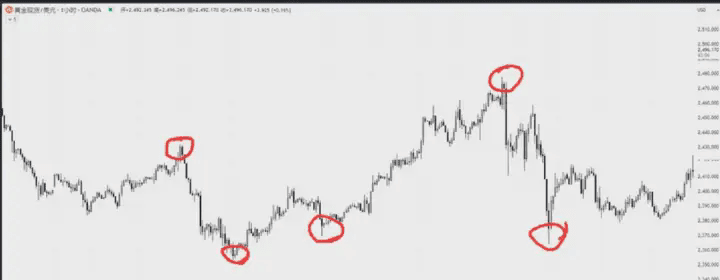
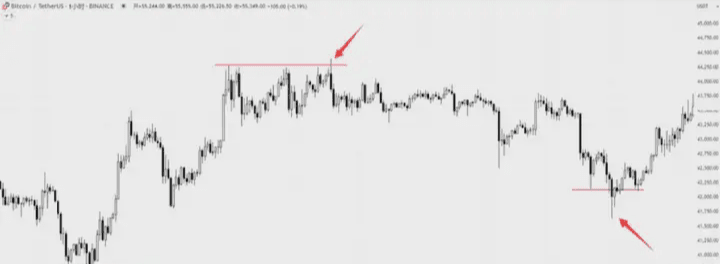
Additionally, the market context can vary, meaning some assets seem inherently unsuitable for right-side traders. For example, gold often directly V-reverses (as shown in Figure 5), fluctuating wildly without giving right-side traders an opportunity. Similarly, with Bitcoin (as shown in Figure 6), if you always like to bottom and top out, you will find that every time the price spikes down, it hits your stop loss before running in the correct direction, making you feel extremely frustrated.
 4. Practical suggestions.
In summary, left-side trading and right-side trading differ not only in return rate, profit-loss ratio, win rate, and the number of trading opportunities, but also in holding time, psychological pressure, capital management, trading difficulty, market context applicability, and emotional control. We cannot simply say which is better or worse. What suits us best is the best.
Trading is an easy task; money is just sitting in the corner. What we need to do is very simple: walk over, squat down, bend over to pick up the money and put it in our pockets, then just leave.
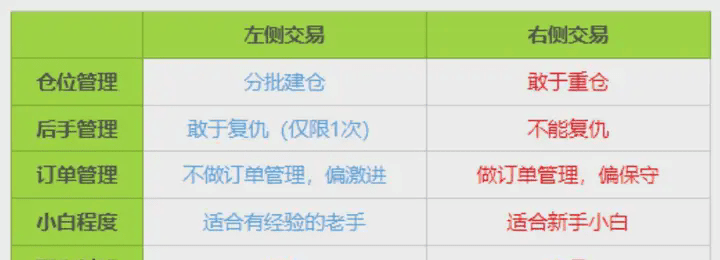 So any action that makes us uncomfortable is, for us, an error. As for whether to trade left-side or right-side, we should do what feels right for us! After all, it took these 9 individuals a full 35 days to find a trading style and system suitable for their own personality! This is not an easy task, nor is it simple! It requires professional methods and scientific practice.
 Don’t gamble anymore! I started with 2,000 in stable assets and rolled to over 20,000 in 2 months +; this is a low-risk money-making method that beginners can follow.
Who still says that short-term doubling in the cryptocurrency market is a bluff? I hit them with my own experience — it’s not about betting everything on a huge surge, but relying on a set of 'anti-human nature rolling warehouse techniques,' starting from 2,000 in stable assets and rolling to over 20,000 in just two months, and the key is keeping it stable throughout, so I can sleep soundly!
A few years ago, I was also a standard 'chasing high prices fool,' fully invested in those hyped 'high volatility assets,' always fantasizing about doubling my investment. What happened? I lost 40% of my principal in half a month, watching the account numbers drop, and during late-night reviews, I wanted to slap myself — only then did I realize that in the cryptocurrency market, 'staying alive' is 100 times more important than 'making quick money.'
After much pain and reflection, I developed this set of rolling warehouse rules, which boils down to two words: discipline! It’s not about gambling and winning big; it’s about letting profits 'snowball.'
Never over-leverage: only use 25% of your principal each time. For example, with 2000 in stable assets, use 500 to enter the market the first time, and keep 75% as 'survival bullets.' No matter how attractive the opportunity is, do not touch the principal.
Be decisive with take profit and stop loss: if you earn 3%, immediately increase your position; if you lose 2%, leave immediately — don’t think 3% is too little; the cryptocurrency market is full of opportunities; what’s lacking is not losing all your principal.
Profit reinvestment: keep the principal locked and only use the money earned for the next round! For example, if you first earn 100, use that 100 for the next trade; even if you lose 2%, you only lose 4, which doesn't affect the foundation. This is the real way to 'lose profits while protecting the principal.'
Many newcomers always think '3% is too slow,' and they want to find opportunities for 'doubling.' But have you forgotten? In the cryptocurrency market, 90% of people fail due to 'heavily betting on a single chance.' I once guided a follower who started with 1000 in stable assets; at first, he complained about 'slow earnings.' But after strictly following the rules for a month, he directly earned 1300 more. Later he told me, 'I used to fully invest at high prices and lost my faith in life; now I understand that slowly earning is real profit!'
This method can work; essentially, it goes against human nature: while others chase high prices heavily, I wait for small profits; while others gamble on luck, I rely on discipline — when my account grows from 2000 to over 20,000, I feel no excitement because this is not a miracle; it is compounded returns from small profits of 3% each time, rewarded for 'not being greedy.'
If you are still chasing prices up and down in the cryptocurrency market, making more losses than gains, or even not knowing how to control risks — don’t panic! I have been deeply involved in the market for 12 years and have encountered more pitfalls than you have seen opportunities. Now, not only have I made the 'rolling warehouse technique' clear, but I also share market dynamics and low-risk opportunities every day, allowing newcomers to follow along.
There’s a saying I strongly agree with: the boundaries of knowledge determine the boundaries of wealth; a person can only earn wealth within the boundaries of their knowledge. In cryptocurrency trading, your mindset must be good; during large drops, don’t let your blood pressure rise, and during large rises, don’t let your ego take over. It’s crucial to secure profits. For those with fewer resources, a down-to-earth approach is the unbreakable way to survive.
I am Little Egg Tart, a professional analyst and teacher, a mentor and friend on your investment journey! As an analyst, the most basic thing is to help everyone make money. I will resolve your confusion and help you with positions using my strength. When you are lost and don’t know what to do, follow Little Egg Tart; Little Egg Tart will point you in the right direction #美联储重启降息步伐 $BTC