
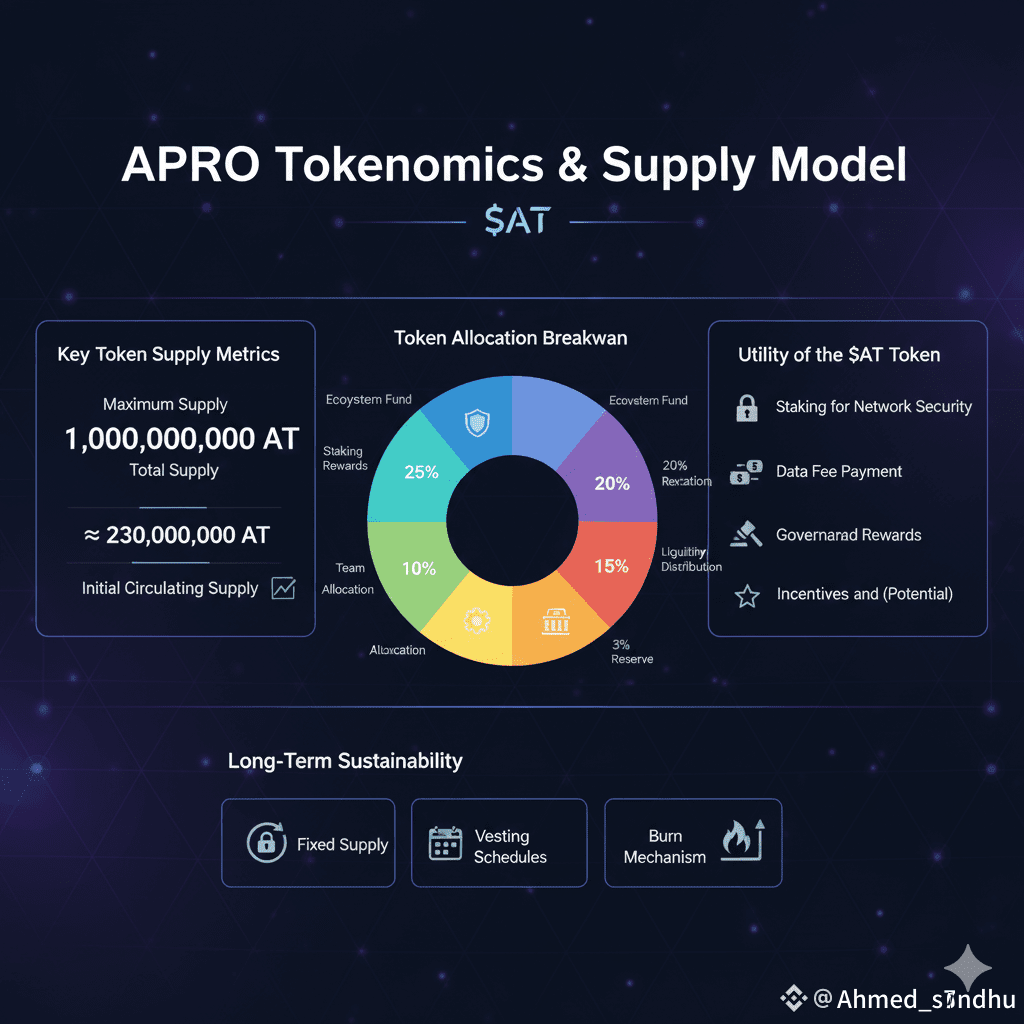
The APRO project’s native token, $AT, is the economic backbone of its AI-enhanced oracle network. Its tokenomics model is designed to maximize network security, incentivize long-term participation, and govern the future direction of the protocol.
The design focuses on a fixed total supply coupled with a structured vesting schedule to ensure stability and mitigate excessive sell pressure post-launch.
Key Token Supply Metrics
The $AT token has a clear and finite supply model, which is a common feature among utility-focused protocols.
Note: The fixed maximum supply of 1 Billion $AT tokens suggests a non-inflationary structure, where the increase in circulating supply over time comes only from the unlocking of initially reserved tokens, not new minting.
🗺️ Token Allocation Breakdown
The APRO team has published a detailed allocation structure, dividing the total supply to align the incentives of various stakeholders, including the community, investors, and the development team.
Allocation Pool
Percentage
Approximate AT Amount
Vesting and Purpose
Ecosystem Fund
25%
250,000,000
For partnerships, grants, hackathons, and long-term development. Vested over approximately 4 years.
Staking Rewards
20%
200,000,000
Rewards for Oracle Node Operators to secure the network. Vested long-term.
Investor Allocation
20%
200,000,000
Distributed to private and seed round investors with structured vesting schedules.
Public Distribution
15%
150,000,000
Distributed for community sales and initial exchange liquidity (TGE).
Team Allocation
10%
100,000,000
Reserved for the core development team, typically with a long lock-up and vesting period (e.g., 1-year cliff).
Foundation Reserve
5%
50,000,000
Long-term operational and regulatory expenses.
Liquidity Reserve
3%
30,000,000
Used to provide deep liquidity on exchanges (DEXs and CEXs).
Operational Activities
2%
20,000,000
Short-term marketing and operational costs.
Total
100%
1,000,000,000
⚙️ Utility of the $AT Token
The $AT token is a utility token with clear, functional roles within the APRO oracle ecosystem:
Staking for Network Security: Oracle node operators are required to stake $AT tokens as collateral to participate in the network. This stake acts as a bond, which can be slashed (taken away) if they provide inaccurate or malicious data, thereby enforcing data integrity.
Data Fee Payment: Decentralized Applications (dApps) and AI agents that consume data from the APRO oracle network must pay for these services using $AT tokens. This creates a direct link between network usage and token demand.
Governance: Token holders are granted the right to participate in the protocol’s decentralized governance. They can vote on proposals for network upgrades, fee adjustments, and other critical parameter changes.
Incentives and Rewards: $AT tokens are distributed as rewards to the oracle node operators who successfully provide accurate and timely data feeds, incentivizing active and honest participation.
🔮 Long-Term Sustainability and Value Accrual
The tokenomics model supports long-term sustainability through several mechanisms:
Fixed Supply: The hard cap of 1 Billion $AT ensures the token is non-inflationary, meaning long-term value will rely heavily on utility and demand for APRO's data services.
Vesting Schedules: The structured release of team and investor tokens prevents sudden large sell-offs, managing the circulating supply growth in a controlled manner.
Burn Mechanism (Potential): While not explicitly confirmed as a core mechanism, fee burning (removing a portion of the $AT tokens used for data payments from circulation) could be introduced by governance to create deflationary pressure as network usage increases.
Would you like a detailed breakdown of the vesting schedule for the team and investor tokens, or information on the current staking yields for node operators?

