
Blockchain researcher criticizes the centralization of XRP and labels it as a fraudulent investment scheme.
The XRP community advocates for decentralization with robust validation and governance resources.
The debate intensifies as critics question the security and economic mechanisms of XRP.
Justin Bons, founder and CIO of Cyber Capital, criticized XRP for being a highly centralized cryptocurrency and labeled it as an "investment fraud." In a recent social media post, Bons criticized Ripple, the company behind XRP, for creating a network that, in his opinion, is far from decentralized.
According to Bons, XRP operates with a permissioned network, a reduced number of validators, and lacks adequate economic security mechanisms, making it more centralized than other cryptocurrencies like Bitcoin (BTC) or Ethereum (ETH).
Bons argues that the XRP Ledger is highly centralized, as Ripple controls a large portion of the ecosystem. He pointed out that Ripple has the potential to restrict access to the network, turning it into a permissioned system rather than a truly decentralized blockchain.
Furthermore, Bons mentioned that the low number of XRP validators contributes to its centralization and lacks the necessary economic security features present in Bitcoin and Ethereum. For Bons, these flaws make XRP a somewhat unreliable investment.
The structure of XRP is defended: a more detailed analysis of decentralization.
In response, the XRP community, including Stellar Rippler, a popular cryptocurrency and blockchain researcher, vehemently disagreed, refuting Bons's claims and presenting detailed counterarguments.
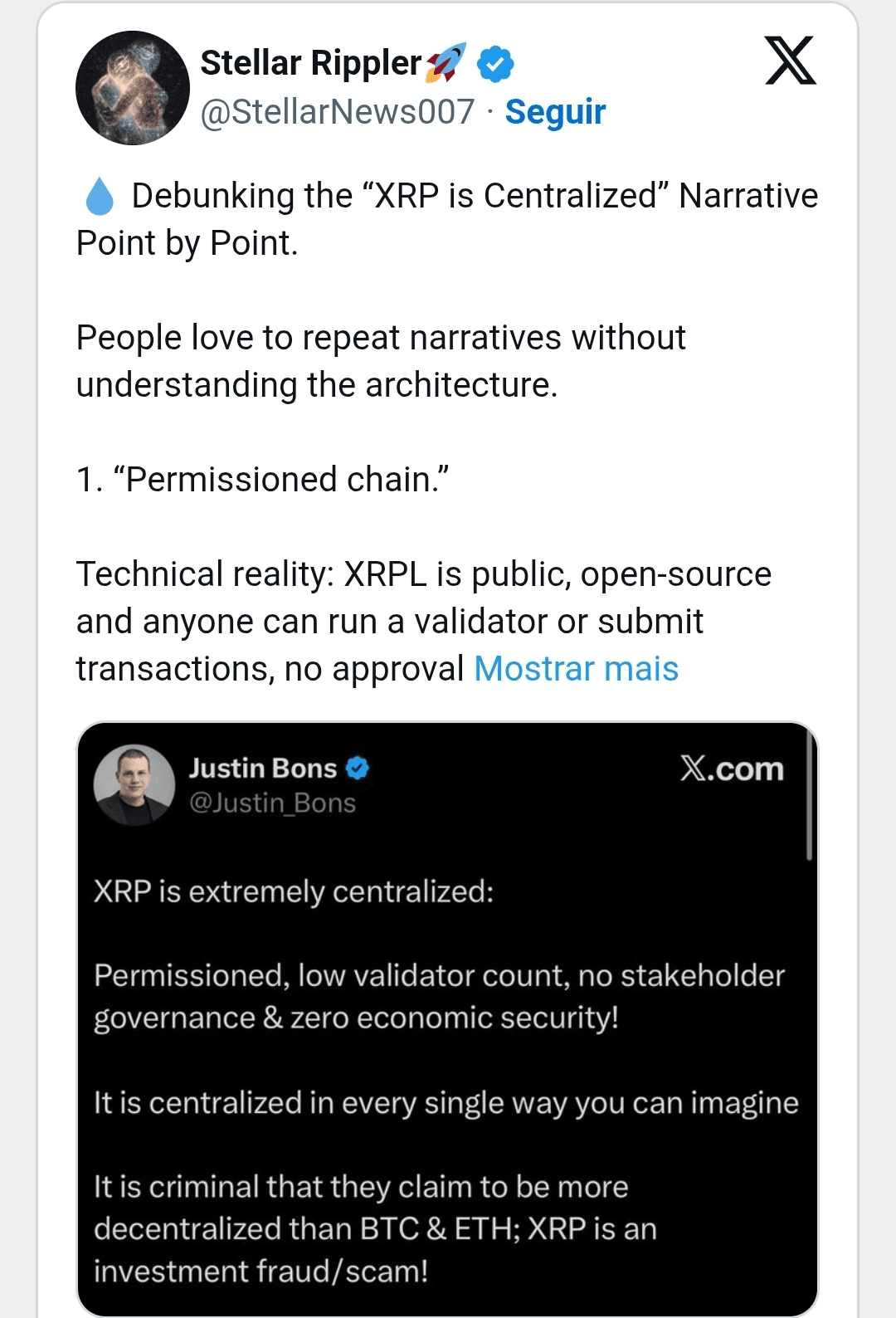
Permissioned chain
The Stellar Rippler emphasized that the XRP Ledger (XRPL) is open-source and public, meaning anyone can run a validator or send transactions without needing Ripple's permission. If XRP were a permissioned system, Ripple could block participation, but it cannot. This directly contradicts Bons's claim that XRP is a permissioned blockchain.
Moreover, Stellar Rippler countered the argument of the low number of validators, emphasizing that quality matters more than quantity. XRP's BFT consensus model ensures the network's security as long as 80% of validators are honest, a higher upper limit than observed in other consensus models like Proof of Work. As he explained, '1,000 bad validators are worse than 150 honest ones.'
Without stakeholder governance
Regarding governance, the Stellar Rippler clarified that changes to the XRP protocol require the approval of 80% of the UNL validators, and this process takes at least two full weeks. This structure prevents Ripple from imposing changes without broad consensus, contradicting the idea that Ripple controls the governance of the network.
Additionally, the Stellar Rippler explained that XRP does not rely on mining or staking dominance to ensure security. Instead, the purpose-based consensus ensures that records are finalized irreversibly in 3 to 5 seconds, with no risk of chain reorganizations. This mechanism offers permanent security, in contrast to the energy-consuming models used in PoW and PoS systems.
Centralized in every imaginable sense.
Addressing the centralization argument, the Stellar Rippler highlighted that Ripple operates less than 30% of the network's validators, with over 80% being independent validators. This makes it clear that no individual entity, including Ripple, can control the network. Furthermore, even if Ripple disappeared, the XRP Ledger would continue to function, as it does not rely on a central entity to operate.
Finally, the Stellar Rippler responded to the accusation that XRP is a 'fraud' by highlighting Ripple's partnerships with major financial institutions such as SBI, Banco Santander, and the Monetary Authority of Singapore, noting that 'frauds do not achieve global regulatory clarity, banking partnerships, and institutional corridors.' Additionally, a U.S. federal court ruled that Ripple is not a security, further validating the legitimacy of the network.
The debate over XRP's centralization continues.
Despite the XRP community's rebuttal, the debate over XRP's centralization remains heated. While critics like Bons argue that XRP's structure makes it more centralized than decentralized, supporters point to the network's fast, efficient, and decentralized consensus model. XRP's ability to attract large institutional partnerships continues to strengthen its market position despite these criticisms.
Remember folks, that nothing said here represents a recommendation to buy, sell, or hold assets.
Thank you all!
