

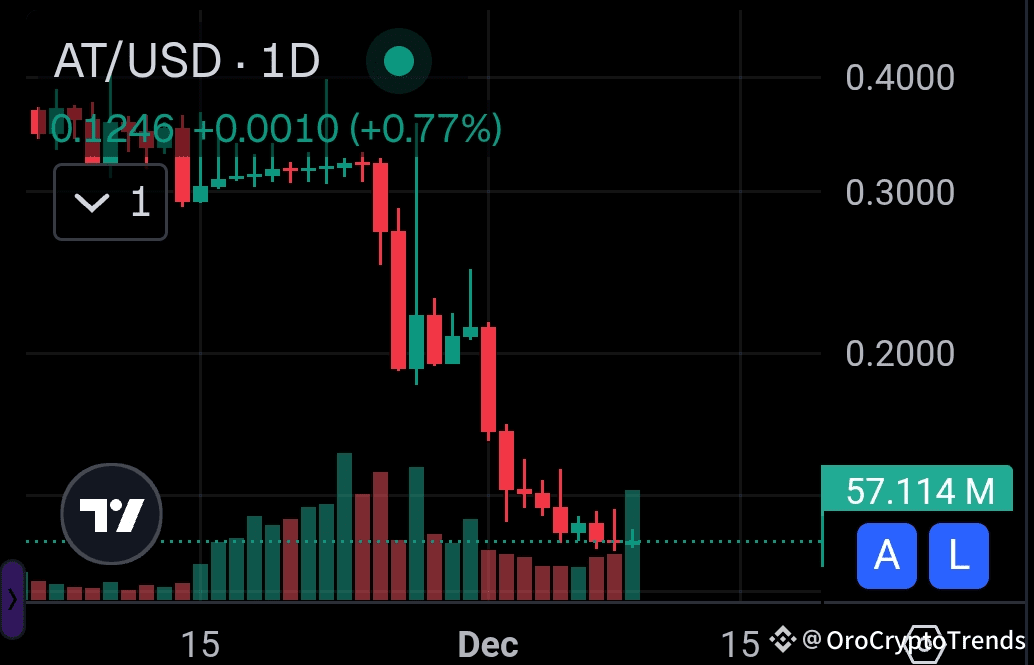
 Apro (AT) is facing bearish sentiment today, driven primarily by poor price performance relative to the broader market, high dilution risk signaled by its Fully Diluted Valuation (FDV), and persistent airdrop-related sell pressure.
Here is a detailed breakdown of the market dynamics and a Binance Square post analysis.
The community's bearish view on Apro (AT), an oracle token, is validated by its -11.00% weekly price drop against a rising market, which is largely attributed to the looming $124M Fully Diluted Valuation (FDV) and ongoing sell pressure from exchange reward campaigns.
Why Apro is Underperforming the Ethereum Ecosystem and What its $124M FDV Implies
Introduction
The Apro (AT) token, the backbone of a data service designed to bridge off-chain computation with on-chain verification, is currently grappling with a strongly bearish sentiment. While the underlying technology—providing real-time Price Feeds and custom data models across 15 major blockchain networks—addresses a fundamental need in the Decentralized Application (DApp) ecosystem, the market's focus has shifted to the token's economic structure and recent selling behavior. The community is right to be cautious, as the token has underperformed both the global crypto market and its Ethereum Ecosystem peers by a significant margin over the last seven days.
Pillar I: The Dilution Trap and High FDV Risk
The most significant structural risk contributing to the bearish outlook is the wide discrepancy between the token's current valuation metrics:
* Current Market Cap (MC): \text{\$28,513,006}
* Fully Diluted Valuation (FDV): ({$123,969,592}
The FDV is approximately 4.3 times the current Market Cap. This high ratio is a glaring red flag for sophisticated investors. FDV represents the theoretical market cap if the total supply of 1 Billion AT tokens were circulating at the current price (currently only 230 Million tokens are tradable).
What this implies: Nearly 770 million AT tokens are currently locked up in vesting schedules, foundation reserves, or incentive pools. As these tokens are unlocked and enter the circulating supply over the coming years, they create an enormous inflationary headwind, potentially increasing sell pressure and limiting long-term price appreciation until the protocol's revenue and adoption (demand) can absorb the increased supply (dilution). In the eyes of the market, this high FDV creates an immediate ceiling on sentiment.
Pillar II: Performance Lag and Airdrop Selling
The bearish sentiment is being reinforced by quantifiable data on recent price action:
* Weekly Underperformance: AT has fallen -11.00% over the last 7 days. This is a severe lag, considering the global crypto market was up 1.80% and the Ethereum Ecosystem tokens, its direct competitors, were up 12.70%. This confirms that the selling pressure is project-specific.
* Airdrop Sell Pressure: Recent exchange activities, such as the Binance Square CreatorPad campaign distributing 400,000 AT tokens (and previous larger prize pools), often trigger a predictable "sell-the-reward" cycle. Recipients of these free tokens frequently cash out immediately, increasing the instantaneous circulating supply and creating downward pressure on the price.
* Volume Spike: Despite the price drop, the daily trading volume surged by 14.10% to $66,673,009. This is a mixed signal. It indicates high market activity, but when paired with a falling price, it often suggests that volume is being driven by strong distribution (selling) rather than accumulation (buying).
Pillar III: The Oracle Utility vs. Centralization Concerns
Apro's value proposition lies in its Data Service, which uses off-chain processing and on-chain verification. This service solves the fundamental "oracle problem"—the inability of a blockchain to natively access reliable external data. The utility is clear: providing 161 Price Feed services across 15 chains.
However, the search results highlight potential long-term concerns that fuel skepticism:
* Centralization Risk: Reports suggest that the AT contract may maintain active freeze/mint authority (unrenounced mint controls). For a service built on trust and decentralization (like an oracle), maintaining centralized control over the token supply is a major "red flag," leading to concerns about regulatory risk and governance integrity.
* Market Dominance: While Apro is expanding its integrations and weekly AI oracle calls, it competes in a market overwhelmingly dominated by established players like Chainlink. Gaining significant market share requires more than just technical features; it requires establishing a deeply trusted, decentralized economic moat, which is challenging for newer entrants with structural FDV risks.
The community’s bearish sentiment about Apro (AT) today is a rational response to its current tokenomics and market performance. The immediate future is constrained by strong selling pressure, driven by exchange-led reward campaigns, and a critical need for the protocol’s adoption (demand) to scale fast enough to match the future supply inflation implied by its high {FDV} ($124M}).
The key question for long-term investors is whether the core utility—a secure, multi-chain data service—can grow revenue and usage to eventually justify the fully diluted valuation. Until the dilution risk is mitigated, either through utility growth or changes in the vesting schedule, the token is likely to remain highly volatile and vulnerable to downward pressure.
Monitor the status of the current Binance airdrop campaigns and track the circulating supply to determine when the next major token unlock event is scheduled, as this will define the immediate future selling pressure.
FAQs
Q: What does the term "Oracle" mean in this context?
A: In blockchain, an oracle is a third-party service that connects smart contracts to real-world, off-chain data (like price feeds, weather, or real-estate data). Apro's Data Service is an oracle, providing the essential external data that DApps need to execute their smart contracts reliably.
Q: What is the risk of the high FDV for AT?
A: The risk of high FDV ({$124M}) compared to the current Market Cap ({$28.5M}) is dilution. It means that for every 1 AT token currently tradable, there are over 3 more tokens waiting to be released into the market. This scheduled inflation acts as a continuous source of potential sell pressure that the market must absorb.
Q: Why is AT underperforming compared to the Ethereum Ecosystem?
A: AT is underperforming because the selling pressure is project-specific, not market-wide. This pressure comes from the confluence of airdrop selling and concerns about the token's economic structure (high FDV and centralized control risks), which are outweighing the positive momentum seen in other tokens in the Ethereum sector.
Q: Where can I check AT's current circulating supply?
A: The circulating supply is approximately 230 Million AT tokens today. This is a critical figure to track, as any major increase (due to unlocks or rewards) will directly impact the FDV-to-MC ratio and price stability.
Hashtags
In-depth analysis of the bearish sentiment surrounding Apro (AT), exploring the critical impact of its {$124M} Fully Diluted Valuation, weekly underperformance, and structural centralization risks for this multi-chain data oracle project.
Disclaimer: Not Financial Advice @APRO Oracle



