


Abstract: The familiar script has returned - after this regulatory crackdown, is it a precursor to a downturn with storm clouds gathering, or another starting point of 'bad news fully priced in'? Let us understand the trajectory after the storm through five key policy nodes.
Author: Viee, Amelia, Denise I Biteye Content Team
Recently, the seven major financial associations in the mainland released the latest risk warning, naming various virtual assets such as stablecoins, RWA, and air coins. Currently, while Bitcoin has not shown significant fluctuations, the recent market sentiment has cooled, accounts have shrunk, and the off-market discount of USDT has reminded people of the scenes during the past rounds of policy tightening.
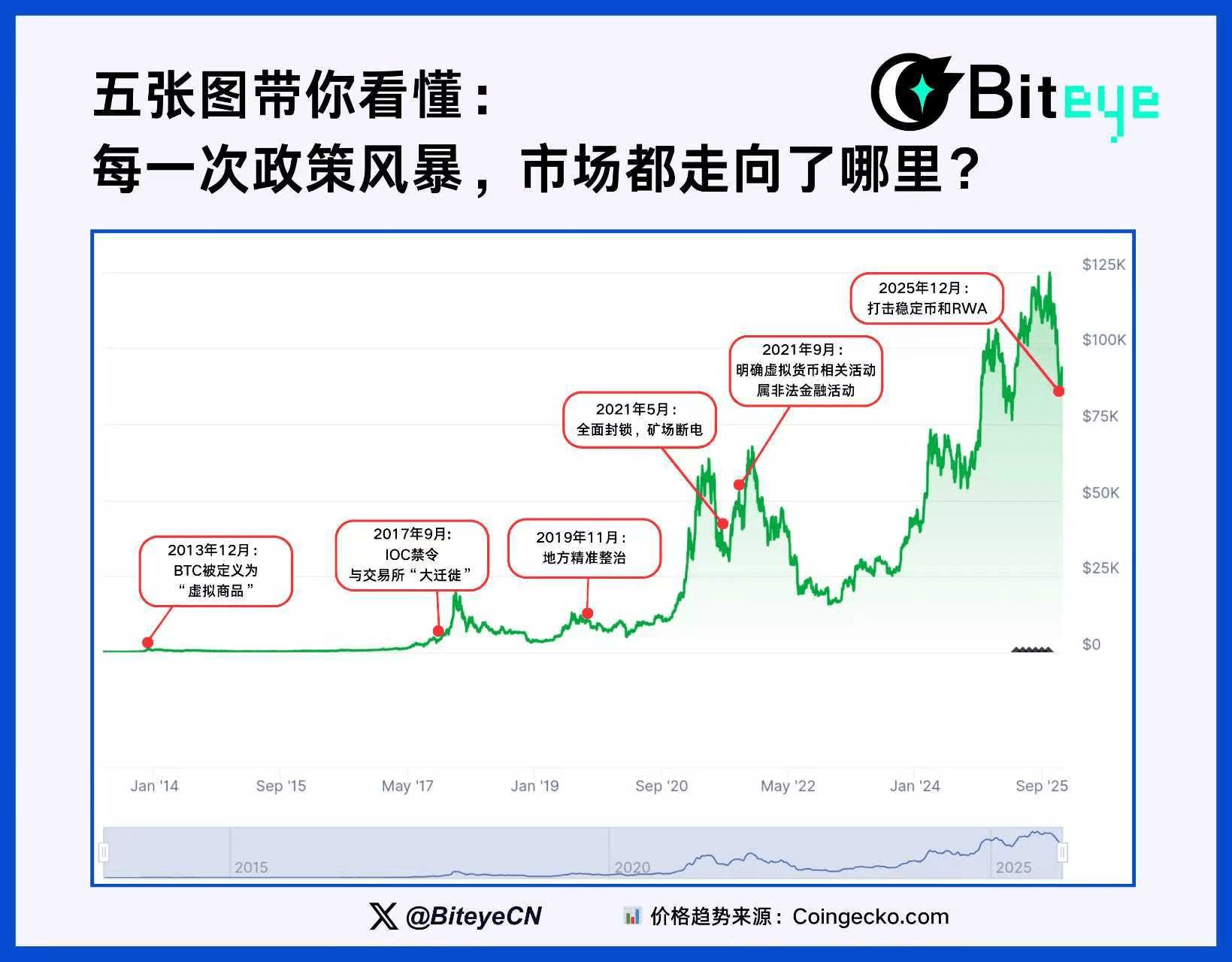
From 2013 to now, mainland China has undergone twelve years of regulation in the crypto field. Policies have repeatedly taken action, and the market has responded each time. This article aims to review the market reactions at these key nodes along the timeline, while also clarifying a question: after regulation takes effect, will the crypto market fall silent, or will it gather strength to set off again?
1️⃣2013: Bitcoin Defined as "Virtual Commodity"
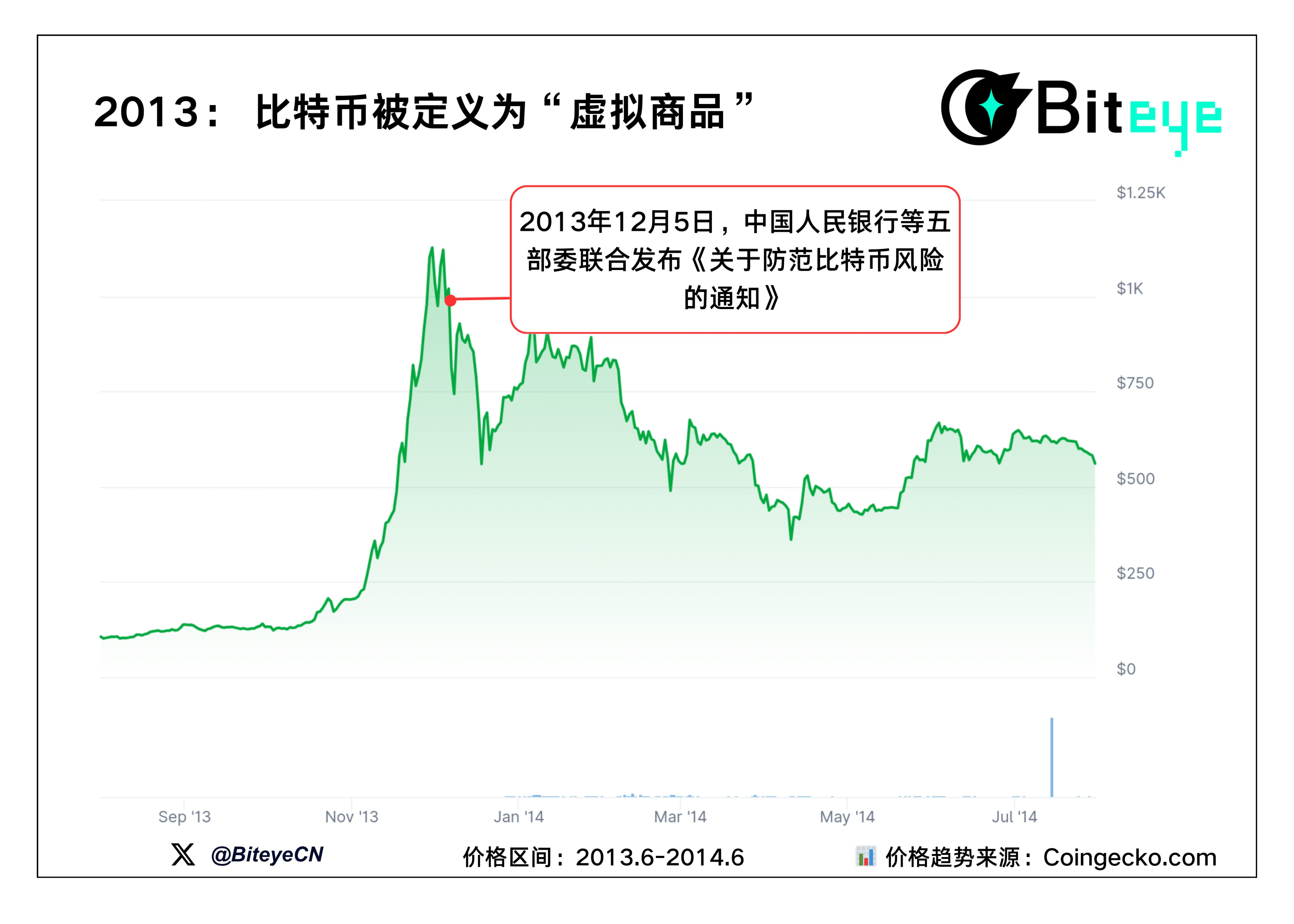
On December 5, 2013, the People's Bank of China and five other ministries jointly issued a notification (on preventing Bitcoin risks), explicitly defining Bitcoin as a "specific virtual commodity" that does not possess legal compensation and is not considered currency. At the same time, banks and payment institutions were prohibited from providing services for Bitcoin trading.
The timing of this notification is also quite subtle, just after Bitcoin hit a historical high of about $1,130 at the end of November. In early December, Bitcoin's price fluctuated between $900 and $1,000, but days after the policy was implemented, the market began to rapidly cool down. Throughout December, Bitcoin's closing price dropped to about $755, with a monthly decline of nearly 30%.
In the following months, Bitcoin fell into a prolonged downward oscillation range, with prices basically between $400 and $600. This decline from the high point essentially marked the end of the 2013 bull market. After that, Bitcoin's price remained below $400 until the end of 2015.
The first round of regulation extinguished the early fervor and opened the curtain on the game between "policy and market."
2️⃣2017: ICO Ban and the "Great Migration" of Exchanges
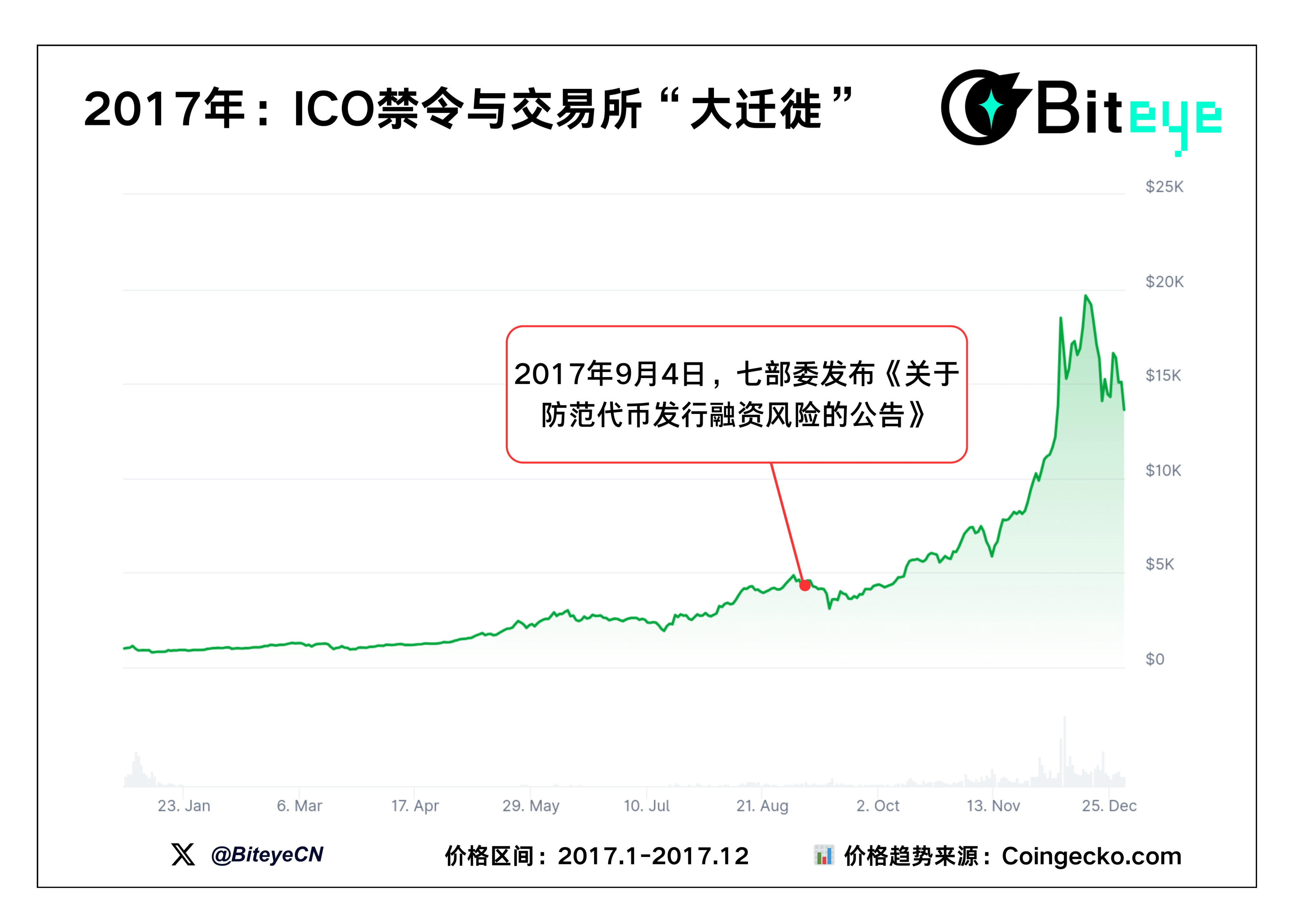
2017 was an extraordinarily noisy year for the crypto market, and also the year of the most decisive regulatory actions. On September 4, seven ministries issued a notice (on preventing risks of token issuance and financing), classifying ICOs as illegal financing and requiring domestic exchanges to shut down entirely. That day, Bitcoin closed around $4,300. However, a week after the policy was issued, BTC fell to a low of $3,000.
However, this round of regulation, while temporarily severing the dominant position of domestic exchanges, did not shake the foundation of the global bull market. As trading activities rapidly migrated to Singapore, Japan, and South Korea, Bitcoin, after completing a phase of clearing, welcomed an accelerated rebound, starting to rise in October, and by December 2017, Bitcoin's closing price had soared to $19,665.
The second round of regulation brought short-term shocks, but also invisibly promoted global diffusion.
3️⃣2019: Local Precise Rectification
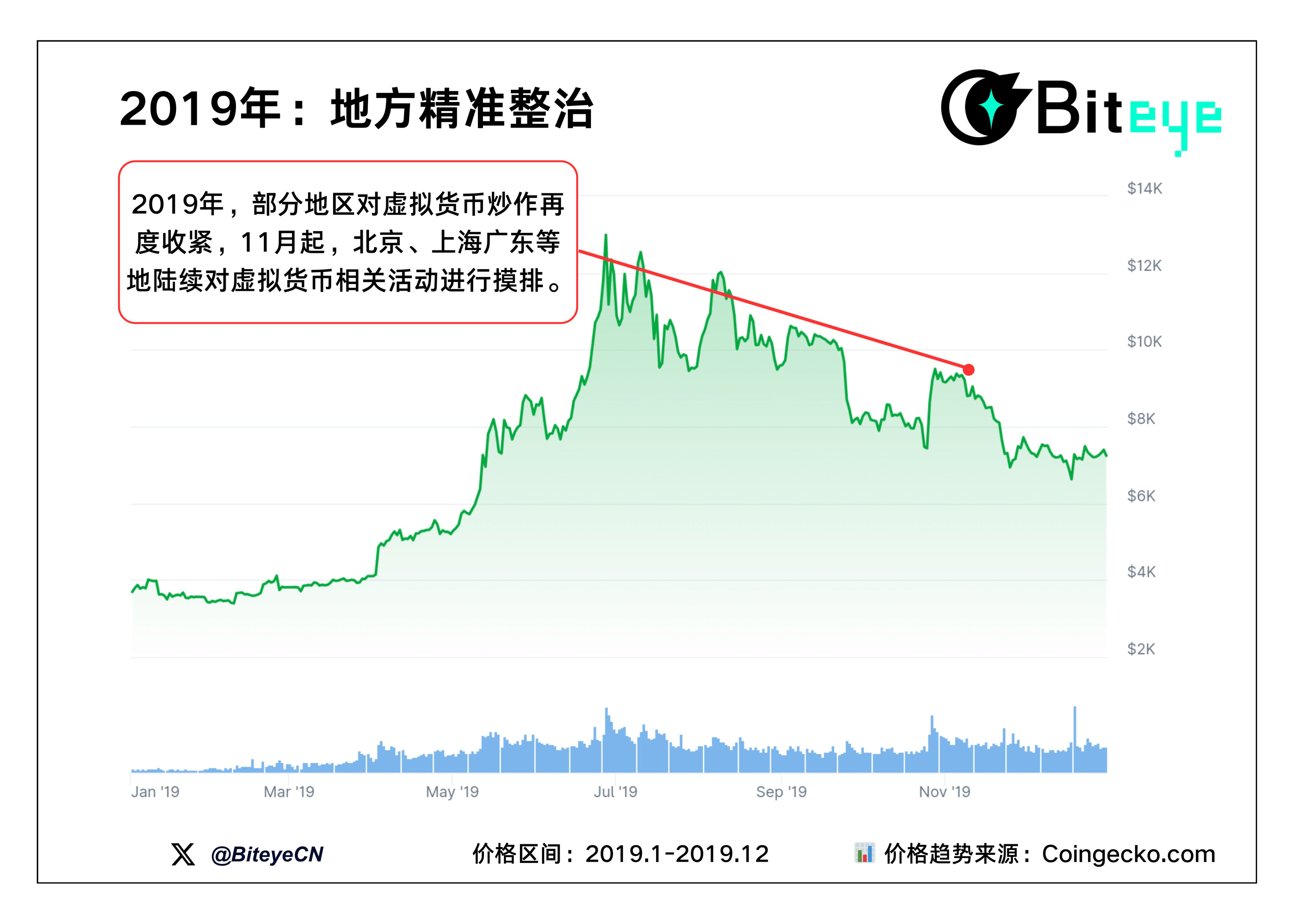
Starting from November 2019, Beijing, Shanghai, Guangdong, and other places have successively investigated virtual currency-related activities, shifting the regulatory approach to "local precise rectification," with no reduction in intensity. That month, Bitcoin dropped from over $9,000 at the beginning of the month to around $7,700, and market sentiment was once low.
The real trend reversal occurred in the following year. In 2020, Bitcoin entered a bull market heating up from $7,000 to over $20,000, driven by the halving expectations and global liquidity easing, smoothly connecting to the epic bull market of 2020 - 2021.
The third round of regulation has, in a sense, cleared the path for the next phase of upward movement.
4️⃣2021: Comprehensive Lockdown, Mining Shutdown
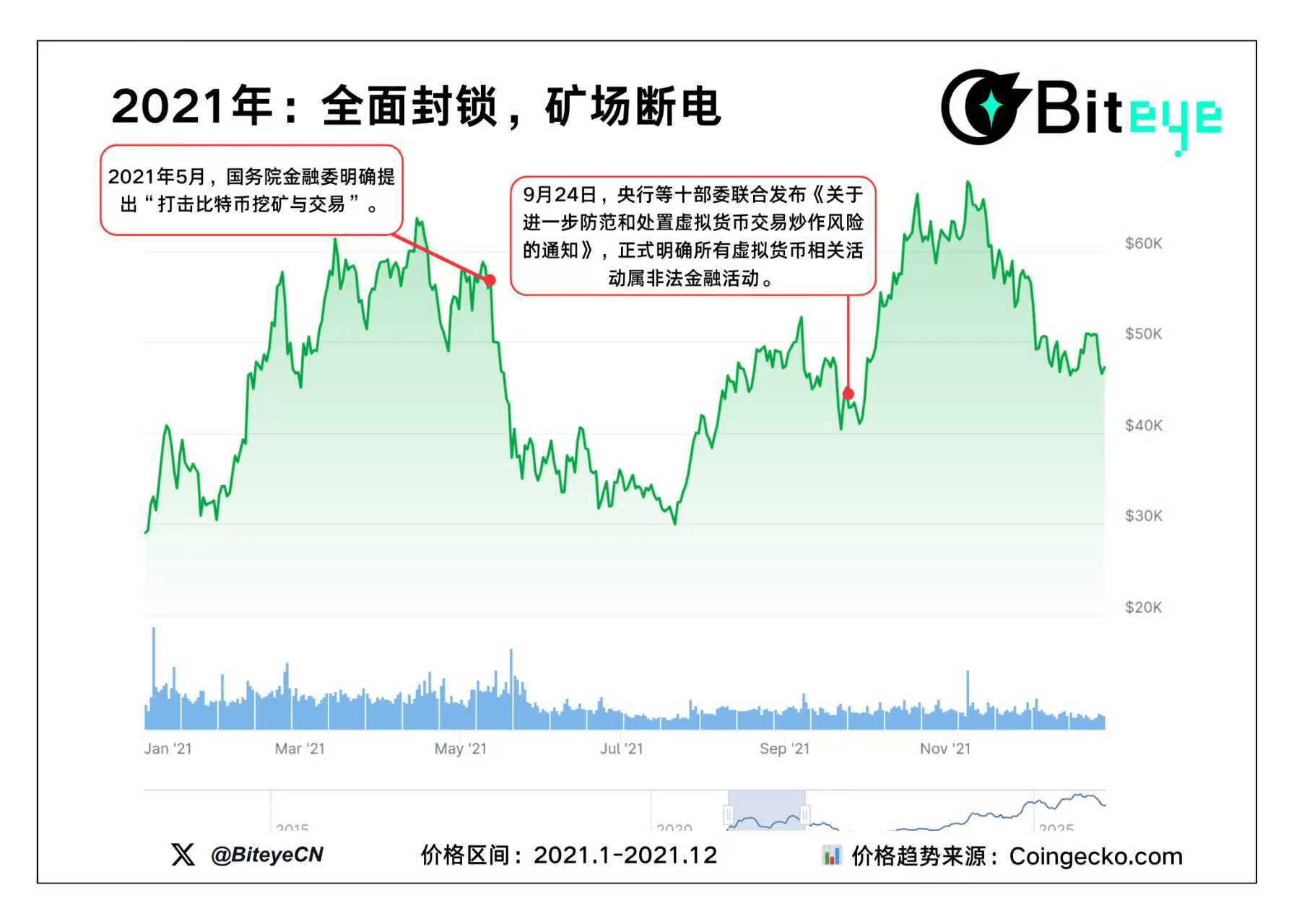
In 2021, regulatory intensity peaked. Two landmark events occurred this year, completely reshaping the structure of the global cryptocurrency market. In mid-May, the State Council Financial Committee explicitly proposed to "crack down on Bitcoin mining and trading." Subsequently, mining provinces such as Inner Mongolia, Xinjiang, and Sichuan successively introduced policies to shut down operations, leading to a nationwide "power outage wave for mining machines." On September 24, the central bank and ten other ministries jointly issued a notification (on further preventing and addressing risks of speculation in virtual currency trading), officially clarifying that all activities related to virtual currencies are illegal financial activities.
In May, Bitcoin fell from $50,000 to $35,000. Entering June and July, BTC consolidated between $30,000 and $40,000, market sentiment hit rock bottom, and later Bitcoin rebounded in August, continuing to rise driven by optimistic expectations of global liquidity, ultimately refreshing its historical high near $68,000 in November.
In the fourth round of regulation, policies can delineate boundaries, but they cannot stop the global redistribution of computing power and capital.
5️⃣2025: Expected Reversal - From "Innovative Testing" to "Comprehensive Tightening"
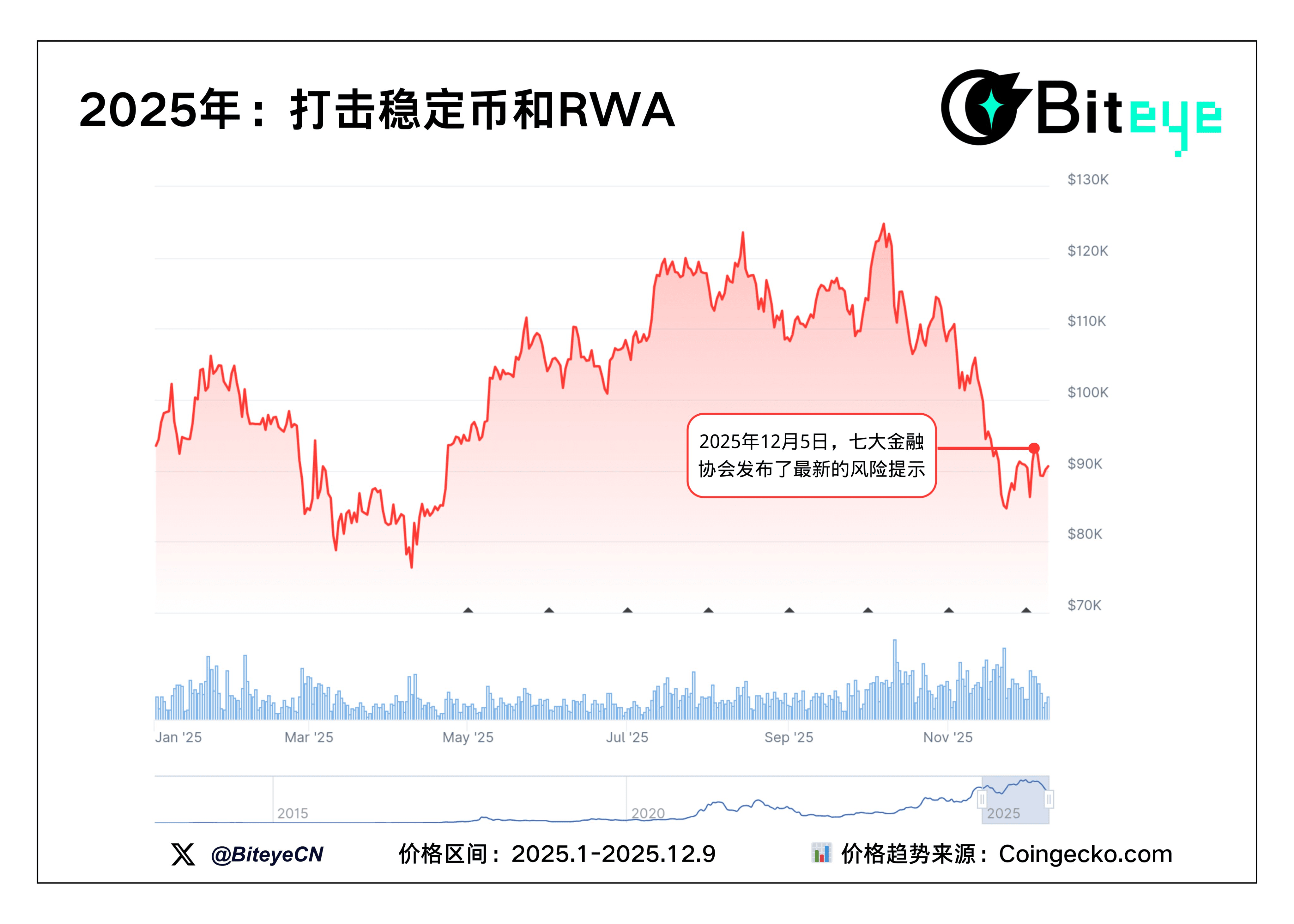
The regulatory narrative of 2025 is filled with dramatic twists. In the first half of the year, a series of signals made the market sense the "melting of ice," and a cautiously optimistic sentiment spread within the circle: whether it was the discussion in Hong Kong regarding the stablecoin issuance framework, or the "Malux grape" blockchain in the outskirts of Shanghai, the market began to discuss the possibility of "compliance paths" and the "Chinese model."
The wind direction suddenly changed at the end of the year. On December 5, the risk warning jointly issued by seven major financial associations conveyed a very clear core message:
Clarify that virtual currencies are not legal tender.
Specifically targeting the crackdown on air coins, stablecoins, RWA, and other popular concepts.
Not only are domestic transactions prohibited, but also propaganda and diversion are banned, and regulation has become more detailed.
This risk warning's core upgrade is that it not only reiterates the illegality of virtual currency transactions but also first spreads to currently the hottest sub-sectors (stablecoins, RWA) and promotional activities.
So this time, how will the market move? Unlike before, Chinese capital is no longer the market's main driver, as Wall Street ETFs and institutional holdings have become the new main force. It can be seen that USDT is trading at a negative premium, indicating that many are eager to convert back to fiat currency and exit.
6️⃣ Market Voices: KOL Opinion Overview
Well-known media personality Wu Shuo @colinwu reminded everyone to pay attention to the movements of CEX from an execution perspective. The real wind direction will depend on whether platforms restrict domestic IPs, KYC registrations, and C2C functions.
XHunt founder @defiteddy2020 compared the mainland and Hong Kong, believing that the stark contrast in crypto policies reflects different market positioning and regulatory philosophies.
Solv Protocol co-founder @myanTokenGeek believes this round of regulation may bring two consequences: one is that users and projects accelerate going overseas, and the other is that underground gray channels make a comeback.
Lawyer Liu Honglin, founder of Shanghai Mankun Law Firm @Honglin_lawyer, added from a legal perspective that many RWA projects are indeed non-compliant, using compliance as a guise for financing and market manipulation, which is essentially no different from fraud. For teams that are truly doing work, going overseas is the only solution.
Crypto circle OG @Bitwux believes this officially confirms what the industry has long known, with limited impact. Regulation is more about reiterating old statements, with the focus possibly on preventing the spillover of gray area channels.
Independent trader @xtony1314 stated that this time the police are taking the lead, and it's no longer just talk. If law enforcement actions begin, restricting trading platforms may trigger a wave of "active escape + market crash."
Independent trader @Meta8Mate believes that every time a concept overheats, a risk warning will follow. 2017 was ICOs, 2021 was mining, and this time it's stablecoins and RWA.
7️⃣Conclusion: The storm has never stopped the direction of the tide; it has only changed the course of navigation.
Looking back over these twelve years, we can clearly see a continuously evolving and purposefully directed logical mainline:
Regulatory policies have remained consistent and necessary. A grain of sand in the era falls on an individual as a mountain. The impact of regulatory policies on the industry goes without saying, but we must admit: regulation is meant to protect investors from uncontrollable financial risks and maintain the stability of the local financial system.
Regulatory actions are characterized by distinct "timing." Policies often drop when market heat reaches a peak or local top, aimed at cooling off overheated risks. From the tail end of the 2013 bull market, the ICO frenzy of 2017, to the mining peak of 2021, and now the rising hype of stablecoins and RWA concepts, this has always been the case.
The long-term effects of policies are diminishing. Except for the first round of regulation in 2013, which directly ended that bull market cycle, subsequent strong interventions (such as the closure of exchanges in 2017 and the mining crackdown in 2021) have not changed Bitcoin's long-term upward trend.
Bitcoin has become a "global game." Wall Street ETFs, Middle Eastern sovereign funds, European institutional custody, and even the consensus of global retail investors together constitute the main support for the current price.
A core conclusion is: the "Eastern strict defense" and "Western dominant pricing" binary pattern may become the new normal in the crypto world.
*Data source from public platforms, content is for information sharing only, not promoting or endorsing any tokens. Readers are advised to strictly comply with local laws and regulations and not to participate in any illegal financial activities.


