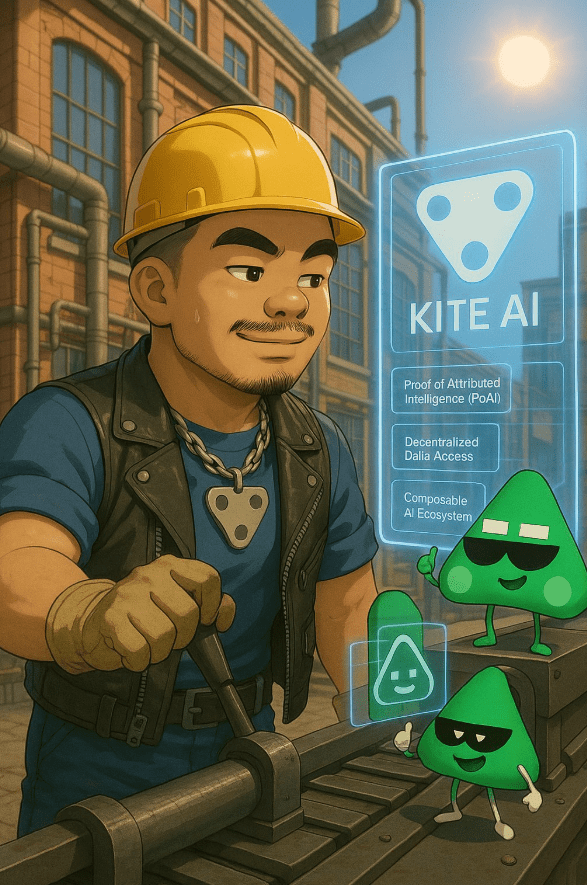
Have you also had those annoying moments like I have:
The explosive idea you pondered over in the middle of the night, thrown to the AI assistant for optimization, only to find months later that a major company released a feature that seems eerily similar to your idea.
The god-level prompt you spent an afternoon perfecting, made the AI spit out a perfect plan, and then it was included in the platform's 'excellent case library', while you didn't even get a credit.
The in-depth analysis and original stories you wrote became the training food for AI models, fattening the valuations of others, while your own account hasn't increased a dime.
This is not an illusion; it is the most blatant free-riding in the current AI economy.
The truth is heartbreaking: every time you 'input,' you are working for the giants.
The current mainstream AI logic, in simple terms, is a large-scale digital harvest:
You: contribute ideas, provide data, train models, generate content.
Platform: silently learn, optimize algorithms, upgrade products, attract investments.
Result: value skyrockets like an elevator—flowing straight into the company's pockets.
Your midnight inspirations, business insights, and even those tangled emotional questions... all become 'free feed' for training AI. Ironically, the models fed with your wisdom are likely to replace your current job in the future.
Is this reasonable? If data is the oil of the new era, why should drilling rigs become wealthy while we, who own the oil fields, get nothing?
Fortunately, someone has started to flip the table.
Recently, I saw a project called KITE AI that revealed a very simple truth:
Your data is not 'content'; it is your digital property.
Its approach is very similar to how Spotify changed the music industry:
In the past: your song has been played countless times online, and you might not earn a single cent.
In the future: every play generates copyright income, even if it was only listened to for 30 seconds.
KITE wants to apply the same logic to intelligent creation:
Every effective prompt, every high-quality data point, and every model tuning can be 'watermarked.'
As long as there are AI applications that use your contributions, the agreement can automatically track, confirm rights, and distribute payments.
You no longer need to defend your rights or send legal letters; the code in the background settles royalties.
In simple terms, it means turning 'powering with love' into 'earning with brains.'
What's cooler is: it wants to pull AI back from the 'cloud altar' into your hands.
Current AI is like a 'cloud giant' living in a luxurious data center, with astonishing electricity costs, slow responses, and always peeking at your data.
KITE's approach is the opposite:
Promote small models: let your phone or computer run AI by itself, without having to send everything to the cloud.
Play with edge computing: your device is just a node, capable of protecting privacy and participating in the network.
Decentralize: let intelligence be distributed across millions of devices instead of locked in the servers of a few large companies.
This is equivalent to turning AI from a 'monstrous centralized entity' into an 'intelligent partner scattered around you.'
So how can we ensure that we can really share the profits?
Having a vision is certainly not enough; KITE has created a combination of technology and economics.
Protocol layer rights confirmation: data is marked and tracked as soon as it comes in, making it clear who contributed.
Smart contract revenue sharing: automatically execute profit sharing with code to avoid disputes and delays.
Token economy drives: contributors are rewarded based on usage, and developers pay fees to obtain quality data.
The core idea is simply this: let the value of AI flow from 'sucking up' to 'irrigating down.'
What does this have to do with us ordinary people?
Don't think this is just a game for geeks. If this logic works:
Creators: your AI training secrets and organized quality datasets can become continuously generating 'digital assets.'
Professionals: your industry insights and solution templates can generate revenue every time they are called.
Ordinary users: can both run AI locally to protect privacy and selectively contribute data to gain rewards.
We can finally transform from 'raw materials being harvested' into 'stakeholders with a voice.'
Honestly, the road ahead will definitely be tough.
I'm not blindly promoting this; the challenges are visible to the naked eye.
The technical difficulty of large-scale data rights confirmation
How to compete with giants for developers and users
Can the actual experience really be seamless and smooth?
There will definitely be ups and downs, trial and error, and moments of 'the ideal is full, but reality is skinny.'
But why am I still willing to pay attention?
Because direction is more important than perfection.
Now this 'AI highway' is under frantic construction, but the rules are skewed: those building the road become rich, while we, who provide the building materials, are treated as free labor.
Projects like KITE are trying to answer a fundamental question:
If intelligence is the most important production material in the future, why should only a few companies own it?
They are betting on another future:
Your intellectual contributions can be quantified, respected, and priced.
The growth dividends of AI can be shared more fairly.
As technology advances, the digital sovereignty of ordinary people is not trampled upon.
This is not just a technological upgrade; it feels more like a rights revolution in the digital age.