Can a low win rate still yield huge profits? Unveiling the underlying logic of 645% ROI.
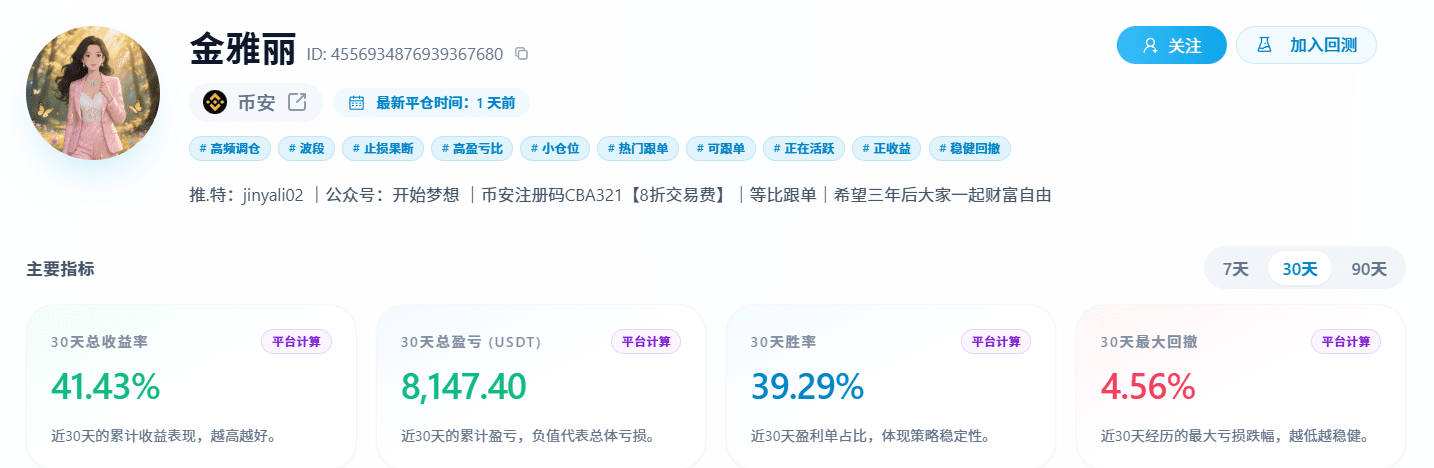
In the cryptocurrency copy trading market, 'high win rate = high profit' seems to be the default consensus, but the trading data of a certain lead trader breaks this convention: a nominal win rate of 49.6% (profiting on 170 trades, losing on 172 trades), yet achieving a 645.74% ROI over 180 days, with total profits exceeding 20,000 USDT, and the account funds almost entirely composed of profits.
However, behind the shiny data, the performance of copy trading shows significant divergence: among 20 copy traders, only 7 are profitable, while 13 are in a loss state (loss rate 65%). This phenomenon of 'lead trader making a fortune, copy traders polarizing' is fundamentally rooted in its extreme strategy of 'altcoin betting + big wins small losses + holding positions for a gamble' — seemingly replicable high returns, but actually concealing multiple uncontrollable risks. This article will help you objectively assess whether it is worth following from three aspects: trading logic, risk breakdown, and practical advice.
I. Objective Analysis of Trading Characteristics: The Core Logic of Low Win Rate and High Returns
1. Core Profitability: A few "home runs" cover most small losses.
The profit model of this order-taker is essentially "exchanging quantity for quality", relying on a very small number of large profits to cover high-frequency small losses.
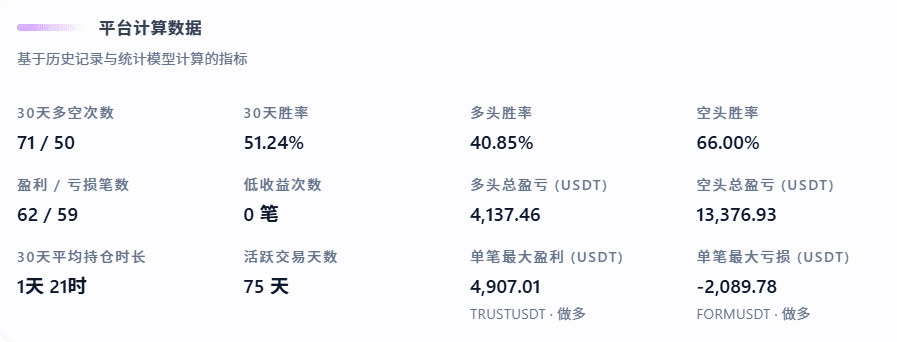
The profit and loss structure is extremely unbalanced: there are 170 profitable trades and 172 losing trades, almost a 1:1 ratio, but the largest single profitable trade of 8373 USDT is 2.86 times the largest single losing trade of 2925 USDT;
Core profitability relies on key trades: two representative profitable orders contributed nearly half of the cumulative profit – a long position in TRUSTUSDT on November 22, 2025, yielding a profit of 4907 USDT within hours; and a long position in AIAUSDT on September 29, 2025, yielding a profit of 4808 USDT after holding the position for 4 days. These two trades totaled 9715 USDT, accounting for the core proportion of its cumulative profit.
Most losses were from "small-scale trial runs": The majority of losing orders were between tens and hundreds of USDT. For example, a short position in XYZUSDT on October 12th resulted in a loss of 89.23 USDT, and a long position in ABCUSDT on November 5th resulted in a loss of 156.71 USDT. This strategy aimed to capture a few high-certainty, large-profit opportunities through high-frequency, small-scale trial runs.
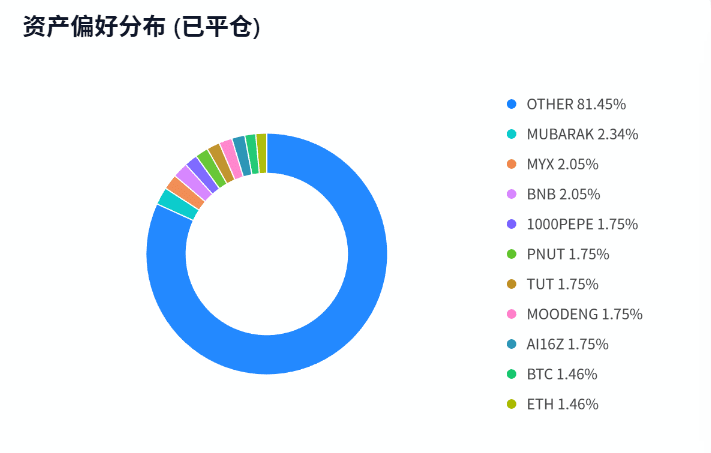
2. Asset Preference: 81.45% of the portfolio is invested in altcoins; high volatility is the source of profit.
The trader's asset selection exhibits an "extreme bias," completely deviating from the stable approach of mainstream cryptocurrencies.
Altcoins dominate: mainstream coins like BTC and ETH account for less than 3% of the total portfolio, with 81.45% of the holdings concentrated in the "OTHER" category (niche altcoins and trending new coins).
Selection logic: A preference is given to newly launched cryptocurrencies with hype and small circulating supply. These assets exhibit high volatility, with daily fluctuations of 20%-50%—they can quickly generate huge profits when the market is rising, but can also experience extreme price drops, such as a "halving in a single day."
Liquidity trade-offs: In pursuit of high volatility returns, some traders deliberately forgo the high liquidity of mainstream cryptocurrencies, which creates a potential for slippage in subsequent copy trading.
3. Trading rhythm: Short-term arbitrage + long-term holding strategy, flexible switching without a fixed pattern.
This trading advisor does not have a fixed trading cycle, but rather flexibly switches between "ultra-short-term trading" and "medium-to-long-term position holding" based on market opportunities.
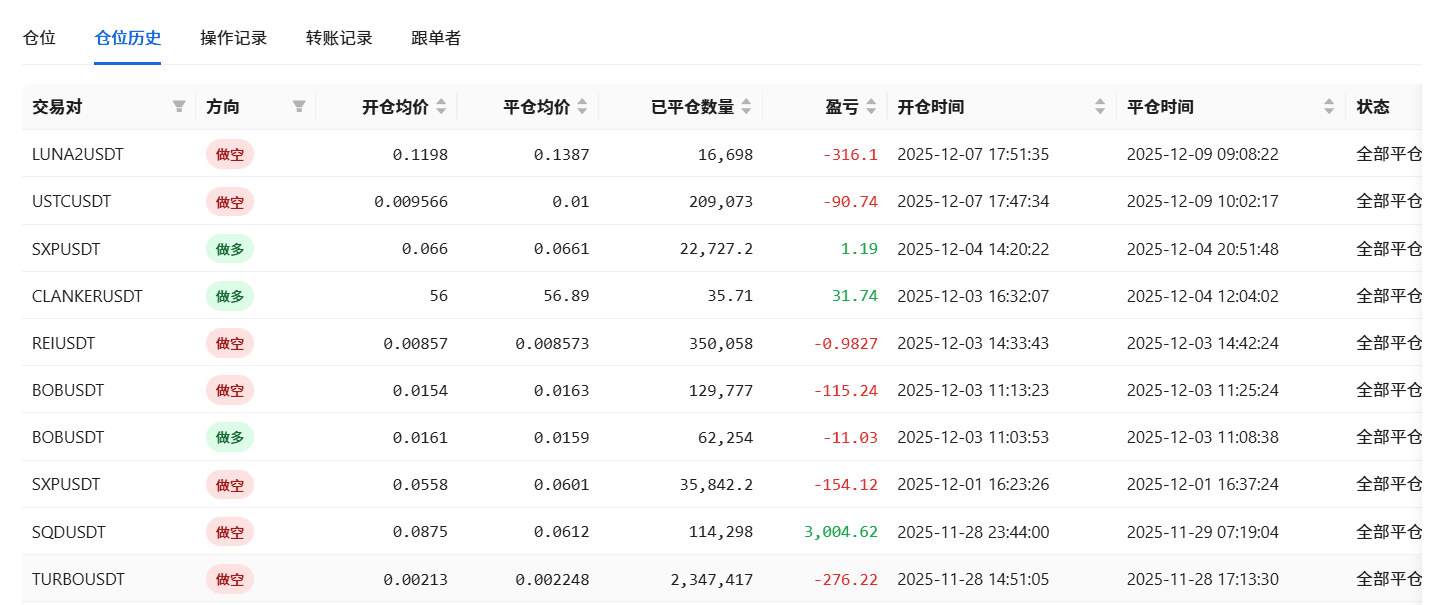
Ultra-short-term high-frequency arbitrage: Approximately 50.9% of trades are completed within 24 hours, with some operations described as "lightning trades"—for example, a long position in KITEUSDT on November 3, 2025, was closed out in just 8 seconds; a short position in BOBUSDT on December 3, 2025, was closed out for profit after 12 minutes, accumulating small profits by capturing millisecond-level price fluctuations;
Medium- to long-term swing trading with sustained positions: 49.1% of trades were held for more than 24 hours, with the longest holding period reaching 114 days. Typical examples include:
On October 6, 2025, I went long on JELLYJELLYUSDT and held the position for nearly a month. During this period, I experienced several periods of floating losses and eventually closed the position with a profit.
On November 2, 2025, I went long on PORT3USDT and held the position for 21 days despite a continuous market decline, ultimately exiting the market with a loss of 1765.94 USDT.
The strategy involves switching positions: high-frequency short-term arbitrage during market fluctuations, and switching to long-term holdings to "bet on a reversal" when a strong trend (or what one perceives as a strong trend) emerges.
4. Risks and Concerns: Tendency to hold losing positions + sharp drawdowns raise questions about the stability of profitability.
Behind the high returns lies a significant risk exposure, primarily manifested in two aspects:
The return curve exhibits rollercoaster-like fluctuations: Historical data shows that its ROI plummeted from 110.27% to 64.64% within 6 days, a drawdown of over 45 percentage points; and from 143.08% to 126.01% within 11 days, a drawdown of approximately 17 percentage points. Such volatility poses a significant challenge to capital management and psychological resilience.
Holding onto losing positions amplifies losses: Some trades that could have been stopped out with small losses escalated into large losses due to prolonged holding. For example, a long position in FORMUSDT in October 2025 resulted in a single-day loss of 2089.78 USDT. Had a stop-loss order been placed in time, the loss could have been kept within a few hundred USDT, but holding onto the position caused the loss to multiply several times.
II. The core reason for the divergence in copy trading: the dual barriers of strategy and practical application.
Why can the lead trader achieve a 645% ROI, while 65% of those copying the trades lose money? The core issue lies in the combined effect of "poor strategy replicability" and "practical obstacles."
1. The Liquidity Trap of Altcoins: Slippage Erodes Profits, and Their Inherently Disadvantaged Trading Prices
This is the primary reason why followers lose money:
Niche cryptocurrencies have low trading depth: Most altcoins have a daily trading volume of less than 10 million USDT. When a trader opens a position, they may occupy 5%-10% of the circulating supply. However, when a large amount of copy trading funds flood in, it can instantly push up (for going long) or push down (for going short).
Significant slippage costs: Copy traders often see their execution prices 5%-10% lower than the lead trader's. For example, if the lead trader goes long on an altcoin at 0.1 USDT, the copy trader might only be able to execute at 0.105-0.11 USDT due to liquidity issues, directly squeezing their profit margin and potentially turning a profit into a loss.
Closing positions is more difficult: When the market reverses, the trader can quickly close positions to lock in profits, while followers may be unable to sell at the target price due to insufficient liquidity, leading to greater losses.
2. The time and financial costs of holding onto losing positions: the "patience" that copy traders find difficult to replicate.
The strategy of a trading facilitator holding onto losing positions places extremely high demands on the financial strength and mindset of those following the trades.
Capital tied up: If the lead trader holds a position for one month, the followers must also tie up their capital for one month. If other investment opportunities arise during this period, or if they have liquidity needs, they may be forced to exit the market prematurely, missing out on subsequent profit reversals.
Differences in psychological resilience: The trading advisor can withstand 21 days of floating losses, while followers may panic and close their positions after only 3-5 days, turning floating losses into realized losses.
Mismatch in financial strength: The account of the person providing the trading signals is mainly composed of profits, allowing them to withstand long-term unrealized losses, while those copying the trades mostly have their own capital, and the psychological pressure from unrealized losses is far greater for them than for the person providing the trading signals.
3. Accuracy of entry timing: Following the crowd at the peak = being passively taken over.
The high ROI of a trading mentor is the result of "long-term accumulation," but followers often enter the market when the ROI reaches a historical high, only to encounter a pullback.
High-point entry risk: For example, if the ROI of a trader drops from 110% to 64%, those who enter the market at this point will directly experience a 45% drawdown, making it difficult to recover their losses in the short term.
Advantages of entering at a low point: Followers who enter after the lead trader's net asset value has fallen by more than 20% and stabilized are more likely to share in subsequent profits, while most followers lack the patience to "enter against the trend" and are more inclined to "chase highs."
4. The randomness of the strategy: High returns depend on "luck + market conditions," and cannot be replicated.
The trader's profits did not rely entirely on technical analysis, but rather on "market conditions matching + luck":
The unpredictable nature of altcoin price movements: Their core profit-generating orders largely stem from "hot concept speculation," a type of market movement that is rare and unpredictable, making it impossible to develop a stable and replicable strategy.
The randomness of successfully holding onto losing positions: Some such positions ultimately become profitable, depending on a market reversal. However, if a sustained one-sided market trend occurs, it can lead to huge losses, and those who follow the trades may simply be caught in this wave of losses.
III. Rational Copy Trading Suggestions: Suitable Target Groups and Practical Guidelines
1. Target Audience Profile (Strictly selected, not suitable for everyone)
✅ Suitable for people who want to copy orders:
Extremely high risk tolerance: Able to accept short-term drawdowns of over 50% of principal, and losses will not disrupt normal life;
Extensive experience in altcoin trading: Familiar with the speculation logic and liquidity characteristics of niche cryptocurrencies, and able to identify market reversal opportunities;
Matching capital with mindset: Having readily available, non-negotiable idle funds (not needed for 6 months) and the ability to withstand 1-3 months of unrealized losses on positions;
Possesses independent judgment: Does not blindly follow all orders, and can manually screen for high-quality targets and entry points.
❌ Absolutely not suitable for:
New investors: Lack of understanding of cryptocurrency risks, especially the extreme volatility of altcoins;
Risk-averse individuals: seek stable returns and cannot accept daily fluctuations exceeding 10%;
Insufficient capital: If the available capital for copy trading is less than 5000 USDT, it's difficult to withstand slippage and small losses.
Those who rely on "passive income" expect to set things up and then leave them alone, lacking the time and energy for proactive risk control and monitoring.
2. Core Practical Strategies (Directly implementable, with manageable risks)
(1) Fund Management: Keeping risks within a controllable range
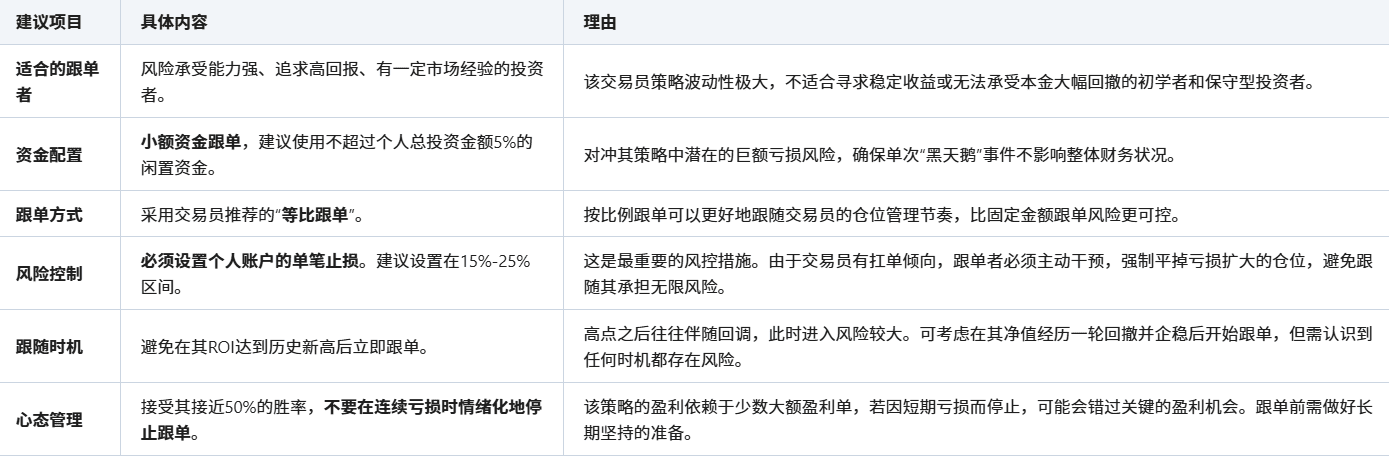
Total capital allocation: No more than 5% of your total personal investment amount, and clearly define this capital as "venture capital," with the intention of mentally preparing for its complete loss;
Single trade limit: Each copy trade must be no more than 10% of the total copy trade capital. For example, if the total copy trade capital is 5000 USDT, the maximum single trade is 500 USDT, to avoid excessive losses in a single transaction.
Fund segregation: A separate copy trading account is opened, and funds are not mixed with daily investment funds to prevent losses from affecting one's livelihood.
(2) Copy trading settings: proportional copy trading + active stop loss, rejecting passively holding onto losing positions.
Copy trading mode selection: Prioritize proportional copy trading, where the position size is synchronized with the trader's margin ratio. This better matches the risk exposure compared to fixed-amount copy trading.
Stop-loss rules (the core of the core):
Single-trade stop loss: Each trade has an independent stop loss line set at 15%-25%. Once triggered, the position is closed immediately, and the trader does not hold onto losing positions.
Total account stop loss: Set a total stop loss of 30%. If the cumulative loss of the copied account reaches 30%, immediately suspend all copied trades and review the market. Do not blindly add to positions.
Manual intervention permission: Retain emergency liquidation permission to proactively stop losses and exit the market in the event of extreme market conditions (such as a single-day drop of over 20% in altcoins).
(3) Timing selection: Only enter the market in the "safe zone" and avoid high points.
Entry timing selection: Only enter the market after the net asset value of the trader has fallen by more than 20% and there has been no further decline for 3 consecutive days (stabilization signal);
Avoid these three types of time periods:
Within one week of the record-high ROI for lead generation;
Following a surge in the altcoin market (with an average daily increase exceeding 15%);
The market has entered a one-sided downward trend (e.g., BTC's single-day drop exceeds 10%).
Trial and error period setup: First, use 10% of the copy trading funds to invest for one month to observe the actual copy trading results (slippage, profit conversion rate) before deciding whether to increase the position.
(4) Target Screening: Manually filter for risks and focus on high-quality altcoins.
Liquidity filtering: Only follow orders for altcoins with a daily trading volume of ≥10 million USDT, filtering out ultra-niche cryptocurrencies with a trading volume of less than 5 million USDT to reduce slippage;
Concept screening: Prioritize altcoins with clear hot topics (such as technological upgrades, ecosystem cooperation, and favorable policies), and avoid "air coins" (coins with no logic whatsoever);
Position screening: Manually filter orders held by the lead trader for more than 15 days and with unrealized losses exceeding 10%, to avoid following them into prolonged losing positions.
3. Continuously monitor key points: make dynamic adjustments and stop losses promptly.
Daily monitoring: Focus on checking the position status of the lead trader (whether there are any long-term unrealized loss orders) and the slippage situation of the copy trading account (the difference between the actual execution price and the lead trader's position).
Weekly review: Analyze the profit conversion rate of the orders being followed. If the slippage rate consistently exceeds 10%, or the proportion of unprofitable orders exceeds 60%, suspend following orders for one week.
Emergency stop signal (triggered by any of the following: immediate stop):
The trader who led the trades suffered two consecutive losses while holding losing positions, with each loss exceeding 2000 USDT.
The altcoin market weakened overall, with an average daily drop exceeding 15%.
The copy trading account has reached its total stop-loss level;
The person leading the trades started trading "air coins" (cryptocurrencies with no real basis or investment value).
Tip
A 49.6% win rate yielding a 645% ROI is essentially a gamble of "high risk for high reward"—the success of the trader is a result of a combination of factors: high volatility in altcoin markets, luck in holding losing positions, and strong financial backing. This model lacks universality and replicability.
For those who copy trades, a 65% loss rate serves as a clear warning: blindly following others will only make you a "bagholder." If you genuinely intend to try it, you must strictly adhere to four principles: "small capital, proactive stop-loss, precise timing, and careful stock selection," always prioritizing the safety of your principal.
The core of cryptocurrency investing is "earning money you understand," not chasing high returns from others. In the high-risk altcoin market, "survival" is more important than "making a fortune."
This report is based on objective analysis of publicly available data and does not constitute investment advice. Investors should make rational decisions based on their own risk tolerance and financial situation, always prioritizing the safety of their principal and avoiding being misled by short-term, large profits into blindly following the crowd.
This is a simplified version of the report. The full analysis report can be accessed using the widget on the homepage.