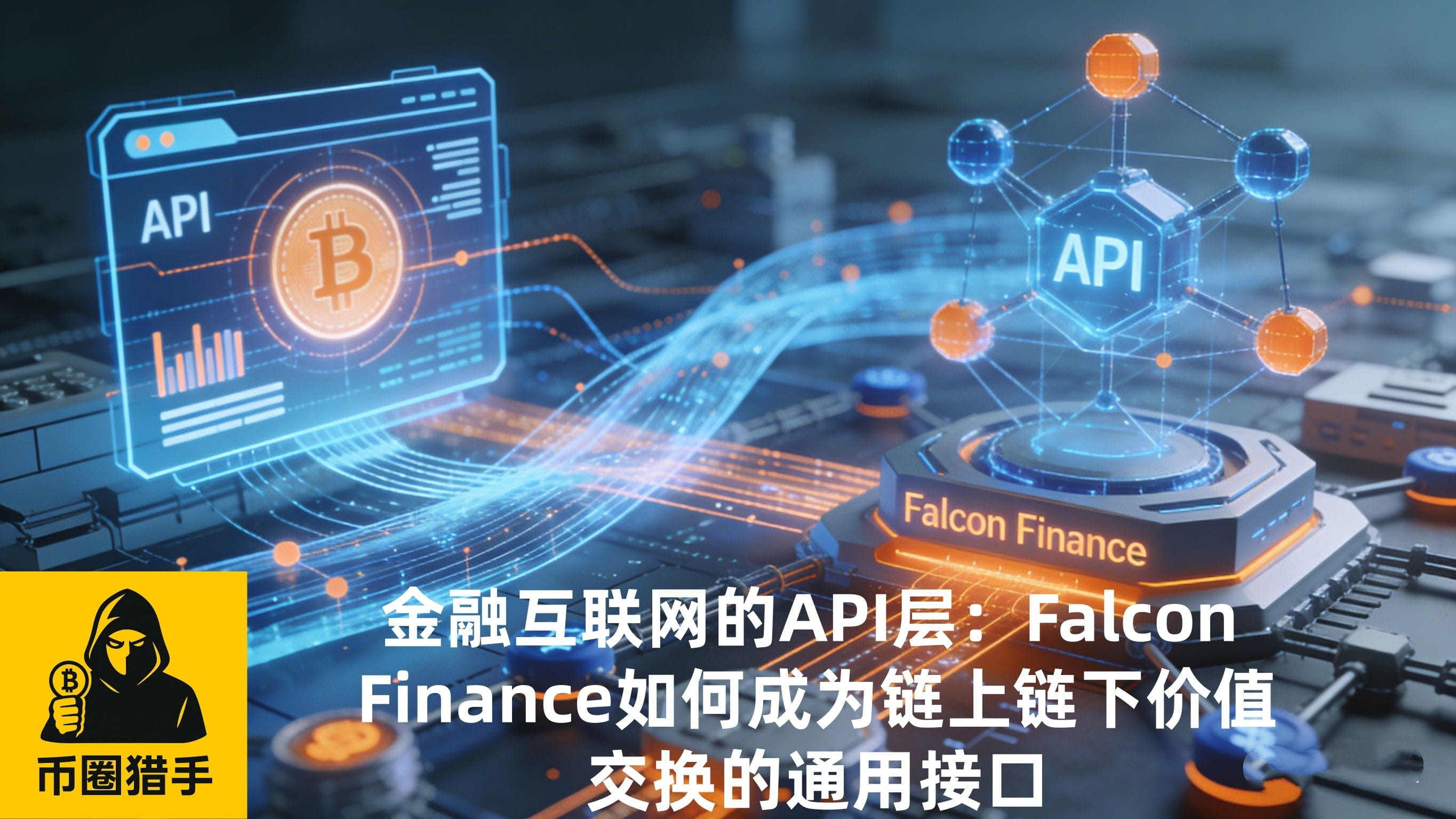
@Falcon Finance #FalconFinance $FF
The core of the internet revolution is not the creation of new information, but rather the ability to allow heterogeneous systems to communicate seamlessly through standardized protocols like HTTP and TCP/IP. Today, the financial world stands at a similar crossroads: the on-chain DeFi ecosystem and the off-chain TradFi (traditional finance) are like two isolated systems using different programming languages—on one side is the crypto world with instant settlement, programmability, but a single type of asset, while on the other side is the traditional system, rich in assets, mature in regulation but inefficient. The lack of a reliable, standardized 'communication protocol' between the two leads to the process of bringing trillions of dollars of real-world assets (RWA) on-chain being as slow and fraught with friction as transmitting 4K video over a dial-up modem.
Falcon Finance (FF) aims to become the 'Value Exchange API' of the financial world. It does not settle for merely replicating a bank on-chain but seeks to define a set of standard interfaces (USDf) that allow any asset—whether its native state is bonds, stocks, commodities, or cryptocurrencies—to be 'called' and return standardized, interest-generating on-chain liquidity. A TVL exceeding $2 billion, covering over 20 chains, is not merely a reflection of capital accumulation but an intuitive manifestation of 'API call volume,' proving that the market is widely adopting this new communication standard. When merchants like AEON Pay start accepting USDf payments, it indicates that this API has moved from internal testing to production.
One, API Architecture Analysis: Three-layer interface design
An excellent API needs to have usability, robustness, and scalability. Falcon's system architecture is built around these three points.
1. Endpoint Layer: A unified and inclusive 'request entry' (general collateral system)
The first element of the API is clearly defined endpoints used to receive requests in various formats.
Multi-format request support: Falcon's collateral contracts define a wide range of 'acceptable request formats':
POST /collateralize {asset_type: "stablecoin", ticker: "USDC"}
POST /collateralize {asset_type: "crypto", ticker: "WBTC"}
POST /collateralize {asset_type: "rwa", identifier: "tokenized_US_Treasury"}
Request validation and parameterization: Each 'request' (asset) is validated based on its metadata (volatility, liquidity) and applies corresponding 'parameters' (collateral ratio). This ensures the robustness of the API and prevents malicious or non-compliant requests from causing system crashes.
2. Business Logic Layer: Intelligent and efficient 'request processing' (active yield routing)
This is the core of the API, transforming raw requests into valuable responses.
Microservices architecture: The protocol routes collateral (request load) to a set of parallel, specialized 'microservices' (yield strategies) for processing:
Arbitrage strategy service: Handles market inefficiencies and returns risk-free price differentials.
Fixed income service: Connects to traditional interest rate markets and returns benchmark yields.
Basis trading service: Handles relationships between spot and derivative markets and returns structural yields.
Load balancing and fault tolerance: The system monitors the health status of each 'microservice' (expected yields and risks) in real-time, dynamically allocates request loads, and ensures high availability and high performance of overall responses (total yields). This is like a cloud service provider guaranteeing 99.9% uptime.
3. Response Layer: Standardized and composable 'data return' (dual token model)
Data after processing must be returned in a unified and user-friendly format.
Standard JSON response (USDf): Regardless of the input asset, the primary object returned by the API is the standardized USDf stablecoin. It is clearly structured (pegged at 1 USD) and is a 'universal data format' that all downstream applications can parse.
Nested data objects and premium endpoints (sUSDf and vault):
sUSDf: Like nesting a real-time updated yield field in the standard response, holding it automatically accumulates yield.
Fixed-term vault: Like calling a premium endpoint POST /vaults/lock, passing in sUSDf and duration parameters to exchange for a higher yield_rate response.
Response caching and consistency: The diversification of assets and strategies in the protocol, like distributed caching and database replication, ensures strong consistency of core responses (USDf pegged) even when some services are temporarily unavailable (localized market turbulence), with a deviation rate of less than 0.1%.
Two, API adoption rates and performance metrics: Developers vote with their feet
In the technology field, the success or failure of an API depends on its adoption rate and stability.
Request volume (TVL) and response volume (circulation): A TVL of $2.086 billion represents huge request throughput, and 2.1 billion USDf in circulation represents massive standardized responses being generated and utilized. This is decisive evidence of API scaled applications.
API response time and success rate (speed and stability): Cross-chain transfer support and second-level yield accumulation reflect 'low latency.' Maintaining the peg during market stress tests (ETH dropping 10%) proves 'high reliability under high throughput,' with no service degradation or major errors.
Developer ecosystem (number of addresses and integrations): Over 500,000 active addresses mean a large developer community is using this API to build applications. Whale withdrawal behaviors are like large clients adjusting their usage and do not affect the overall scale. The $24 million 'developer funding program' (financing) and the expansion to Solana RWA indicate that the API is actively expanding into new 'platforms' and 'programming languages' (different blockchains and asset types).
Three, Protocol Comparison: MakerDAO's 'Monolithic Application' vs. Falcon's 'Microservices API'
From the perspective of software architecture, the differences between the two are clear:
MakerDAO: A meticulously designed yet outdated 'monolithic application.' It is powerful and secure but tightly couples all functionalities (collateral, governance, stability). Adding support for new assets (new features) requires rewriting a lot of core code, resulting in long upgrade cycles and slow innovation speed. It is like large desktop software that requires users to download installation packages for every update.
Falcon Finance: A cloud-native, loosely coupled 'microservices API platform.' Its collateral, yield, and governance modules are relatively independent and communicate via standard interfaces (USDf). Adding new assets or strategies is like adding a new microservice or endpoint to the API platform, allowing for rapid iteration and easy scalability. It resembles a modern cloud API where developers can call the latest features at any time.
Falcon's CeDeFi hybrid model adopts the best practices of combining custodial services with self-built services, ensuring core security (decentralized consensus) while utilizing professional services (centralized strategy execution) to optimize performance. Its ability to integrate new assets within days reflects this architectural flexibility.
Four, The Value Logic of $FF: The 'License' and 'Governance Rights' of the API platform
In the financial API economy built by Falcon, the $FF token is key to accessing, managing, and benefiting from the platform.
API call permissions and premium feature keys: Staking $FF can earn yield, similar to paying for premium API calls or holding licenses for better service terms. In the future, using certain exclusive data or strategies may require consuming $FF.
Platform governance and roadmap voting: $FF holders determine the development direction of the API—what new endpoints (asset types) to add and which microservices (yield strategies) to optimize. This is equivalent to a seat on the 'open-source project maintenance committee.'
Platform equity certificates: As the value of financial applications built on this API (TVL) grows and the API call volume (transactions and payments) rises, the value of the platform itself also increases. $FF is the equity certificate of this value growth.
Hunter's Perspective:
The history of technology repeatedly proves that the greatest value capture often occurs at the 'standardization layer.' IBM defined the personal computer standard, Microsoft defined the operating system API, and Google defined search and advertising protocols. In the wave of financial digitization, whoever defines the standard interface for 'value exchange' will control the hub of the next generation of financial infrastructure.
Falcon Finance is competing for this position. Through USDf and its underlying universal collateral system, it attempts to become the 'default financial port' connecting the on-chain world with off-chain billions of assets. This is no longer a debate about which stablecoin is more decentralized, but a race about who will become the 'HTTP for Money' of the future value internet.
Investing in $FF is based on a strategic judgment: In a future where all assets are tokenized and everything can be represented as a token, the biggest bottleneck and opportunity lies in the middle layer that translates these heterogeneous values into a universal liquidity language. Falcon is fully committed to building this translator and router.
When future developers want to integrate 'any asset earning' features into their applications, the first thing they will think of is calling Falcon Finance's API. At that time, USDf will not only be a stablecoin but will become the standard unit of value liquidity, like the bytes transmitted over the internet today.
Falcon Finance is attempting to draft an RFC (Request for Comments) for the future financial internet.
I am a hunter in the crypto sphere, searching for those key interfaces that define interoperability in the underlying protocol battle between code and capital.