
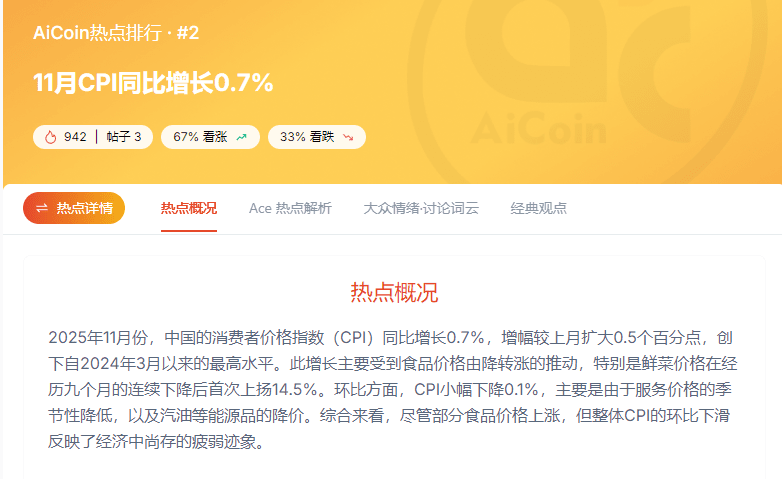
The CPI data for China in November 2025 presents some noteworthy characteristics. In terms of year-on-year growth, the increase of 0.7% is not high, but it has expanded by 0.5 percentage points compared to the previous month and has reached the highest level since March 2024, indicating a certain upward trend in overall prices.
This increase is mainly driven by food prices, especially the price of fresh vegetables, which rose by 14.5% for the first time after declining for nine consecutive months. The change in fresh vegetable prices has a significant impact on food prices, thereby driving the CPI growth. This may be due to seasonal factors, supply conditions, and other reasons that have altered the supply-demand relationship in the fresh vegetable market, leading to a price increase.
However, on a month-on-month basis, the CPI decreased by 0.1%. This is mainly due to seasonal reductions in service prices and price drops in gasoline and other energy products. Seasonal decreases in service prices are relatively common phenomena; for example, industries such as tourism and catering may see reduced demand in specific seasons, leading to price declines. The price drop in gasoline and other energy products may be influenced by fluctuations in international energy market prices and adjustments in domestic energy policies.
Considering the situation of year-on-year growth and month-on-month decline, although some food prices have risen, causing the CPI to grow year-on-year, the overall month-on-month decline in CPI still reflects some weaknesses in the economy. This may indicate that consumer demand has not fully recovered, and certain industries are still facing operational pressure. The government may introduce some policies to stimulate consumption, stabilize prices, and promote better economic development, and we can continue to pay attention to the changes in subsequent economic data.
The CPI data for China in November 2025 reflects the economic situation and also impacts the cryptocurrency sector. The year-on-year recovery is not significant but still reaches a new high, raising market concerns about sustained inflation. The central bank may tighten monetary policy, leading to increased capital costs and a decreased willingness to invest in risky assets, which could affect the cryptocurrency sector. However, the month-on-month decline shows weak short-term demand, and the market expects stronger economic recovery efforts. The central bank is likely to maintain a loose policy, ensuring liquidity in the cryptocurrency sector, which may attract capital.
Market sentiment and capital flow are crucial. If the year-on-year recovery is viewed as easing inflationary pressure and boosting confidence, capital may flow into the cryptocurrency sector; if there are concerns about uncontrollable inflation, funds will flow into safe-haven assets such as gold and the U.S. dollar, putting pressure on the cryptocurrency sector. The data for November is affected by seasonal changes in fresh vegetable and service prices.

In the short term, this CPI data is friendly to the cryptocurrency sector. The year-on-year figure did not exceed expectations, and the month-on-month data shows that demand is still to be repaired. The central bank is likely to maintain a loose policy, providing support for capital in the cryptocurrency sector, and mainstream cryptocurrencies like Bitcoin may rise. The rise in fresh vegetable prices is a seasonal supply issue and not a systemic inflationary pressure. Market concerns about tightening monetary policy are small, and the risk appetite in the cryptocurrency sector can be maintained.
In the long term, the situation is complex. The government may support the economy through consumption stimulus policies and infrastructure investment. If the economic fundamentals improve and consumer demand recovers, it may indirectly drive the development of the cryptocurrency sector. However, uncertainties such as the China-U.S. tariff conflict and the deteriorating global trade environment will make market sentiment tense, leading to capital seeking safety and increased volatility in the cryptocurrency sector. Fortunately, domestic policies have a hedging effect, which can partially offset the impact.$ETH