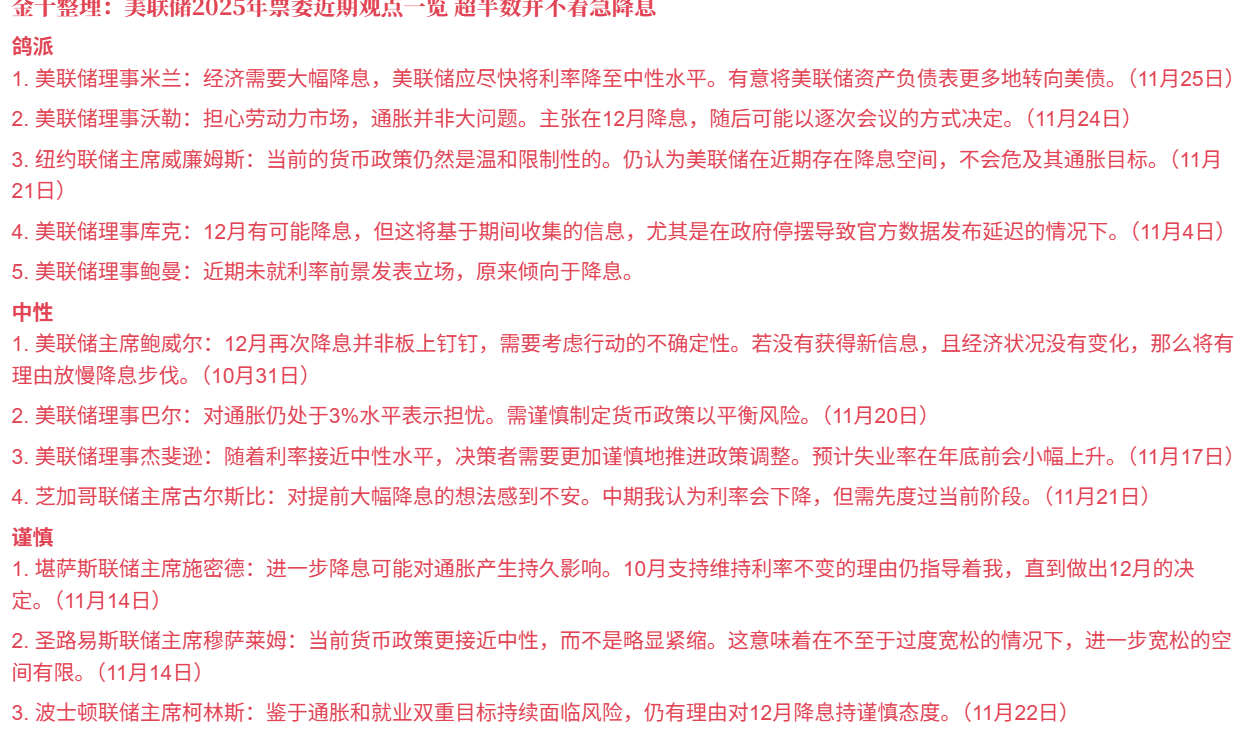
As shown in the figure.
The strong demand for interest rate cuts from the Trump faction clashes with the data-driven Federal Reserve.
Why is Trump so eager to lower interest rates?
The main goal is still to stimulate economic growth and employment, temporarily relieve social pressure, and secure votes for the midterm elections.
But can lowering interest rates really improve the economic environment?
According to data, inflation is still below target, remaining around 3%. The Federal Reserve is concerned that continuous interest rate cuts may quickly bring inflation back to previous high levels, making this year seem like a wasted effort.
This also includes some judgments about interest rates and comparisons of economic data, not to be elaborated on for now. We mention a more important reason: the face of the Federal Reserve.
The Federal Reserve is an independent institution outside of government agencies that can make decisions independently. It must avoid being seen as influenced by political pressure and adhere to a data-driven decision-making model to maintain market trust and the effectiveness of long-term policies. Any Federal Reserve Chair needs to maintain an independent persona, a role that can stand on equal footing with the government; if decisions are made entirely according to the orders of the old Trump, it is likely to be very difficult after the transition, planting the seeds for anyone to intervene and give commands...
The reason why old Trump is eager to change people, and why the Federal Reserve is 'going against' him is actually very clear.
Trump on the political level: Pursuing short-term economic growth, employment improvement, and electoral benefits, leaning towards quickly stimulating the economy through interest rate cuts. Such political decisions are often influenced by cyclical and public opinion factors, emphasizing 'speed' and 'effectiveness', after all, you don't know what stage of the economic cycle your term is in.
The Federal Reserve: Balancing inflation and employment dual goals, placing more emphasis on medium- to long-term economic stability, and being vigilant about inflation rebound and financial risks. The Federal Reserve's decisions rely on economic data and models, emphasizing 'gradual' and 'cautious', as Powell stated, 'slowing the pace of rate cuts'.
Trump's pressure on the Federal Reserve has reached a level that worries the market, and people are already speculating about how likely it is that the independence of the Federal Reserve will be interfered with after the transition.
If the market's sensitivity to rate cuts and hikes decreases over time, it is certainly due to political figures over-politicizing policies.