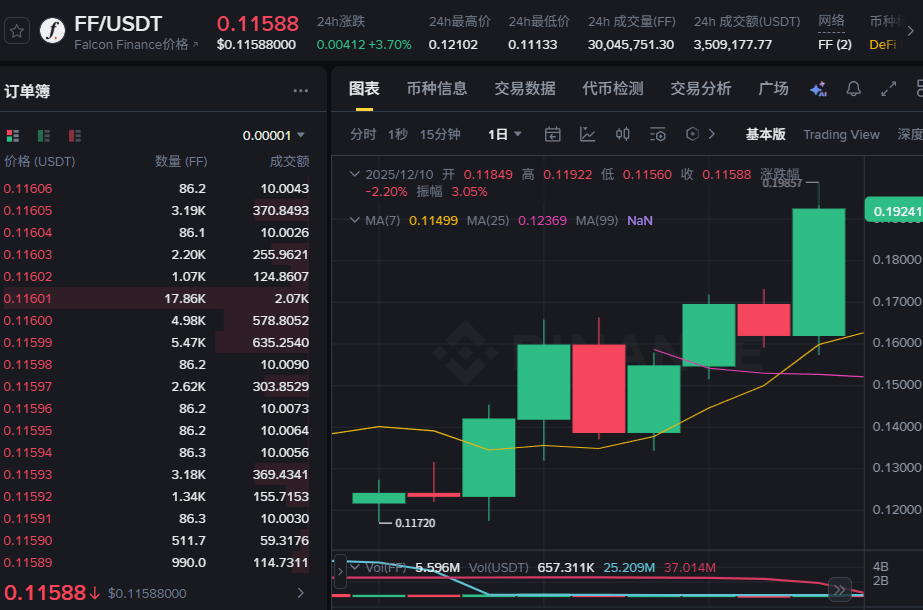
@Falcon Finance #FalconFinance $FF


As everyone's attention focuses on the fluctuations of Bitcoin, a dangerous signal considered a 'liquidity reset' by top on-chain data firms is quietly emerging from the veins of Solana (SOL) — over half of the holders are selling at a loss. Meanwhile, on the other side of the market, a platform called Falcon Finance, described as a 'universal collateral infrastructure,' is quietly operating, providing an innovative path to convert volatility risks into stable returns for assets seeking refuge in turbulent times.
On December 10, the latest data released by Glassnode indicates that Solana's 30-day average realized profit-loss ratio has remained below the critical threshold of 1 since mid-November. This cold data means that in the past nearly month, for every $1 profit generated in the SOL market, there has been over $1 loss realized. Analysts point out that this 'surrender-style selling' and 'comprehensive liquidity reset' are typical characteristics of markets undergoing large-scale adjustments and approaching phase bottoms. Once key support is lost, long positions amounting to about $500 million may face liquidation, triggering a chain reaction.
While the market is uneasy about the liquidity exhaustion of SOL and the potential liquidation risks, an innovative financial paradigm aimed at addressing and even capitalizing on this extreme market situation is emerging. The 'Universal Collateral Infrastructure' represented by Falcon Finance allows users to over-collateralize various volatile assets, including SOL, and mint stablecoins pegged 1:1 to the US dollar, USDf. This is not just a yield-generating tool, but a new strategy for asset hedging and capital preservation for investors during the market 'liquidity reset' period.
01 Data warning: SOL trapped in a 'loss-dominated' liquidity spiral
Glassnode's on-chain data reveals a grim reality: The Solana network is undergoing a deep 'liquidity reset'.
Core indicators: The profit/loss ratio continues to be below 1
Data interpretation: The realized profit/loss ratio is a key thermometer for measuring market health. When this ratio falls below 1, it indicates that the total value of sold assets realizing losses exceeds the total value of realizing profits.
Current situation: Since mid-November, the 30-day average profit/loss ratio of SOL has fallen below 1 and has continued to this day. This marks a shift in market sentiment from profit-taking to widespread 'cutting losses' exits. Historical experience shows that this large-scale loss realization (Capitulation) often occurs at the bottom of market phases.
Market impact: Liquidity contraction and increased volatility
This ongoing loss sell-off has led to a significant liquidity contraction, and market depth has become shallower. Analysts at Altcoin Vector point out that Solana is in a 'comprehensive liquidity reset phase', historically signaling the end of an old cycle and the beginning of a new liquidity cycle. SynFutures COO Wenny Cai added that this round of reset is driven by sell-offs triggered by realized losses and a reduction in open futures contracts. For traders, the lack of liquidity means that large orders are more likely to cause significant price fluctuations, increasing the challenge of the trading environment.
02 Liquidation crisis: $500 million in long positions hanging by a thread at $129
Analysts warn that if pessimistic sentiment continues to spread, leading to further price declines, a significant risk point lies ahead.
According to analysis, if the price of SOL falls to around $129, it may trigger forced liquidations of approximately $500 million in long positions. Large-scale liquidations have a strong self-fulfilling and amplifying effect:
Chain reaction: Initial liquidations will lead to increased selling pressure, price declines, and further trigger more liquidation lines.
Liquidity crash: In an already weak liquidity market, such a crash will dramatically amplify declines.
Psychological defense line: $129 is close to SOL's realized price (historical average cost), and once breached, it may shake the confidence of long-term holders and trigger a broader sell-off.
03 Breaking the impasse: How does Falcon Finance 'turn crisis into opportunity'?
In the face of volatility and potential liquidation risks, traditional holding or selling is not the only option. Next-generation DeFi protocols represented by Falcon Finance (FF) offer an innovative idea for converting risk assets into stable productive capital.
Core mechanism: Multi-asset collateral for minting stablecoins
The core of Falcon Finance is as a 'universal collateral infrastructure'.
Operational path: Users can deposit their SOL (or other mainstream cryptocurrencies like BTC, ETH) into the protocol as over-collateral and mint a synthetic stablecoin USDf pegged 1:1 to the US dollar.
Risk isolation: This process instantly converts users' direct exposure to SOL price fluctuations into holdings of the stablecoin USDf. Even if the SOL market continues to fluctuate, the value of USDf remains stable.
Yield continuation: More importantly, the sUSDf that users stake can continue to earn returns generated by the protocol's complex arbitrage strategies (such as funding rate arbitrage, cross-exchange arbitrage), with current annualized returns ranging between 8.48% to 20%. This means that while staying away from price volatility risks, capital is still continuously working.
Narrative fit: Financial tools to cope with the 'liquidity reset'
Against the backdrop of the current liquidity reset in the SOL market, Falcon Finance's solutions appear particularly timely:
Providing an exit for holders: For SOL holders worried about declines but not wanting to exit completely, this provides a 'soft landing' path to convert volatile assets into yield-generating stable assets.
Capturing reset period returns: Market volatility and differentiation often create fertile ground for arbitrage strategies, which is precisely an important source of Falcon's returns.
Protocol's own strength: Falcon Finance was co-founded by top market maker DWF Labs and has received tens of millions of dollars in investments from institutions like World Liberty Financial. Its USDf circulation has quickly surpassed $1.25 billion, entering the top ten stablecoins, demonstrating strong market acceptance.
04 Historical reflections and future outlook
Looking back at history, similar on-chain 'surrender signals' often require time for the market to bottom. Altcoin Vector analysis suggests that if this year's April pattern repeats, it may take about four weeks for the market to reignite enthusiasm, which would be around early January 2026.
For investors, the current stage requires:
Pay close attention to SOL's performance in the critical area of $129 and guard against the rapid decline risk triggered by liquidations.
Recognize that the liquidity reset is a necessary process for market clearing, laying the foundation for the next healthy rise.
Explore the use of emerging DeFi tools like Falcon Finance for risk management, transforming pure speculative positions into asset allocations supported by stable returns.
As Solana's on-chain data flashes red loss signals, and the market trembles between fear and greed, the gears of financial innovation never cease to turn. The 'asset activation' scenario depicted by Falcon Finance attempts to transform the volatility of the crypto world from a source of risk into a source of return.
This reset of liquidity may not only be cleansing weak chips but also accumulating strength for the next round driven by real returns and risk hedging. The market bottom is always forged by the most pessimistic sellers, while the top is formed by the most optimistic buyers. The only question is, during the process of the profit/loss ratio returning above 1, will your assets choose to remain dormant in the downturn or be 'activated' in the new financial game?