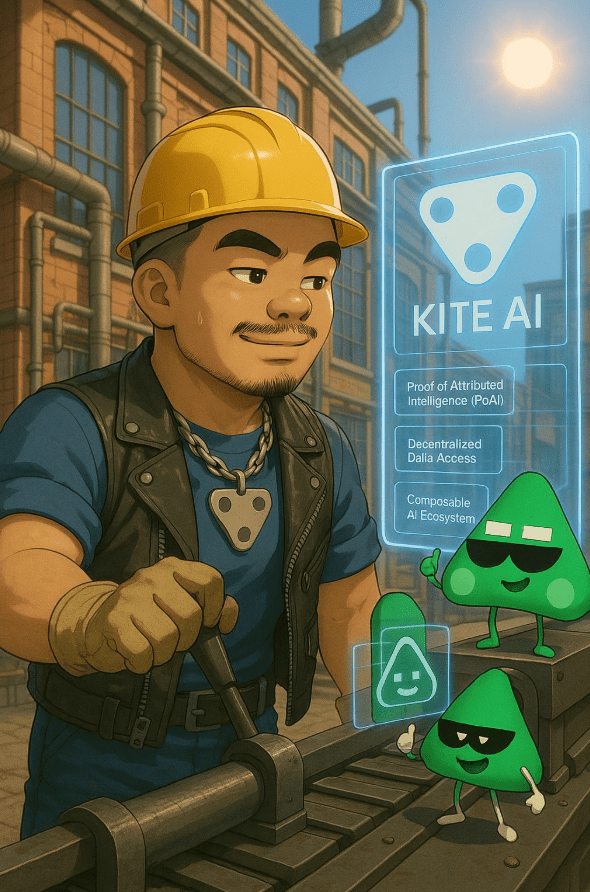
I have played with quite a few crypto projects and have read various white papers on 'autonomous agents.' Most of the time, they feel quite abstract to me—like telling a distant sci-fi story, it sounds cool but is intangible. Until I crouched down and really fiddled with something called Kite. In just a few hours, it didn’t paint any grand picture of 'disrupting the world,' but it truly corrected my imagination of the future.
In the past, I also pondered AI agents and thought they were just smarter automation scripts. But on Kite, I felt something different for the first time. It made me imagine two AIs, just the two of them, one selling data and the other buying services, negotiating by themselves, signing contracts by themselves, and settling payments by themselves—start to finish, without a human clicking that 'approve' button. When this image came to mind, I felt a chill down my back, not from fear, but from that shock of 'Wow, so this is really needed.' My first impression of Kite is that it doesn't treat AI as a plugin or an additional feature; it treats AI as a native resident of this chain. This original design intention immediately opened up a gap.
Identity issues, it finally made it clear!
What makes me feel particularly comfortable is how it handles identity. Other projects in this area always seem a bit sticky. Either they let the AI inherit the heir's private key directly (which is too scary), or they create a mess with permissions. Kite, on the other hand, neatly divides it into three layers: you (the user), your AI agent (the worker), and the specific task session (one job).
It's like giving your housekeeper (AI agent) a temporary key that can only open your front door (session permissions), with an engraving saying 'can only clean the living room, cannot enter the bedroom' (scope of permissions). Once the work is done, the key automatically becomes invalid. If it needs to use this key to sign for a package, it doesn’t have to touch the master key of your safe (your main private key).
This design makes me suddenly feel that 'authorization' is safe and refreshing. It clearly delineates the boundaries, gives AI the space to work, but the control is firmly in your hands. This sense of security is something that many grandiose promotions cannot provide.
The future is not 'faster', but 'completely different'.
Once the thinking is clear, imagination cannot be contained. On Kite, the AI economy is no longer a concept in a PPT.
What you might be thinking of is a travel AI that can keep an eye on ticket prices, instantly helping you place orders to lock in during a price drop, while also coordinating car rentals and hotels.
What I have in mind is a financial AI that operates like a tireless machine, tirelessly traversing DeFi 24/7, frequently rebalancing your assets in small amounts, capturing opportunities that humans cannot grasp.
There is also medical AI. Once the patient is discharged, it instantly verifies the insurance policy, submits the claim, and triggers payment, without delays or paperwork.
Or in the supply chain, every time a container passes a gate, the AI responsible for logistics and payment automatically completes the confirmation and settlement, synchronizing the flow of money and logistics.
These scenarios thought up on Kite no longer feel like a brain high. Because the speed, identity, and payment stack it provides are just the minimum conditions for these scenarios to 'come alive'. It makes me feel like the infrastructure this time seems to really be waiting ahead of demand.
Pragmatism is its biggest charm.
I really like the overall temperament of Kite. It is not noisy. Many projects are clamoring about 'redefining everything'. Kite feels quite quiet, even a little 'stuffy'. It just exists there, honestly solving the most basic problems of AI agents operating autonomously: how do I safely let it represent me? How does it recognize and trust other agents? How can transactions be both fast and accurate? How can costs be predictable?
Its token design is also a two-step process: first, let the ecosystem run, then gradually introduce governance and more complex economic models. This pace of 'laying the foundation first, then building the house' makes people feel that the team is thinking, rather than speculating.
How my thoughts were changed by it.
Ultimately, Kite has changed my subtle feelings about the 'human-machine relationship'. In the past, I was always a bit instinctively uneasy about handing power over to AI. But within the framework of Kite, AI feels more like a digital partner that understands boundaries. It knows its capabilities and is clearly aware that power is something you temporarily and conditionally grant. This clear encrypted relationship makes me more willing to delegate some tedious, repetitive decisions to it for optimization.
It makes me feel that we are not creating uncontrollable monsters, but designing new economic participants who understand rules and collaboration. There always seems to be a missing bridge between AI and blockchain; AI is running wildly, while DeFi is self-indulging. Kite gives me the feeling that the first solid looking bridge pillar is standing there.
From skepticism to feeling like 'this route is right', this change is not due to any earth-shattering technological breakthrough, but because it responds to the deepest concerns with a systematic and empathetic design. It knows what we fear, and then silently installs the guardrails.
This might be the biggest difference between real architecture and marketing rhetoric. I'm quite curious now, wanting to see what tricks the first batch of truly autonomous AI economies can play under this set of 'traffic rules'.