
Guilds have always been the social backbone of gaming. But Web3 introduces an entirely new possibility: player groups that not only coordinate gameplay but govern themselves as sovereign digital organizations. The shift is subtle, but the implications are enormous.
Yield Guild Games (YGG), through its SubDAO model, is actively engineering this transition. What began as thematic divisions of the broader ecosystem is steadily maturing into a network of independently governed, economically functional digital guild-states.
From Coordinated Groups to Autonomous Units
SubDAOs already operate with operational separation. Each one maintains its own leadership ecosystem, revenue streams, geographic communities, performance metrics, quest frameworks, and internal talent development. This federated structure resembles early forms of decentralized cooperatives—prototypes of self-managed online collectives.
The next stage is full autonomy. When a guild’s governance procedures, economic flows, and incentives are encoded into on-chain logic, central oversight becomes optional rather than required.
YGG’s SubDAO framework provides the foundational components:
On-chain, permissionless proposal systems
Treasury-controlled assets
Automated revenue-sharing structures
Incentive mechanisms tied to verifiable performance
Delegated leadership roles
Contribution scoring via transparent data
These features shift SubDAOs from thematic clusters to digitally sovereign entities capable of collective decision-making without top-down direction.
Players Stop Being Participants and Become Stakeholders
In a self-governing SubDAO, every member influences core decisions:
Quest directives
Talent acquisition
Treasury allocation
Game partnerships
Local programs
Reward models
This replaces personality-driven leadership with rule-based decision systems where transparent governance—and economic logic—shape outcomes.
Questing as the Governance Engine
YGG’s questing platform provides a powerful filter for self-governance:
Proof of participation
Proof of skill
Proof of reliability
Proof of contribution
These metrics enable autonomous guilds to:
Select leaders using provable merit
Distribute rewards based on performance
Establish role hierarchies algorithmically
Match players to tasks through reputation layers
Completing quests becomes the credential that unlocks governance influence.
Treasury Autonomy: The Birth of Digital Economies
Once a SubDAO controls its own treasury, it transitions from a community group into an on-chain economy. Its assets may include:
Game resources
Tokens
NFT inventories
Staking positions
Reward reserves
Partnership allocations
Treasury rules—spend limits, reinvestment ratios, seasonal distributions, bonus structures—create a regulated economic system steered by community policy.
A guild becomes a miniature economy with its own flows, constraints, incentives, and capital strategy.
SubDAOs as Decentralized Esports Organizations
With full autonomy, guilds can interact directly with game studios:
Negotiate competitive access
Request game features
Manage token allocations
Form elite teams
Organize guild championships
Co-create questlines and content
This transforms them from player groups into operational partners—decentralized esports franchises governed by their members.
Reputation as the Unifying Infrastructure
A robust, on-chain reputation layer is the adhesive that stabilizes autonomous guilds. It provides:
Trusted elections
Transparent promotions
Fair task allocation
Resistance to freeloading
Higher retention
Community-enforced accountability
YGG’s authentication framework becomes the trust currency that powers decentralized governance.
A Federation of Player-Governed Systems
As independence grows, SubDAOs begin to collaborate horizontally:
Co-governing regional events
Sharing skilled player pools
Coordinating multi-season meta strategies
Pooling capital for large-scale investments
Voting on inter-guild policy decisions
This is the foundation of a federation: autonomous guild-states connected through a shared YGG governance protocol.
Unlocking a Guild-Driven Creator Economy
Governance-enabled SubDAOs can deploy their resources to support creators:
Content teams
Analysts
Streamers
Tournament operators
Quest designers
Scholars
Mod builders
This pushes creator activity from individual influencers to guild-sponsored micro-organizations with defined incentives and budgets.
The Endgame: A Player-Governance Protocol for Web3 Gaming
If the SubDAO framework continues evolving, YGG could become the governance substrate for the broader player economy—supporting:
Guild-specific identities
Cross-game governance assets
Universal contribution standards
Interoperable player credentials
Marketplace-style digital labor
Treasury-driven economic systems
In this model, YGG is not merely a guild network—it is the protocol layer for decentralized player sovereignty.
The Power Shift
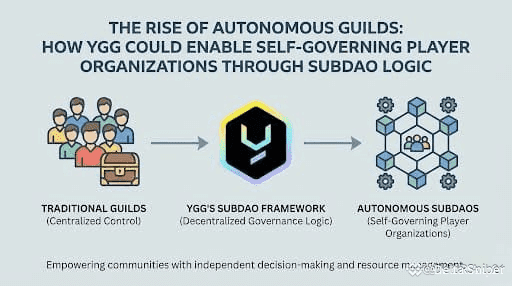
The evolution from centralized guild managers to autonomous SubDAOs mirrors a macro shift in digital economies: a move from platform-controlled ecosystems to community-owned, system-driven environments.
YGG is not just enabling this transition—it is constructing the governance architecture and economic logic that make it inevitable.
Professional Thought of the Day
Communities gain real influence when governance becomes collective, transparent, and economically aligned. In Web3, governance is not an accessory—it is the value engine that reshapes entire ecosystems.
@Yield Guild Games #YGGPlay $YGG
