

For years, professional gamers have built real skills in environments that reward precision, discipline, and decision-making under pressure. Yet those skills have often struggled to translate outside of competition. The rise of on-chain organizations is quietly changing that equation, and few groups have explored that transition as deliberately as @Yield Guild Games 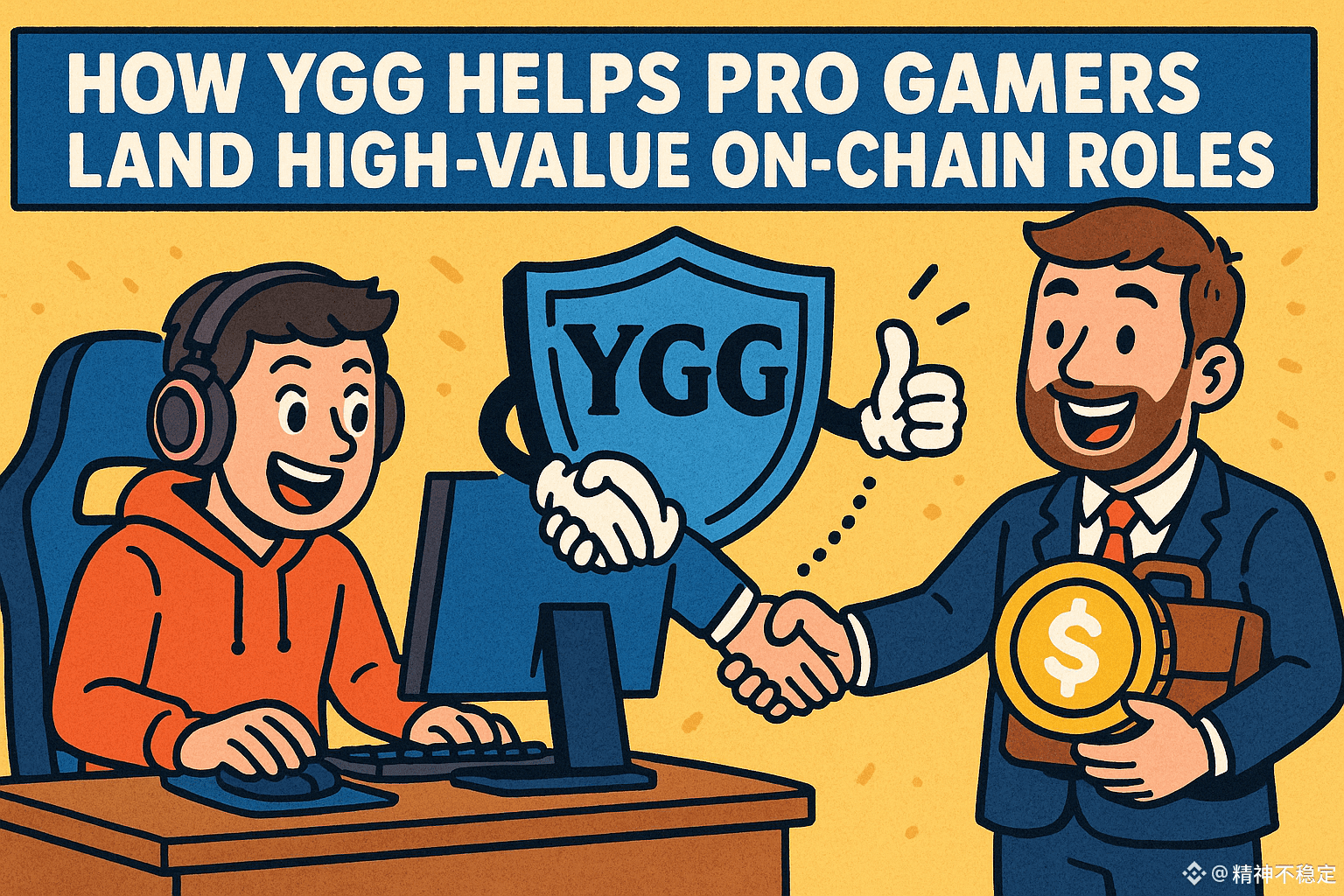
YGG began as a guild built around play, but its evolution reflects a broader truth about gaming culture. High-level players already operate like decentralized teams. They coordinate across time zones, adapt to shifting metas, analyze data obsessively, and make economic decisions in live environments where mistakes are costly. On-chain ecosystems recognize those abilities in a way traditional employers rarely have. Smart contracts, DAOs, and tokenized systems turn participation into visible, verifiable work. For gamers used to grinding leaderboards, this kind of transparency feels familiar rather than foreign.
What YGG offers is not a shortcut into web3 careers, but a proving ground. Many gamers enter the ecosystem thinking success means winning tournaments or farming assets. Over time, the more observant ones notice something else happening. Guild operations require logistics, treasury awareness, governance participation, moderation, data tracking, and trust. These needs create roles that go far beyond play, and they are roles where top players already excel because they understand systems, incentives, and human behavior inside them.
One reason YGG has been effective is its insistence that responsibility comes before status. On-chain work leaves an immutable record. Votes are public. Proposals are traceable. Wallets reflect decisions. For gamers who grew up with match histories and stat pages, this visibility makes sense. It rewards consistency and reputation rather than credentials. A player who demonstrates sound judgment in community governance or economic strategy builds proof the same way they did in ranked play through results.
Pro gamers also tend to be unusually fluent in risk. They understand variance, probability, and timing intuitively. In volatile on-chain environments, this mindset matters. YGG members who transition into roles around treasury management, asset allocation, or analytics are not guessing blindly. They approach these systems with the same measured confidence they once brought to high-stakes matches, aware that patience and discipline often matter more than speed.
Another overlooked advantage is communication. Professional play requires clarity in chaotic situations. Shot-calling, coaching, replay analysis, and team leadership all mirror the demands of DAO coordination. When YGG contributors step into roles managing subDAOs, partnerships, or regional communities, they are drawing from years of experience aligning people around shared goals under pressure. The difference is only the interface, not the skill.
YGG’s structure also exposes gamers to something most never encounter early in their careers: ownership. Tokens are not just compensation. They are responsibility.
Having a voice in decisions pushes contributors to look beyond personal gain and care about the whole community. Players move from just using the game to helping support it.Importantly, YGG does not pretend that gaming alone qualifies someone for on-chain roles. The transition requires learning. Governance frameworks, legal constraints, security practices, and economic models are not intuitive. What YGG does well is contextualize those lessons within environments gamers already understand. Instead of abstract education, learning happens through participation. Mistakes are visible, sometimes expensive, but instructive in a way few classrooms can replicate.
The result is a talent pipeline that feels organic. Some contributors move into analytics, tracking player behavior or protocol performance
Others take roles in community management, partnerships, or esports work. Some act as a link between players and developers by testing games and giving feedback. Each path reflects a different expression of the same underlying skill set that competitive gaming forged.
What makes these roles high-value is not just compensation. It is leverage. On-chain work compounds reputation quickly. A single well-reasoned proposal or successful initiative can open doors across the ecosystem.
Many pro gamers are judged only by their mechanics, so being recognized for more than that can be life-changing.
YGG shows that gaming can lead to real professional skills, not just wins and losses. And it’s fine if some players choose a different direction.
YGG proves that gaming can prepare players for real careers. Not everyone will follow that route, and that’s perfectly fine But for those who do, the line between play and work is becoming less rigid, more honest, and more demanding in the right ways.
In that sense, YGG is less about turning gamers into web3 workers, and more about revealing what they already were. Systems thinkers. Coordinators. Strategists. People comfortable operating in transparent, high-stakes environments where trust is earned slowly and lost quickly. On-chain ecosystems did not invent these skills. They finally gave them somewhere to land.
@Yield Guild Games #YGGPlay $YGG

