

Bitcoin (BTC) reclaimed $92,000 on Tuesday, as the market rebounded following Monday’s dramatic collapse. The flagship cryptocurrency reached an intraday high of $92,291 on Monday before pulling back to $90,653, a move analysts attributed to FOMC meeting jitters. BTC is marginally up during the ongoing session, trading around $92,714.
The flagship cryptocurrency has started December in positive territory, with momentum driven by a rate cut following the FOMC meeting, and Strategy’s latest purchase of $960 million worth of BTC, its largest in months.
Bitcoin (BTC) Edges Higher But Faces Resistance
BTC reclaimed $92,000 late on Tuesday as the market braced for the Federal Reserve’s decision on interest rate cuts. A rate cut could boost risk assets, but a hawkish stance could see Bitcoin and other cryptocurrencies retreat, jeopardizing the crypto market’s recent recovery. For now, an improving market sentiment has driven the Fear & Greed Index up to 30, pushing it out of the “extreme fear” zone. $429 million in liquidations suggested that traders were adjusting positions before the FOMC decision. Open interest jumped to $133 billion, while the market’s RSI remained in neutral territory at 51.
The Federal Reserve’s decision is expected at 2:00 p.m. ET (4:00 p.m. UTC). Market experts and investors are almost certain of a 25bps rate cut. If confirmed, the rate cut and a dovish dot plot that predicts several rate cuts in 2026 would significantly enhance market liquidity. Such a scenario could push BTC past $95,000. However, leveraged short positions getting liquidated could also trigger volatility.
CryptoQuant analysts highlighted that Bitcoin tends to make uneven moves around rate cuts. The flagship cryptocurrency reached a four-week high following September’s rate cut before dropping nearly $2,000.
Upbit To Store User Assets In Cold Wallets
Bybit will begin storing all customer assets in cold storage after a $30 million hack drained its Solana hot wallet. The exchange’s parent entity, Dunamu, said it will increase user funds held in cold wallets to 99%, cutting customer asset exposure to nearly 0%. The move also sees the exchange comfortably comply with South Korea’s Virtual Asset User Protection Act, which mandates exchanges keep 80% of user funds offline.
“South Korea’s largest crypto exchange, Upbit, has announced it will increase the proportion of user assets stored in cold wallets (offline) to 99%, reducing the hot wallet proportion to 0%, following the theft of 44.5 billion KRW from its hot wallet by hackers. – Wu Blockchain”
Dunamu disclosed that Upbit held 89.33% of customer funds in cold storage at the end of October 2025, with only 1.67% held in hot wallets. According to data from lawmaker Heo Young, Upbit maintains the lowest share of customer funds in hot wallets, while rival platforms keep their cold wallet share between 82% and 90%.
Bitcoin ETF Demand Continues
Spot Bitcoin ETFs recorded $352 million in inflows last week, accounting for almost half of all crypto ETF inflows, according to data from CoinShares. In more good news for investors, CoinShares data also revealed waning interest in products that short BTC.
“Short-Bitcoin products saw outflows of $18.7 million, the largest since March 2025. At that time, outflows coincided with a similar price low, suggesting that ETP investors believe the current bout of negative sentiment may now have reached its bottom. – James Butterfill, CoinShares’ head of research.”
In total, crypto-related ETFs and investment products recorded $176 million in inflows last week. While assets under management have fallen substantially from their $264 billion peak, data reveal the market is rebounding. Butterfill added that small outflows on Thursday and Friday were likely in response to broader macroeconomic data highlighting ongoing inflationary concerns.
“Daily data highlighted minor outflows on Thursday and Friday in what we believe was a response to macroeconomic data in the U.S. alluding to ongoing inflationary pressures. Total assets under management have risen by 7.9% from their November lows to $180 billion, but remain well below their all-time high of $264 billion.”
Meanwhile, Fidelity’s FBTC registered $199 million in net inflows on Tuesday, as US spot Bitcoin ETFs recorded $151 million in inflows. Several other ETFs, including Bitwise’s BITB, ARK Invest’s ARKB, Invesco’s BTCO, Franklin Templeton’s EZBC, and Grayscale’s GBTC, also recorded inflows. However, BlackRock’s IBIT recorded over $136 million in net outflows.
Bitcoin (BTC) Price Analysis
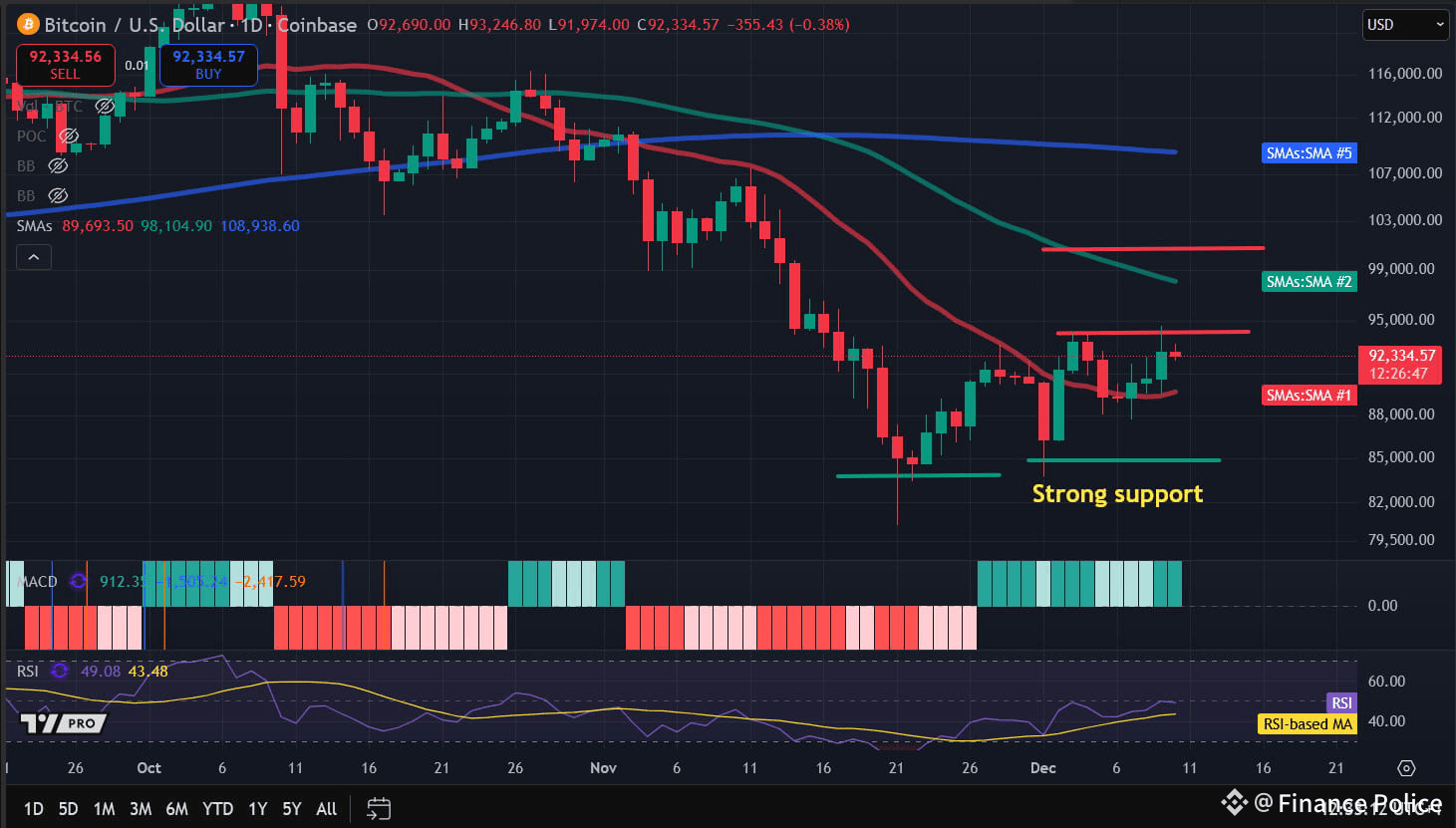
Bitcoin (BTC) reclaimed $92,000 on Wednesday, reaching an intraday high of $94,640. However, selling pressure at upper levels, as indicated by a long upper wick. As a result, the flagship cryptocurrency settled at $92,690. The price is marginally down during the ongoing session, trading around $92,359.
Analysts have described the current market sentiment as “cautiously optimistic” amid expectations of a 25 bps rate cut at the end of the FOMC meeting. However, CME’s FedWatch and Polymarket are showing rising odds that Fed Chair Jerome Powell could pause cuts in January as the Fed attempts to achieve a delicate balance between containing inflation and a cooling labor market. Coin Bureau co-founder and investment analyst Nic Puckrin stated in a note,
“If Powell does indeed deliver a hawkish speech, the likelihood of a Santa rally for Bitcoin diminishes.”
Meanwhile, Binance founder Changpeng Zhao has predicted a crypto “supercycle” in 2026. During a discussion with senior economist and Euro Pacific Asset Management founder Peter Schiff, Zhao predicted Bitcoin could post a significant rally in 2026, potentially matching gold’s 60% year-to-date performance. Another indicator, the Bitcoin hash ribbon, is flashing green, indicating a favorable entry point for market participants.
Analysts also expect crypto to rally once President Trump announces his pick for Fed Chair Jerome Powell’s replacement. Powell’s term as Fed Chair ends in May.
According to the daily chart, BTC is attempting to break out of a multi-week descending trendline. A jump in trading volume indicates buyers are re-entering the market, pushing prices higher. The MACD is also flashing bullish, while the RSI is at 48, giving BTC plenty of room to rally.
BTC began the month with a sharp drop to $83,800. It recovered to settle at $86,282, ultimately dropping 4.52%. The flagship cryptocurrency recovered on Tuesday, rising nearly 6% to reclaim $90,000 and settle at $91,308. Buyers retained control on Wednesday as BTC rose 2.35% to $91,308. However, it lost momentum on Thursday, dropping 1.46% to $90,093. Selling pressure intensified on Friday as BTC fell almost 3%, slipping below $90,000 to $89,345.
Source: TradingView
BTC started the weekend with a marginal decline on Saturday. Volatility returned on Sunday as BTC reached an intraday high of $91,779, fell to an intraday low of $87,733, before reclaiming $90,000 and moving to $90,402. Buyers retained control on Monday as the price reached an intraday high of $92,291 before settling at $90,653. Bullish sentiment intensified on Tuesday as BTC rose 2.25% to $92,690. The price is marginally down during the ongoing session, trading around $92,325.
Disclaimer: This article is provided for informational purposes only. It is not offered or intended to be used as legal, tax, investment, financial, or other advice.
