

The Federal Reserve (Fed) conducted its third rate cut of the year as the market expected, but the internal divisions behind this policy adjustment are unprecedented. The Federal Open Market Committee (FOMC) passed the rate cut of 0.25 percentage points with a vote of 9 to 3, lowering the benchmark interest rate range to 3.5% to 3.75%. Although this is seen as a 'hawkish rate cut', the Fed simultaneously released a highly cautious stance towards further easing in the future, and market expectations for rate cuts next year are rapidly cooling.
Three officials opposed the resolution, revealing internal fissures within the Fed.
The voting results of this meeting marked the first time since September 2019 that three officials cast dissenting votes, reflecting a high level of inconsistency regarding the policy direction. The 'dove' position held by board member Stephen Miran supported a 0.5 percentage point rate cut, while the steadfast 'hawk' position was represented by Kansas City Fed President Jeffrey Schmid and Chicago Fed President Austan Goolsbee.
Miran is set to leave office in January next year, marking his third consecutive time voting 'no', while Schmid has voted against the rate cut for the second consecutive time, further indicating a clear internal division within the Fed on interest rate policy.
The wording of the 'business as usual' statement returns to the tone of 2024, hinting at a pause in rate cuts.
In the post-meeting statement, the Fed revisited the language from December 2024: 'When considering whether to further adjust the target range for the federal funds rate, the committee will carefully assess new data, economic outlook, and risk balance.' This wording was interpreted by the market at that time as a precursor to pausing rate cuts, and indeed, rates were not cut again until September 2025.
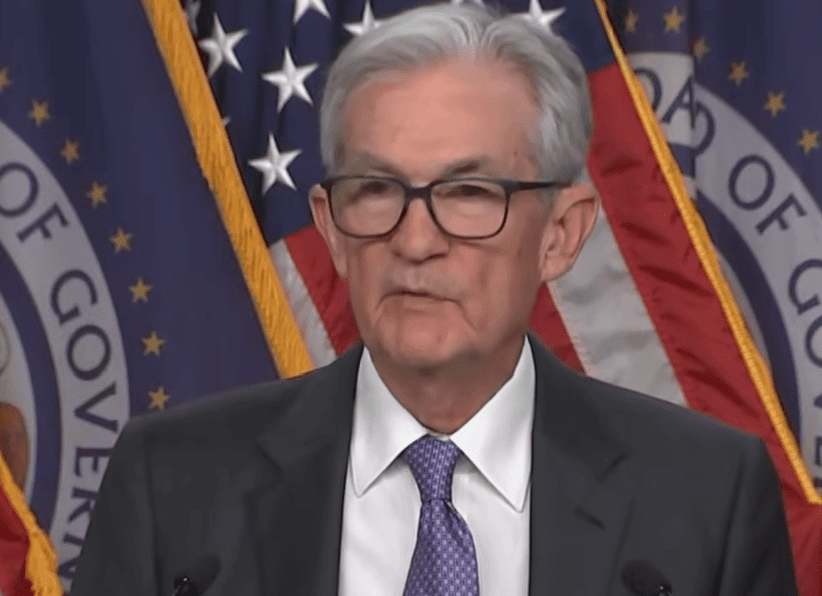
Chairman Powell pointed out at the press conference that this rate cut has put the Fed in a 'good position' on interest rate policy and that they can now observe economic changes before deciding whether to adjust.
U.S. stocks are rising, the bond market reacts flatly, and the market digests the expectation of the 'last rate cut'.
After the interest rate decision was announced, U.S. stocks reacted positively, with the Dow Jones Industrial Average rising nearly 400 points. However, the bond market reacted flatly, with long-term U.S. Treasury yields nearly unchanged, indicating persistent market doubts about the future policy direction.
The focus randomly shifts to the policy space after 2026. According to the latest released interest rate forecast 'dot plot', officials generally expect only one more rate cut in 2026 and only one adjustment in 2027, with the long-term interest rate target maintained around 3%. This is consistent with the September forecast but further highlights internal divisions: 7 officials do not believe there should be a rate cut in 2026, and 4 non-voting officials also expressed 'soft opposition' to this decision.
Economic data: GDP forecast revised up, inflation still above target.
In terms of economic outlook, the FOMC has raised its GDP growth forecast for 2026 from the original 1.8% to 2.3%, showing increased confidence in economic resilience. However, the outlook for inflation remains pessimistic, with expectations that it will not fall back to the Fed's set 2% target until before 2028.
According to the latest data from September, the Fed's preferred core inflation indicator still has a year-on-year growth rate of 2.8%, which, although far below the peak inflation period, remains above the target range.
Unexpected increase! The Fed resumes bond purchasing to address short-term funding pressures.
In addition to the interest rate adjustment, the Fed also announced that it will begin repurchasing government bonds starting this Friday, with the first round purchasing $40 billion in short-term government bonds, expecting to maintain a high bond-buying scale for several months before gradually reducing it.
This move echoes the 'stop balance sheet reduction' policy mentioned in the October meeting, primarily due to growing concerns about pressure in the overnight funding market. The Fed's action is seen as an emergency measure to release liquidity and stabilize funding.
With Powell's term counting down, the market is focused on who will succeed the Fed chair.
The Fed is currently in a sensitive period regarding policy and personnel. Powell has only three more FOMC meetings before ending his second term, and President Trump has clearly stated that he will use 'a tendency towards low interest rates' as a criterion for appointing the new chair.
The market generally bets that White House National Economic Council Director Kevin Hassett will become the next Fed chair. As of Wednesday morning, the Kalshi platform shows his nomination probability at 72%. Other competitors like former Governor Kevin Warsh and current Governor Christopher Waller have far less support.
The government shutdown affected decision-making, and the Fed is proceeding under 'incomplete information'.
It is worth noting that the Fed has made decisions in recent months in the absence of sufficient data. The U.S. government previously caused delays or omissions of several key economic data due to the shutdown, and data was only gradually supplemented after the government resumed on November 12.
Although the Fed has observed a 'low hiring, low layoffs' phenomenon in the labor market from existing data, according to the report from Challenger, Gray & Christmas, as of November, U.S. companies have announced layoffs of over 1.1 million people, casting a shadow over the job market for the coming months.
This article discusses the Fed's timely 'hawkish rate cut', with internal divisions widening, and only one more cut anticipated in 2026. It first appeared in Chain News ABMedia.