
In the swirling world of crypto, Injective (INJ) has quietly built something revolutionary. Dazai wants to walk you through how Injective is turning decentralized finance into a speed-demon playground — where high-frequency trading (HFT) is no longer the domain of shadowy firms on centralized exchanges, but something any savvy trader can do — on-chain.
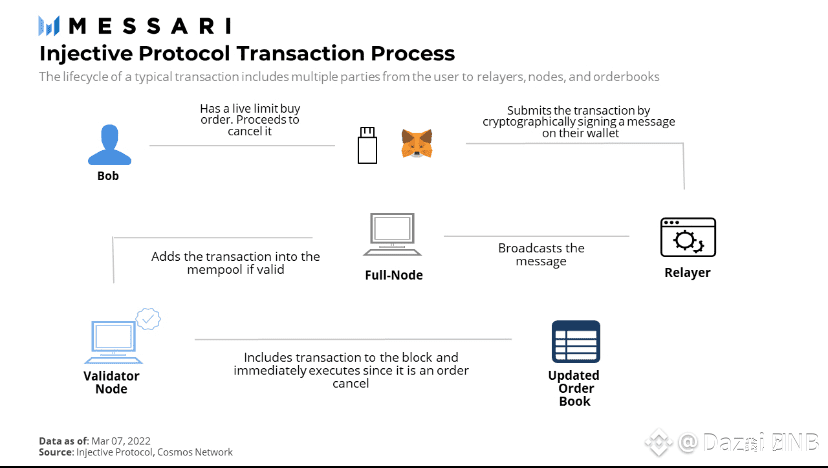
At its core, Injective is not just another blockchain. This is a Layer-1 network engineered from the ground up for speed, flexibility, and financial-grade trading infrastructure. Unlike many decentralized platforms that rely on automated-market-maker (AMM) models, Injective offers a proper on-chain order book and matching engine — more like traditional trading systems, but fully trustless and open
What that means for high-frequency fanatics: orders can be placed, changed, canceled, matched — all at near-lightning speeds — without relying on middlemen. This alone closes a major gap between traditional exchanges and DeFi. But Injective doesn’t stop there. Underneath the hood the chain is optimized to process huge throughput: block times are ultra-fast (sub-second times) and transaction fees remain negligible, creating a low-latency, high-performance base suitable for HFT strategies.
A new era of algorithmic trading
For traders who want automated strategies — bots that sniff arbitrage, capitalize on order-book dynamics, or scan funding-rate disparities — Injective just built the infrastructure to make it possible. The recently released Injective Trader framework does the heavy lifting. It handles everything from order placement to risk controls, live-market monitoring, logging and analytics — letting traders deploy custom logic and execute across multiple markets simultaneously with minimal manual interference
Combine that with integration support for third-party bot engines (traders using Python or Go, for example), and suddenly what used to require decades-old infrastructure becomes accessible to a wider audience.
Now imagine arbitrage bots flipping between derivatives and spot markets, market-making bots posting bids and asks every few milliseconds — all running on a decentralized blockchain with transparent order books. That’s Injective’s promise.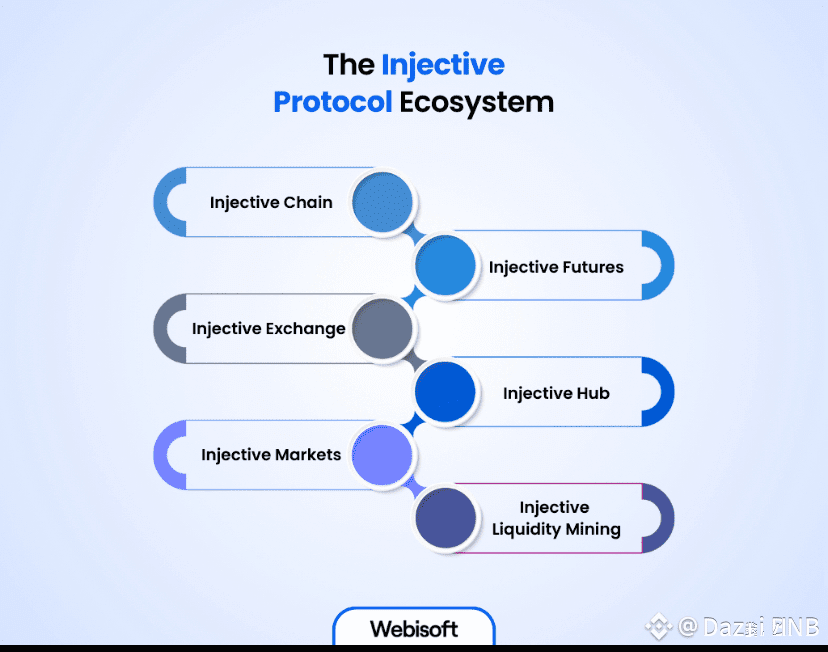
Ecosystem upgrades fueling growth
But dazai isn’t blind to the bigger picture. Injective’s potential doesn’t rest solely on fast trading. It’s also making moves on governance, tokenomics, and broadening access — moves that could reshape how institutions view DeFi. The network supports cross-chain margin trading, futures, forex, and derivatives, giving traders a full suite of tools under one decentralized roof.
It also has multi-VM support: developers can build with native CosmWasm or Ethereum-compatible environments, while the chain itself boasts optimizations for sub-second block times and ultra-low fees — the kind of performance that institutional trading demands.
What’s been going on with INJ lately
In recent months the spotlight on Injective has grown brighter. On December 8, 2025, INJ surged over 5% to roughly $5.85, fueled by a volume spike and broader crypto-market rebounding. Part of that momentum came from integration with DexTools, exposing Injective’s ecosystem to millions of users and making it easier for traders to monitor assets and move in.
There’s also a big push from institutions: reports surfaced that firms like Pineapple Financial initiated a $100 M strategy focusing on INJ, acquiring hundreds of thousands of tokens to stake on-chain — illustrating that real money is starting to take INJ seriously.
Meanwhile, INJ’s tokenomics are evolving: the project completed its first community-led buyback and burn of 6.78 million tokens (roughly $32 M) — a deflationary step meant to reward holders and potentially reduce supply over time
On the product and infrastructure side, the recent shift to a gas-free or near-zero-fee model on its native exchange — removing a common DeFi friction — is helping traders move faster and cheaper, which again plays right into the strength of HFT.
Challenges on the horizon
Dazai knows: it’s not all rainbows. Many analysts still view INJ’s technical outlook as cautious at best. Some forecasts predict modest gains for the near term — the token appears range-bound between roughly $5.5 and $6, maybe inching toward $8 if things break right
There’s also macro-risk: broader crypto volatility, regulatory uncertainty, and competition — both from other Layer-1 blockchains and centralized venues — could all stifle Injective’s momentum. And as always, automated trading isn’t a guarantee. Bots may fail, liquidity may waver, and in a bear market even the slickest infrastructure can’t save traders from sharp losses.
Why Injective might be the DeFi game-changer
Still, dazai believes what makes Injective special is that it bridges the gap between traditional finance speed and decentralization transparency. For the first time, DeFi users can deploy complex algorithmic strategies on-chain — arbitrage bots, market-making bots, derivatives bots — and trust the blockchain to execute with lightning-fast consistency
If the ecosystem keeps evolving — more integrations, more institutional interest, more developer activity — Injective could become a hub for the next generation of DeFi trading. Not just for hodlers or average retail users, but for serious traders who think in milliseconds and live for volume
Final word
Injective is more than a token. It’s a high-frequency trading engine disguised as a blockchain. For anyone who has ever felt frustrated by slow block times, high gas fees, or messy liquidity, Injective offers a glimpse at what DeFi could be: fast, efficient, hyper-connected, and open to anyone with a wallet and a strategy. Dazai sees rails built for speed — and maybe, just maybe, a future where on-chain HFT isn’t just possible, but preferred.

