Four in the morning, I can't sleep, I open the chart $AT - and the first thing I see is a drop of almost thirteen percent for the day. Price 0.1120, while the maximum was 0.1312. It's painful to watch, I won't lie. But you know what shocked me even more? The volume. More than five hundred million tokens have passed in a day. This is not just a panic sell-off, it's something else. Someone is selling, but someone is clearly buying during this drop. And here I am, looking at these red candles and thinking - maybe it's in moments like these that the best opportunities are born?
Let's be honest - oracles are the most boring topic in crypto. Everyone wants to discuss meme coins, new blockchains, revolutionary protocols. But oracles? Ugh, uninteresting. It's like discussing the plumbing in a house - no one wants to, but without it, the whole house becomes uninhabitable. And here @APRO-Oracle is dealing with these "pipes" of the crypto industry, only instead of water, information flows through them.
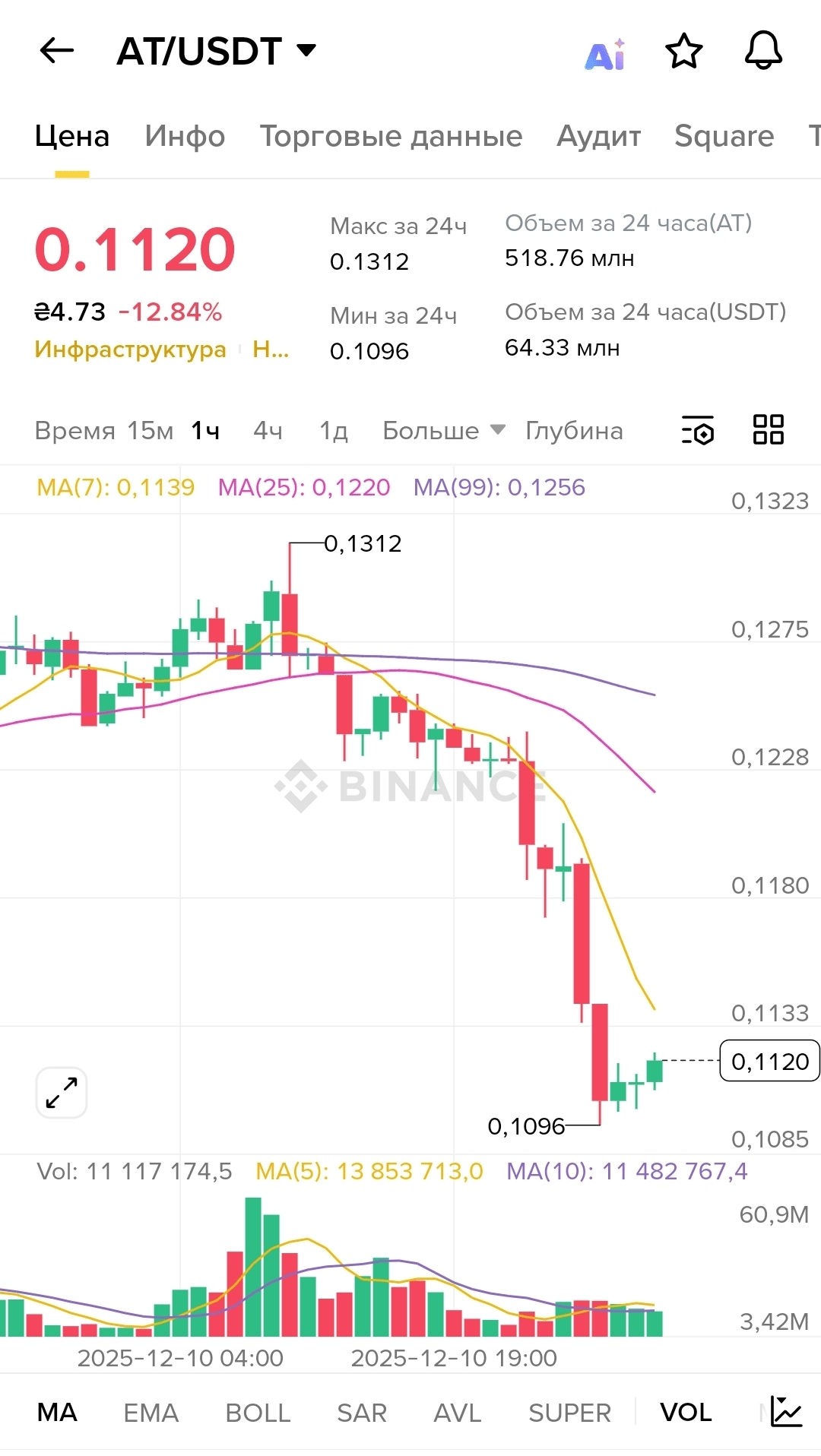
I look at the technical indicators - the weekly moving average at 0.1139, the monthly at 0.1220, the long-term at 0.1256. The price has broken all three downwards. This is a bearish signal, no options here. The volume chart shows spikes in activity - someone clearly exited with large positions. Maybe early investors are locking in profits. Maybe they know something I don’t. Or maybe it’s just panic, as is usually the case in crypto.
I remember a conversation with a developer friend a few months ago. He was working on a project for prediction markets, and the main headache was oracles. "You understand," he said, "my smart contract is useless if the oracle gives incorrect data. One glitch - and everything goes to hell." And this is a fundamental problem for all decentralized finance. How to get data from the real world into the blockchain reliably and securely?
Chainlink solved this problem first and captured the market. Now everyone uses Chainlink because it is tried and true. But here’s the catch - being first does not mean being the best. Chainlink is expensive, slow in some scenarios, and most importantly - too centralized for what should be decentralized infrastructure. It’s like if the whole internet depended on one company. It works, but it’s fragile.
And here #APRO comes along and says - listen, maybe it’s time to stop depending on a single solution? Maybe we can build an alternative that will be cheaper, faster, and more decentralized? Ambitious. Very ambitious. Because competing with Chainlink is like a young boxer stepping into the ring against a world champion. The technique may be better, but the experience and reputation of the champion is a huge advantage.
I think about why the price has dropped so much. Maybe the market doesn’t believe that APRO can compete with the giants. Maybe there’s an overall bearish sentiment in crypto. Maybe there are some news that I missed. Or maybe it’s just classic crypto volatility, where the price moves plus or minus thirty percent without any particular reason.
But here’s what’s interesting - the volume indicates that interest hasn’t disappeared. Over sixty million dollars in volume in a day - this is not a dead project. Someone is actively trading, someone clearly sees value in this. I look at the volume chart below - huge green bars are visible around the drop. These are purchases on the dip. Smart money or desperate speculators? Time will tell.
I remember the investment concept - "be greedy when others are fearful, and fear when others are greedy." Right now is clearly a time of fear. The chart is red, all moving averages have been broken downwards, panic is in the air. This is the moment when long-term investors buy, and short-term speculators sell in panic. The only question is - who is right?
I ponder the fundamentals. Does the market need alternative oracles? Absolutely. Chainlink's monopoly is a systemic risk for all decentralized finance. Can $AT become a serious competitor? Technically - yes, they have interesting solutions. But technology alone is not enough; they also need to attract developers, convince protocols to integrate, and build an ecosystem. This is years of work.
I look at the minimum for the day - 0.1096. Almost twenty percent off the maximum. This is a sharp correction. But if you look broader - we are still higher than we were a month ago, according to the long-term moving average. So this is a pullback within a broader upward trend. Or the beginning of a new downward trend? Technically fifty-fifty.
I think about the risks. The main risk is that they can build a great product, but no one will use it because everyone is already integrated with Chainlink and switching is expensive. This is a classic challenger problem - you need to be not just better, but SIGNIFICANTLY better for people to want to switch.
The second risk is that competition does not stand still. Chainlink is evolving, Pyth is gaining momentum, and other players are emerging. The oracle market is becoming crowded, and breaking through will be increasingly difficult. You need to find your niche where you are clearly better than others.
The third risk is technological. One serious bug, one leak of incorrect data that leads to losses in protocols - and reputation is destroyed. In oracles, there is no room for error. Chainlink has earned trust through years of stable operation. APRO must follow the same path.
But there are positive moments too. The market is growing, more blockchains are emerging, more protocols, and more data needs to be delivered on-chain. The pie is getting bigger, and even if Chainlink remains the leader, there will be enough space for other players. It’s not necessary to defeat the giant; it’s enough to occupy your profitable niche.
I recall the story with search engines. Google was not the first. Before it, there were Altavista, Yahoo, Lycos. But Google was better and ultimately won everyone over. Maybe @APRO-Oracle will become that "Google" in the world of oracles? Or will it go down in history as just another challenger that tried and failed? It’s impossible to know for sure.
I look at the chart once more - the candles continue to form, the price fluctuates in a narrow range after the drop. A classic consolidation after a sharp movement. Maybe a bottom is forming for a bounce. Maybe it’s a breather before the next wave down. Technical analysis provides probabilities, not guarantees.
I think about what I would do. Buy now on the dip? Risky, it may fall further. Wait for confirmation of a reversal? Safer, but you might miss the best prices. A classic trader's dilemma. There is no right answer; there is only a bet on your vision of the future.
If I believe that #APRO solves an important problem, that the team is strong, that the technology works, and that the oracle market will grow - then this dip is a gift. An opportunity to buy cheaper something that could be worth several times more in a year. If I don’t believe - then it’s better not to touch it at all, regardless of the price.
The hardest thing in crypto is to honestly answer the question "what do I really believe in?" It’s easy to believe when the chart is green and everyone around is shouting "to the moon." True faith is tested when the chart is red, everyone is in panic, and you need to make a decision - hold, buy, or sell.
I’m closing the chart, but thoughts remain. $AT right now in the moment of testing. The market is testing the project for resilience. Weak hands are exiting, strong ones are staying or even adding. In a few months, it will be clear who made the right decision. For now - only waiting, observing, and reflecting on the nature of risk, value, and faith in technology against market panic.