
Last week was Dubai Blockchain Week, where the 'Gold Bug' Peter Schiff had a debate with Binance founder CZ on the topic of (Bitcoin vs. Tokenized Gold). This article summarizes the viewpoints of both sides for your reference.
About the individuals:
1. Peter Schiff is a highly recognized and controversial investment advisor in the United States, who gained fame for accurately predicting the 2008 global financial crisis and is nicknamed 'Dr. Doom'. He frequently appears in mainstream media, such as guesting on CNBC and Bloomberg television, and hosts shows like (Wall Street Perspective) and (The Peter Schiff Show). He has authored several bestselling economics books, including (The Dollar Collapse), (Why Nations Fail), and (Economics of Small Islands).
2. CZ (Zhao Changpeng) doesn't need to be mentioned, everyone is very familiar, and he has even topped the list of the richest Chinese.
Regarding opinions: (streamlined version)
Peter Schiff:
Bitcoin is a 'tulip bubble', its value comes from 'the collective fantasy of speculators', and its essence is 'purely speculative assets', with the price relying entirely on 'the later buyers taking over'.
'No one prices goods in Bitcoin; merchants must exchange coins for fiat currency', it cannot serve as a unit of account, nor can it become a medium of exchange, with no actual application scenarios.
Bitcoin has 'zero value support, relying solely on confidence', while tokenized gold has physical backing, combining scarcity with the convenience of blockchain, supporting physical extraction or token transfer.
CZ:
Bitcoin is 'Gold 2.0 in the digital age', with a total supply of 21 million coins and transparent supply, while the gold reserve is unknown.
In terms of investment function: 1 kilogram of gold must be declared across countries, Bitcoin cross-border transfers arrive in seconds, liquidity is not on the same level; it already has hundreds of millions of users and a market value of 2 trillion dollars, with a stable ecosystem, definitely not a 'Ponzi scheme'.
In terms of monetary function: neither gold nor Bitcoin is better than fiat currency, and gold is even worse than Bitcoin. Bitcoin achieves 'seamless use' through products like the Binance card, with payment convenience far exceeding that of gold.
A few personal opinions:
This debate only discussed who is superior between Bitcoin and tokenized gold, and vaguely touched on 'is Bitcoin a bubble'. As the host, CZ is reluctant to say very intense things.
But in my view, Peter Schiff seems to oppose for the sake of hype. Because his viewpoint is that Bitcoin is a bubble, but he also wants to convince everyone that tokenized gold has value. It is very much like a person opposing imperial authority but wanting to sell the imperial sword from the previous dynasty at a good price.
In fact, Peter Schiff has promotional needs, and Binance also wants to make things more lively, so this debate has some performative elements. Before the debate started, Schiff had been 'attacking' Bitcoin for two months just to maintain the heat.
(The following are detailed contents of the debate)
——————————————————
1. The issue of physical gold
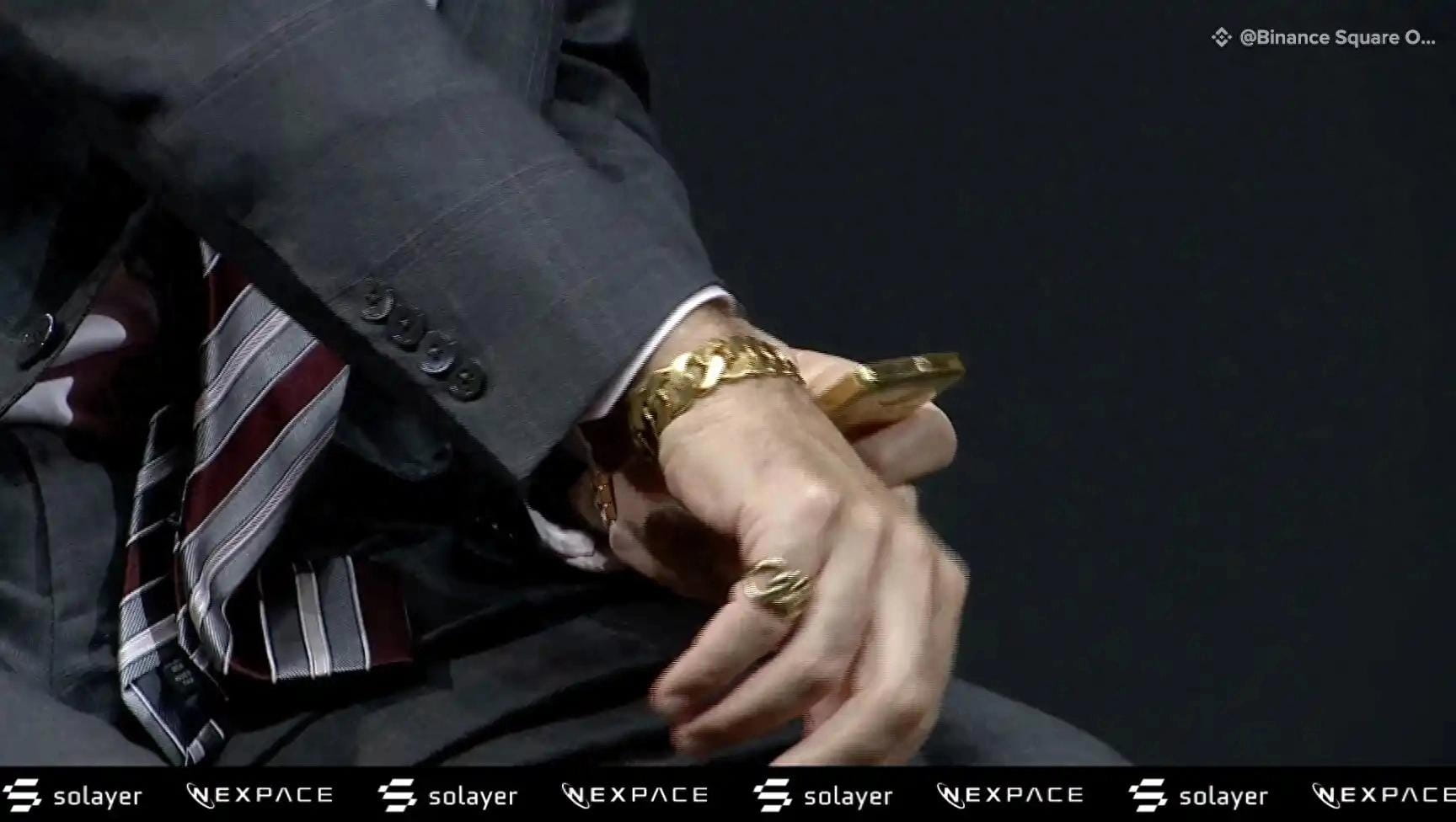
At the beginning, CZ directly took out physical gold, along with a national-level certification document, and discussed the certification issue of physical gold with Schiff:
Physical gold cannot be verified in trading scenarios. Even if CZ has a certification document, and even if Schiff's own bracelet is pure gold for comparison, it still cannot be identified as real gold and cannot be used for trading.
Even if it is verified as real gold, a whole gold bar cannot be divided, and fiat currency is still needed to make change. Because once a gold bar is cut, the backing of the mint is no longer valid, and the next person cannot identify whether it is real or not.
Even if gold is given to the other party, they cannot take it out of the country; complex reporting processes are required, and one must prove the legality of the source.
Based on this, Schiff took out a project for tokenized gold, saying that tokenized gold is equivalent to BTC in terms of verifiability and liquidity, while tokenized gold also has the 'eternal physical gold' backing:
No need to worry about authenticity issues, there are similar USDT backing mechanisms;
Can be divided into precise small portions for rapid circulation.
2. 'Intangible' virtual assets vs 'eternal' physical gold
So CZ threw out the accepted web2 to prove that virtual assets are also assets:
Twitter is valuable, Google is also valuable, so virtual existence can also have huge value as long as it has applications.
If we judge value based on whether it can be applied in the real world, then gold has very few applications, far less than coal, steel, etc. The value of gold should be very low. But in fact, because of its scarcity, gold's value is much higher than its applications. Bitcoin is the same.
The application of financial attributes, and eternal characteristics, are equally applicable to Bitcoin.
In Schiff's view:
Gold has physical and chemical properties that other metals do not possess; many industries must use gold, and it can maintain high value purely based on supply and demand.
Gold has another use, which is as a reserve asset for central banks. This also affects the market price of gold because central banks need it and must buy it on the market.
Gold from ten thousand years ago still exists today, so the price of gold reflects its present value for all uses from now to the future. Those goods that will rot or wear out cannot do this because they will ultimately disappear. But gold will not; it exists eternally.
3. Deep thinking about scarcity and monetary attributes
CZ:
The total amount of gold is uncertain; tomorrow a large gold mine may be discovered. Just like how synthetic diamonds can be made now, it may also be possible to create synthetic gold in the future. But BTC is already an eternal quantity written into code, with no variables, making it a better asset than gold.
Bitcoin represents a kind of currency innovation, a technological upgrade of an asset class. It has already been used as a reserve asset by some countries.
Economists have a very narrow definition of currency. Even if you can define currency very narrowly, the fact is that many people do treat it as currency.
Schiff:
Gold is considered an asset, so tokenized gold can be an asset; but if Bitcoin itself has no value, then the total supply limit is meaningless.
Bitcoin is not 'money' because it is not a commodity. By definition, money should be the most liquid commodity, but Bitcoin does not meet this condition. For example, if I ask you how much your salary was last year, you wouldn't tell me how many Bitcoins it was, but would only say how many dollars. Even your monthly salary is not a fixed number of Bitcoins, but a fixed dollar amount, which is then converted to Bitcoin at the end of each month based on the price.
If a country's currency depreciates, the central bank can sell gold and repurchase its own currency to support the exchange rate. But Bitcoin cannot do that.
4. Consensus of 300 million users vs 'greater fool' theory
The above definition of currency has already been a divergent discussion; returning to the question of BTC and tokenized gold, CZ proposed:
BTC does not require trust in any third party, but tokenized gold requires trust in third parties, which is even less than trusting government fiat currency;
Simply issuing tokenized gold is meaningless; it essentially needs someone to trust it, while BTC now has 300 million users who trust it.
And Schiff believes:
Their trust is all air; it is essentially similar to trusting casino chips. If that is the case, why not trust tokenized gold?
In the past four years, the price of Bitcoin has dropped from its peak, and its purchasing power relative to gold has decreased by 40%. This is because gold has real demand; whenever gold drops, someone will buy the dip. But the demand for Bitcoin is only because people 'want it'; once people are scared and do not believe it will rise in the future, that 'want' will disappear.
5. Payment practice and the 'cooperation space' between both parties
CZ:
The value of Bitcoin now has payment applications; because of Bitcoin, a user in Africa has shortened the settlement time from 3 days to 3 minutes.
In the future, the application of blockchain technology will be more widespread, and the most widespread and successful application of blockchain so far is still Bitcoin. Bitcoin, as a better asset than gold, will be accepted by young people as 'Gold 2.0'.
The Binance card already has hundreds of thousands of users who are using Bitcoin for payments; but so far, no one has used gold for payments.
Schiff:
Now Bitcoin is just a paper price. Once everyone tries to exit, the market will collapse immediately. Young people in the future will no longer believe in it.
Your card may be easy to use, but it does not pay with Bitcoin itself; you are selling Bitcoin to get dollars, then paying with dollars, which is no different from any debit card linked to a brokerage account.
Everyone treats Bitcoin as digital gold because gold has been stagnant for 12 or 13 years. But now gold has broken through the consolidation zone; I think Bitcoin will find it hard to compete.
