
Let’s put it this way, you have a job that pays 10,000 a month, but in the cryptocurrency contracts, if you have 10,000 in capital and do a 100x contract, as long as it goes up by 1%, you can earn 10,000, and if it goes up by 10%, that's 100,000, which is a year's salary in just a few minutes.
How many people earn more than 10,000 in salary? How many people have 100,000 a year?
In the cryptocurrency market, those who play contracts, besides the big funds opening small positions as spot traders, are experts.
There are only small-scale gamblers relying on leverage to get rich. In the cryptocurrency market, the fluctuations during extreme conditions can be 1-2% in a second, which is just luck. You can earn your monthly salary in a second, or even a year's salary in a few minutes.
Monthly salary: 3,000 yuan, annual income: 36,000 yuan, lifetime income: 1.44 million yuan.
Monthly salary: 4,000 yuan, annual income: 48,000 yuan, lifetime income: 1.92 million yuan
Monthly salary: 5,000 yuan, annual salary: 60,000 yuan, lifetime salary: 2.4 million yuan.
Monthly salary: 6,000 yuan, annual salary: 72,000 yuan, lifetime salary: 2.88 million yuan.
Monthly salary: 7,000 yuan, annual salary: 84,000 yuan, lifetime salary: 3.36 million yuan.
Monthly salary: 8,000 yuan, annual income: 96,000 yuan, lifetime income: 3.84 million yuan
Monthly salary: 9,000 yuan, annual income: 108,000 yuan, lifetime income: 4.32 million yuan.
Monthly salary: 10,000 yuan, annual salary: 120,000 yuan, lifetime salary: 4.8 million yuan
Monthly salary: 20,000 yuan, annual salary: 240,000 yuan, lifetime salary: 9.6 million yuan.
Monthly salary: 30,000 yuan, annual salary: 360,000 yuan, lifetime salary: 14.4 million yuan.
Monthly salary: 40,000 yuan, annual salary: 480,000 yuan, lifetime salary: 19.2 million yuan.
Monthly salary: 50,000 yuan, annual income: 600,000 yuan, lifetime income: 24 million yuan
Very few people earn more than 10,000 yuan a month, and even fewer earn more than 20,000 yuan a month. Most people earn less than 10,000 yuan a month. It feels like the money that ordinary people earn in their entire lives is only enough to buy a house!
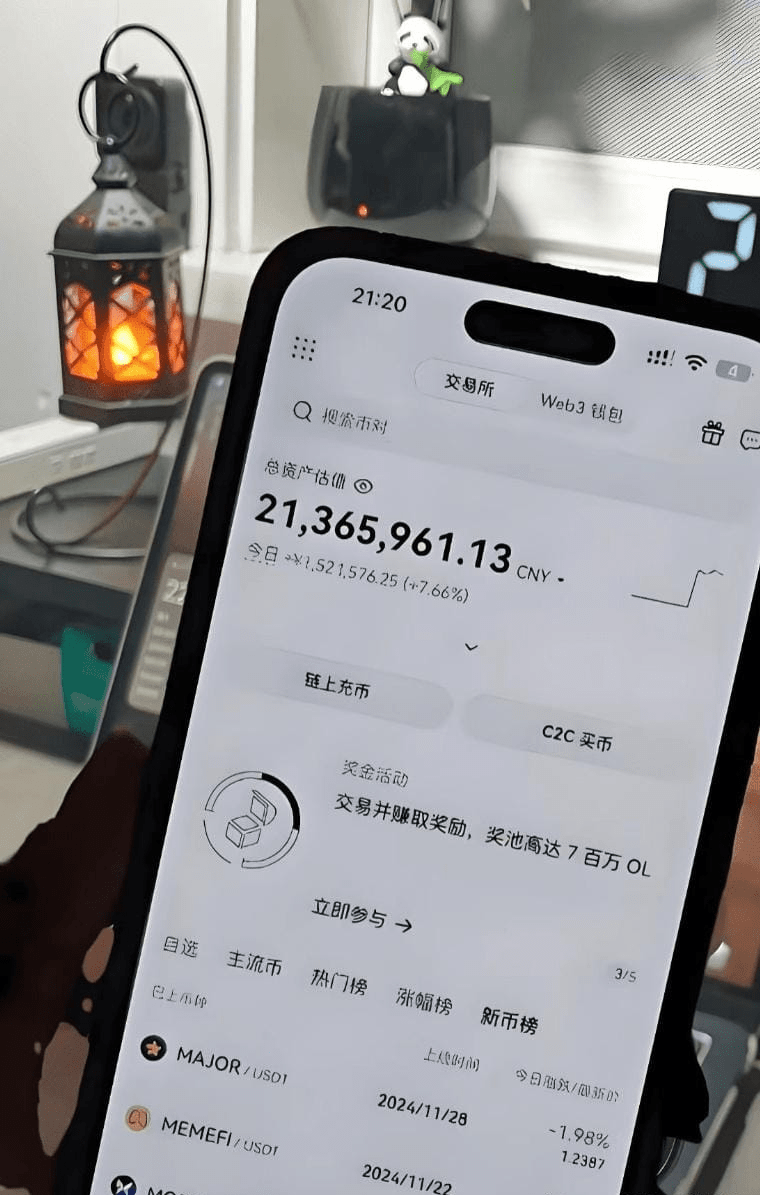 I entered the cryptocurrency world in 2013. In the first two years of trading, I made about 10 million yuan, with an initial investment of 10,000 yuan. I had never worked since graduating from university. I spent my days watching videos and recording data.
1. With an initial investment of 10,000 yuan, I worked on projects during university, including Taobao affiliate marketing, fake orders, express delivery, app boosting, and various small tasks, and saved up 10,000 yuan.
2. Entering the crypto market: I felt BTC was too expensive, so I focused on ETH, which offered leverage, and then altcoin spot trading. Coin selection...
Manage your positions well. Stick to this simple approach: if the market is bad, take a small loss; if the market is good, make a killing.
Why enter the circle?
If you want to change your destiny, you must try the cryptocurrency world. If you can't get rich in this world, then ordinary people will never have a chance in their lifetime.
I'd like to share my cryptocurrency trading strategy with you:
Many people start trading contracts with only 10,000 USDT (approximately 1400 USDT), thinking, "My capital is small, so I'll just go for it." But the truth is: the smaller the capital, the more crucial position management becomes. Larger capital can be sustained over time, but smaller capital relies entirely on discipline. Otherwise, a single margin call will force you to rebuild your "faith" from scratch.
The following method is suitable for contract traders with capital between 5,000 and 20,000 RMB. The goal is not to double your money in a day, but to achieve low drawdown and steady growth.
 I used these four "simple" steps to consistently earn seven-figure profits in the cryptocurrency market.
By eliminating complex metrics and refusing to chase trends, simple discipline has led me to a path of consistent profitability.
I almost quit my job once, becoming obsessed with hundreds of technical indicators, AI bots, and social media signals, only to lose more money the harder I tried. Then I made the difficult decision to cut out all the fancy methods and stick to the core four-step approach.
This "simple method" has allowed me to consistently earn seven-figure profits in a highly volatile market since 2022. Today, I'll break down the framework of this strategy for you. Its core principle is—don't chase trends, don't gamble on news, and only trade market conditions that you understand.
Step 1: Let the market help you filter and leave behind the truly strong.
My first step in screening coins is very straightforward: I only look at those that have entered the "daily gainers list" in the last 11 days.
Popularity is the first hurdle to overcome before major players will pay attention. However, I won't blindly chase high prices; instead, I'll conduct a second screening: decisively eliminating coins that have experienced three consecutive days of decline.
A continuous decline, even if the chart looks good, likely indicates that major funds have withdrawn, leaving retail investors struggling to hold on. After these two rounds of screening, my watchlist is usually reduced from hundreds to twenty or thirty, saving time and effort, allowing me to focus only on truly promising stocks.
Step Two: Identify the major trends and only ride the wave.
After filtering out the candidate list, I don't rush to determine the buy or sell point. Instead, I switch to the monthly chart and only look at one indicator: whether the MACD has formed a golden cross.
A golden cross on the monthly chart indicates an upward trend, signifying a true bull market; an upward movement without a golden cross is likely just a rebound within a bear market. This step will cut my shortlist by about 70%, but significantly improves the win rate of the remaining trades.
I firmly believe that true masters don't predict the market; they simply wait for the trend to become clear before riding the wave.
Step 3: Patiently wait for the best hitting point
Even for cryptocurrencies I'm bullish on, I never buy blindly. My only entry signal is very clear: the price retraces to the 60-day moving average for the first time, and there are signs of increased trading volume.
The core of this strategy lies in the "first pullback"—it signifies a normal correction within a trend, not a trend reversal. Regarding position management, I employ an extremely cautious approach: ensuring that a single loss does not exceed 2% of total capital. Specifically, I work backward from the principle of "stop-loss at 5% loss" to determine how much capital should be invested. This way, even if the judgment is wrong, the loss remains within a controllable range.
Step 4: Sell strictly according to the tiered pricing strategy to protect profits.
My selling strategy was executed exactly as planned, eliminating any emotional interference: if the price rose by 30%, I sold 1/3 of my position to secure the profits. If it rose by 50%, I sold another 1/3 to further lock in the gains.
The remaining position will be sold off immediately if the daily closing price falls below the 60-day moving average.
The core of this tiered profit-taking method is that it avoids exiting too early and missing out on subsequent gains, while ensuring that most of the profits are safely secured. Remember, you can re-enter the market at any time after a drop, but a single margin call could force you out of the market forever.
My bottom line for money management
In addition to the core four-step strategy, I also have a few ironclad rules to protect my capital: hold no more than three stocks at the same time to avoid a chain reaction caused by black swan events.
If the maximum drawdown in a single month reaches 6%, immediately stop trading, leave the market and rest to prevent emotional trading from exacerbating losses. Allocate 50% of profits annually to stable assets to ensure that gains from a bull market are not wiped out during a correction. Surviving in this market long-term depends not on intelligence, but on the determination to adhere to discipline and the courage to accept the consequences.
Like most people, I used to believe that the more complex the method, the more effective it was. But now I understand that true profitability comes from the repeated execution of simple rules. Whenever I see market trends surging while I'm holding cash, I silently tell myself, "Better to miss an opportunity than make a mistake."
This method, while simple, requires immense patience and self-discipline. Hopefully, you can extract the useful parts and build your own stable profit-making system. In this market, longevity is the true measure of success.
Unveiling the Institutional Traders' Position Building and Hunting: Understanding Liquidity and Seeing Through How "Smart Money" Manipulates Prices
 Liquidity is fundamental to price fluctuations in financial markets, including stocks, futures, forex, and cryptocurrencies. It determines the efficiency of trade execution, affects market stability, and influences price volatility. Institutional traders (often referred to as "smart money") actively seek liquidity to execute large orders without causing significant slippage. To do this, they often target stop-loss points and liquidity pools used by retail traders.
Understanding how liquidity is formed and moves can help traders:
Identify high-probability trading opportunities.
Avoid common liquidity traps and false breakouts.
Identify how prices interact with liquidity pools ahead of major price movements.
This guide will break down key concepts of liquidity, including internal and external liquidity, liquidity zones, liquidity cleansing, and how institutions manipulate liquidity to achieve optimal trade execution.
Types of liquidity in the market
Internal liquidity
Internal Liquidity (IRL) forms within the current trading range. It represents the area where short-term traders place orders, for example:
Secondary support and resistance levels; intraday highs and lows; order blocks and consolidation zones.
External liquidity
External liquidity (ERL) lies outside the current trading range and typically appears at key swing highs and lows. This is where smart money seeks liquidity before initiating significant price reversals. External liquidity usually exists in:
Key breakout levels; near major institutional pricing areas; outside the previous trading day's high and low.
Traders should be aware that smart money often manipulates price behavior to first access external liquidity before initiating major price movements.
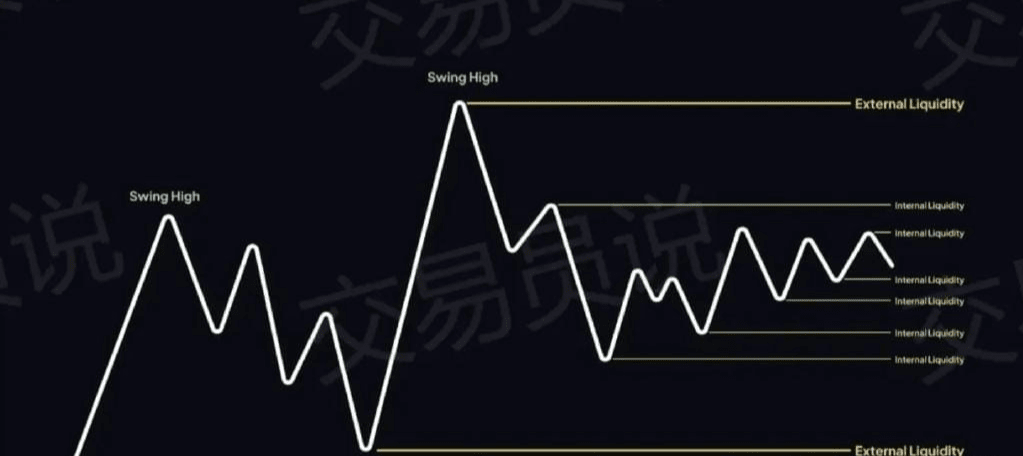 Liquidity Zones and Key Price Levels
Liquidity pools typically form at key price levels, where institutional investors often execute trades to achieve efficient order matching. The most important liquidity zones include:
Last month's high/low points (PMH/PML): a long-term liquidity pool that influences macroeconomic trends.
Last week's high/low (PWH/PWL): Liquidity levels frequently tested by retail and institutional traders.
Previous day's high/low (PDH/PDL): Important price levels for intraday traders, often used for intraday trading setups.
By monitoring these liquidity zones, traders can anticipate potential price reactions and avoid being caught in the trap of smart money.
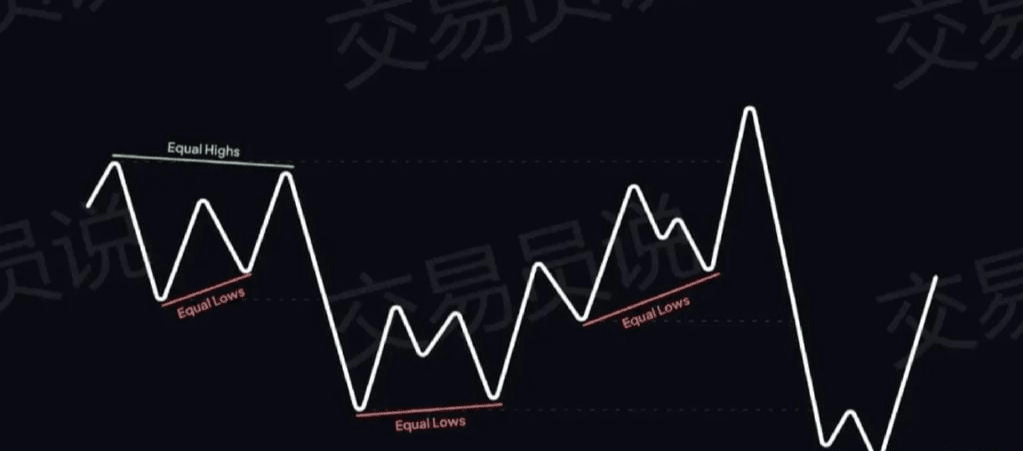
 Liquidity Clusters: Equal Highs and Equal Lows
When price action forms clear support and resistance zones on a chart, liquidity clusters emerge, leading to a concentrated distribution of stop-loss orders.
Equal Highs (EQH): A resistance zone where traders typically place stop-loss orders. Institutions often push prices above these levels to trigger liquidity before reversing downwards.
Equal Low (EQL): A support zone where stop-loss orders are concentrated below it. Smart money may sweep through these levels, triggering liquidity and pushing prices higher.
Understanding the existence of liquidity clusters helps traders avoid false breakouts and identify potential reversal points.
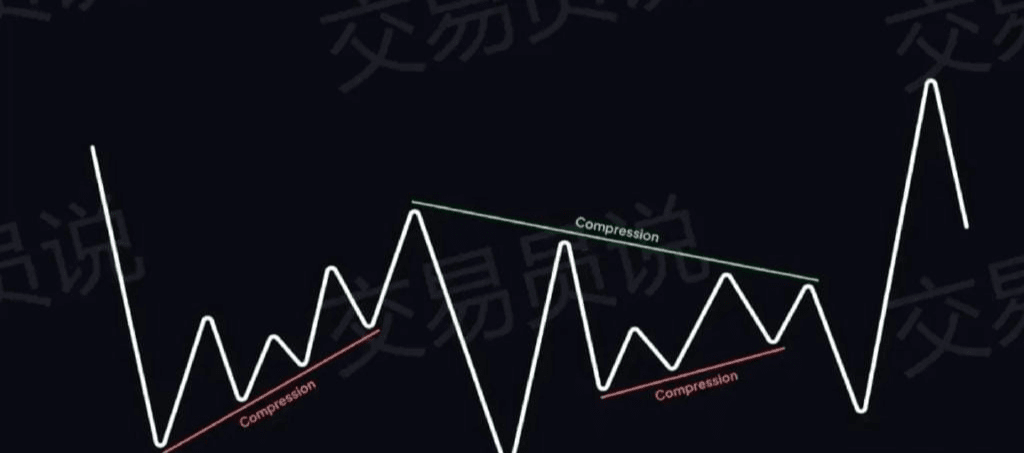
 Compression and Liquidity Accumulation
What is compression?
A compression pattern, also known as a low-resistance liquidity run (LRLR), refers to a price fluctuation within a narrow range, resulting in an accumulation of liquidity. This pattern is analogous to a "fuel zone" before an impending price surge.
How compression can lead to explosive market movements
When prices remain compressed for an extended period, buy and sell orders accumulate at both ends of the range. Once liquidity reaches a critical point, smart money executes large orders, triggering sharp price fluctuations. Traders should pay attention to the following signals:
Prolonged consolidation before a breakout; increased trading volume near key liquidity areas; price suddenly piercing one side of the range to clear liquidity and then reversing.
 Buyer and seller liquidity
Liquidity exists on both sides of the market, which are the areas where traders place orders.
Sell-Side Liquidity (SSL): Located below significant lows, these are areas where traders typically place stop-loss orders and buy orders. Institutions often sweep through these areas, triggering sell stop-loss orders before pushing prices higher.
Buy-Side Liquidity (BSL): Located above significant highs, this level is where stop-loss and sell orders are concentrated. Prices are often pushed to these levels to trigger these orders before reversing downwards.
Understanding where liquidity is located helps traders anticipate the next move of smart money.
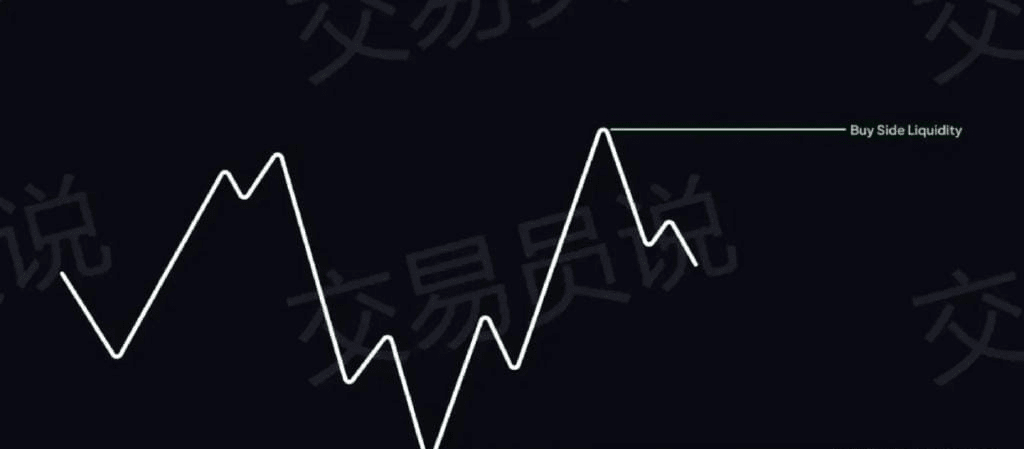 Liquidity cleanup and false breakout
A liquidity sweep refers to the phenomenon where prices briefly break through a key level to trigger stop-loss orders, only to quickly reverse course. Smart money uses this sweep to create liquidity for its positions.
Common false breakout scenarios:
Bull trap (false breakout to the upside): The price breaks through the resistance level, triggering buy orders, and then quickly reverses and falls. Institutions sell when liquidity is triggered.
Bear market trap (false breakout): The price falls below the support level, triggering sell orders and then rebounds quickly. Institutions buy when liquidity is triggered.
Identifying these patterns helps traders avoid falling into traps and improve the accuracy of their entry timing.
Liquidity and Institutional Manipulation in Trends
Liquidity plays a crucial role in trending markets. Institutional investors utilize liquidity pools to conduct large-scale position building or distribution operations before the trend continues.
Liquidity in an upward trend
When prices continue to rise, liquidity pools typically form below structural lows.
Smart money often creates false breakouts downwards to quietly accumulate long positions during market panic, and then push prices higher.
Liquidity in a downtrend
When prices continue to fall, liquidity pools form above structural highs.
Institutions may create a false breakout above the resistance level to lure in buyers, and then push prices down after liquidity is triggered.
How institutions manipulate liquidity
Create false breakouts to trigger stop-loss orders and create liquidity;
Using trend lines and key price levels to lure retail investors into a liquidity trap;
Complete the position building or distribution operations before the main trend begins.
By understanding these techniques, traders can follow the actions of institutional investors instead of getting trapped in the retail investor trap.
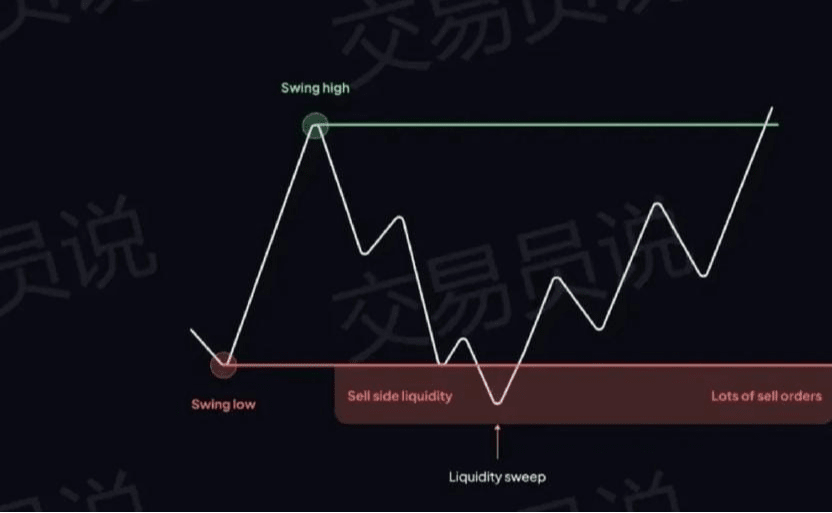 Using indicators to identify smart money patterns
Some software platforms have built-in "Smart Money Concepts" (SMC) indicators that can automatically mark swing points, order blocks, fair value gaps, and liquidity zones, helping traders save time and verify trading settings.
Simply make sure you are using the appropriate time frame (e.g., 4 hours or 1 hour) and adjust the parameters according to your strategy.
Comprehensive application: A basic smart money strategy
Here is an example of a simple trading strategy based on the smart money theory:
1. Identify trends
Use high-period charts to determine whether the market is currently in an upward or downward trend.
2. Mark band points
Plot the recent highs and lows to clarify the market structure.
3. Identify Key Areas of Interest (POIs)
Identify liquidity zones, fair value gaps (FVGs), and order blocks on the chart.
4. Wait for the price to enter a key area.
Let prices move to your target range on their own; don't chase highs or sell lows.
5. Look for entry confirmation signals
Confirmation can be achieved using price action signals, such as structural breakouts (BOS) or engulfing patterns.
6. Entry and Risk Management
Always use stop-loss orders and manage position size appropriately based on account size.
Trading Example (Entry to Go Long)
Timeframe settings
High-Temperature Scale (HTF): 1 hour or 4 hours, used to identify market structure and key areas.
Low-frequency (LTF): 5 or 15 minutes, used to find precise entry points.
Entry requirements
The fair value gap (FVG) is within the discount range of the high-cycle (HTF) price.
Observe structural shifts in the Low-Temperature Flow (LTF): A low point appears, and then the price breaks through the previous high point = an entry trigger signal.
Entry method:
Aggressive approach: Enter the market immediately upon a breakout.
Conservative approach: Wait for the price to retest the structural change before entering the market.
Stop loss and take profit settings
Stop loss: Set below the low of the last wave (with appropriate buffer).
First target (TP1): Internal liquidity or secondary resistance level.
Second target (TP2): Key liquidity areas (e.g., buyer liquidity areas on high cycles).
in conclusion
Liquidity is the core driver of market volatility and institutional trade execution. By understanding liquidity dynamics, traders can better:
Identify high-probability trading opportunities; avoid liquidity traps and false breakouts; understand the tactics of smart money and trade in line with its flow.
Instead of emotionally chasing price fluctuations, analyze liquidity behavior to anticipate potential price movements. Mastering liquidity principles will give traders a significant advantage, allowing you to interpret and trade price action with greater confidence and ease.
 The epiphany from a novice who suffered a margin call to a prudent trader
Staring at the screen full of red candlestick charts, my palms were so sweaty that they soaked the mouse – this was my daily routine seven years ago.
I remember my first experience with contract trading. I only had 6,000 USDT in my account, but I dared to open a 50x leverage account. In less than half an hour, my assets were halved. At that moment, it dawned on me: account liquidation is never a matter of luck, but rather a "death invitation" that high leverage hands up to novices.
Too many people enter the futures market with the dream of "getting rich quick," but they don't understand the true meaning of leverage. They think leverage is "return multiplied by a factor of two," but it's actually "risk multiplied by a factor of three." The harsher mathematical reality is: after losing 90%, you need to multiply your investment ninefold to break even—a feat comparable to building a rocket by hand.
Today, I want to share my survival experience, gained through hard-earned money, to help newcomers avoid the pitfalls I encountered over the years.
Leverage is not a magic wand for wealth, but an accelerator.
The greatest allure of contract trading lies in leverage, which is also its greatest pitfall. Leverage can amplify profits, but it also amplifies risks. For example, with 5x leverage, if the price of a coin rises by 2%, your profit will be magnified to 10%; however, if the price falls by 2%, your loss will also be magnified 5 times.
What many beginners don't understand is that the combination of high leverage and the high volatility of cryptocurrencies can lead to huge losses or even liquidation in a very short period of time.
Build your "survival system"
The key to my ability to go from continuous losses to consistent profits lies in establishing a complete trading system. This system not only includes the application of technical indicators, but also a strict risk control mechanism.
Practical Applications of Bollinger Bands
Most people know that Bollinger Bands consist of an upper band (resistance line), a lower band (support line), and a middle band (moving average line), but few truly understand their essence.
My Bollinger Bands trading strategy has three steps:
Narrowing Phase: When the Bollinger Bands narrow, it indicates that market volatility is compressing and the market is accumulating energy. This is an observation period, not an action period. Middle Band Slope: The slope of the middle band reveals the market's bullish or bearish bias. When the middle band slopes significantly upward, it suggests a potential upward trend.
Bollinger Bands widening with increasing volume: When the Bollinger Bands widen and are accompanied by increased trading volume, it indicates that market momentum has been activated, and this is a signal to consider entering the market.
Last August, ETH's daily chart showed six consecutive narrow candlesticks, with the Bollinger Bands extremely narrow and the middle band slightly upward sloping. I initiated a small position near the lower band, setting my stop-loss at the low point before the bands narrowed. Subsequently, the price of ETH surged directly to the upper Bollinger Band, resulting in a considerable profit in a single month. It wasn't that my prediction was accurate, but rather that the system transformed the chaotic market into a manageable probability game.
The Iron Law of Risk Management
Technical analysis is merely a tool; the true key to survival lies in rigorous risk management. I posted three ironclad rules next to my screen, which I still adhere to today:
1. Never lose more than 2% of your total capital in a single trade. If your account has 10,000 USDT, the loss on any single trade should not exceed 200 USDT. This ensures that even if you suffer 10 consecutive losses, you will still have 80% of your principal.
2. You can open a maximum of two positions per day. Frequent trading increases costs (such as transaction fees) and the probability of making mistakes.
3. Once the unrealized profit reaches 50%, move the stop-loss order to the cost price. This way, even if the market reverses, you can at least exit at break-even.
Key points for practical contract trading: Choosing the appropriate contract type.
Beginners should first understand the two main types of contracts: perpetual contracts and delivery contracts.
Perpetual contracts have no expiration date, offering great operational flexibility and making them suitable for most beginners. However, they have a funding fee mechanism, which may incur additional costs for long-term holding. Futures contracts have a fixed expiration date, no funding fee, but are automatically settled upon expiration. For beginners, I recommend starting with USDT-margined perpetual contracts, as they are priced in USDT and are more intuitive and easier to understand.
Choice of margin model
Isolated margin mode calculates margin independently for each contract position, so the liquidation of one position will not affect other positions. Cross margin mode uses all assets in the account as margin, which is much riskier. Beginners should definitely choose isolated margin mode to control the maximum loss in a single trade and avoid losing everything at once.
Psychological discipline is the ultimate weapon
In contract trading, your biggest enemy is often yourself. Greed and fear can tempt you to deviate from your trading plan.
Avoid overtrading: When there are no obvious opportunities, be patient and wait for the right market conditions.
Learn to take breaks: The market operates 24/7, but you need to learn to step away from the screen when necessary to keep your mind clear.
Trading Log: Record the reasons for entering and exiting each trade, the emotional state, and the result, and review them regularly.
Beginner's Guide to Practical Steps
If you are completely new to contract trading, you can get started by following these steps:
Learn the basics: First, understand the basic concepts, types, and rules of contract trading.
Choose a reliable platform: Select a safe and easy-to-use trading platform and complete the registration and identity verification.
Demo trading: Practice with a demo account before investing real money.
Start with small amounts: Your initial investment should not exceed the amount you can afford to lose.
Develop a plan: including entry point, stop-loss point, and take-profit point.
Continuous learning: Pay attention to market dynamics and continuously optimize your trading system.
The futures market does offer potentially high-return opportunities for ordinary people, but "trading based on intuition is like handing the steering wheel to emotions, while trading with a system is about taking control of your own destiny."
The market's abyss is always there; this article can only serve as a beacon to help you avoid it. Whether or not you choose to follow this path to safety is entirely up to you. Remember, only by surviving can you have a chance to see tomorrow's bull market.
If you are still struggling in this cycle of margin calls, please force yourself to do these three things first:
1. Reduce transaction frequency:
2: Strictly implement stop-loss orders.
3: Don't let any small loss get out of control
If you're still feeling lost in the market and unsure of your next move, I'm here to share more specific strategies and mindset management methods. Opportunities are right in front of you; if you take the initiative, we can have a story together.
I'm Little Egg Tart, a professional analyst and instructor, a mentor and friend on your investment journey! As an analyst, the most basic requirement is to help everyone make money. I'll help you resolve confusion, get out of trouble, and let my results speak for themselves. When you're lost and don't know what to do, follow Little Egg Tart. Little Egg Tart will guide you. #美联储降息 $BTC


