
With the development of the Web3 industry, 'compliance' is no longer a matter of choice but a necessary question for a project's long-term survival. Especially in the oracle sector, which acts as a crucial bridge connecting on-chain and off-chain, involving data transmission, asset staking, cross-chain interaction, and other aspects, it is more likely to touch regulatory red lines. As an AI oracle primarily targeting the RWA sector, what compliance measures has APRO taken in the face of global regulatory differences? And how does it achieve ecological expansion within the compliance framework? Today, we will conduct an in-depth analysis.
First, recognize: the compliance pain points in the oracle sector, what challenges does APRO face?
The compliance risks for oracles mainly concentrate on three core levels. Due to its layout in the RWA track, APRO faces more prominent challenges, as detailed below:
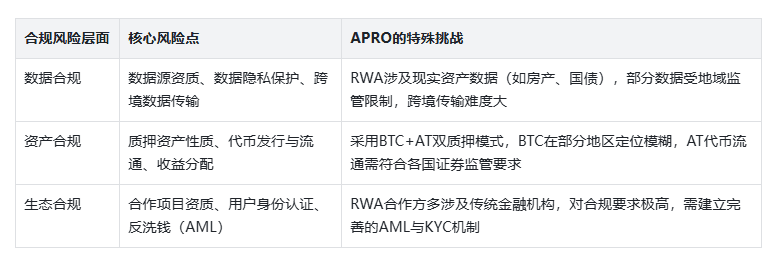
Breaking the Deadlock: APRO's Three Major Compliance Strategies Covering Data, Assets, and Ecology
Faced with a complex regulatory environment, APRO has not adopted a passive approach, but has actively built a compliance system from three dimensions: data, assets, and ecology, specifically addressing compliance pain points.
Strategy One: Data Compliance—Select Authoritative Data Sources and Build Cross-Border Transmission Channels
Data is the core asset of APRO and the first line of defense for compliance. To ensure data compliance, APRO has implemented a dual approach of 'source control + channel optimization.'
1. Selection and Audit of Data Sources: APRO's 1400+ data sources have all been rigorously selected, prioritizing data sources from compliant entities such as government agencies, authoritative exchanges, and international rating agencies, such as data channels from the London Gold Exchange and the China Foreign Exchange Trading Center, ensuring the legality of data sources; meanwhile, it has established a 'dynamic audit mechanism for data sources' to regularly verify the qualifications of data sources. If a certain data source becomes non-compliant due to regulatory policy changes, a backup data source will be switched immediately.
2. Optimization of Cross-Border Data Transmission: In response to the cross-border data regulatory requirements of different regions, APRO collaborates with several compliant cloud service providers globally to build 'regionalized data nodes'—establishing local data nodes in core markets like the EU, the USA, and Southeast Asia, where data is first verified locally and then synchronized across regions through compliant channels, meeting regional regulatory requirements such as the General Data Protection Regulation (GDPR) while ensuring data transmission efficiency.
Strategy Two: Asset Compliance—Clarify the Positioning of Pledged Assets and Optimize the Token Mechanism
To address the compliance risks of the BTC+AT dual pledging model, APRO optimizes from both asset positioning and token mechanism perspectives:
1. Compliance Positioning of Pledged Assets: APRO defines BTC pledging as 'security collateral' rather than 'investment targets.' Through the Babylon protocol, BTC pledging is made compliant, with the clear purpose of node-pledged BTC being to ensure data verification security and avoid crossing the 'illegal financing' red line. Additionally, a 'regionalized pledging scheme' has been launched, allowing nodes in regions with strict crypto asset regulations to replace part of the BTC pledge with compliant digital assets.
2. Compliance Optimization of the AT Token Mechanism: APRO clearly defines the AT token as a 'utility token,' emphasizing its core functions are data service payments, node pledging, and ecological governance, rather than financing tools. In terms of token circulation, strict compliance with regulatory requirements in various countries is observed, and AT token promotion activities are not conducted in regions where cryptocurrency trading is explicitly prohibited, while cooperating with compliant exchanges to ensure that AT trading complies with local AML/CFT requirements.
Strategy Three: Ecological Compliance—Establish a Cooperation Audit Mechanism and Improve User Identity Verification
The compliance of ecological cooperation directly affects APRO's long-term development. To this end, APRO has established a full-process compliance audit system:
1. Qualification Review of Collaborative Projects: For RWA projects, prediction markets, and other partners, APRO has established a dedicated compliance audit team to conduct strict reviews from multiple dimensions such as entity qualifications, business compliance, and regulatory filing status, requiring partners to provide compliance operating permits from their respective regions. Particularly for RWA projects, additional materials such as asset ownership proofs and regulatory filing documents must be provided to ensure that collaborative projects are legal and compliant.
2. User Identity Verification and AML Mechanism: For users participating in core ecological activities such as node pledging and RWA investment, APRO implements a 'tiered KYC mechanism'—ordinary users participating in small-scale entrusted pledging only need basic identity verification, while those participating in large-scale pledging or RWA project investments must complete advanced identity verification, including asset source proof and risk assessment. Additionally, APRO collaborates with compliant anti-money laundering service institutions to monitor user fund flows in real-time, promptly detecting and reporting abnormal transactions to meet global AML regulatory requirements.
Future Outlook: Compliance and Innovation Go Hand in Hand, Creating a Global Compliance Ecosystem
APRO stated that in the next six months, it will focus on advancing two compliance initiatives: first, establishing compliance subsidiaries in crypto-friendly regions such as Singapore and the UAE to handle local ecological expansion and regulatory liaison; second, applying for relevant financial technology compliance licenses to enhance the project's compliance endorsement.
It is worth noting that APRO's compliance strategy is not a 'one-size-fits-all' approach, but rather 'compliance adapted to innovation'—retaining flexibility for technological innovation and ecological expansion while meeting regulatory requirements. For example, in data verification technology, it ensures compliance in data sources and transmission while improving verification efficiency through AI model iterations; in ecological layout, it conducts strict audits of collaborative projects while actively exploring RWA innovative scenarios within the compliance framework.
Overall, APRO effectively addresses global regulatory challenges through its three major compliance strategies of 'source control of data, asset positioning optimization, and full-process ecological audit.' In the context of increasingly stringent Web3 regulation, only by integrating compliance into the core of project development can long-term stable development be achieved. Moreover, APRO's compliance path provides a reference for other oracle projects.
[Risk Reminder: This article only analyzes project compliance strategies and does not constitute any investment advice! Global regulatory policies entail uncertainties, and project compliance measures may not fully address regulatory change risks. Thorough research is imperative before investing!] #APRO @APRO Oracle $AT


