
With the deep integration of AI technology and Web3, the AI oracle track is ushering in a period of explosion. In addition to APRO, a number of projects focusing on 'AI + oracle' such as Band Protocol 2.0 and Nest AI have emerged in the market, all attempting to break the monopoly of Chainlink. However, players in the track are clustered together, and homogeneous competition is becoming increasingly fierce. What allows APRO to stand out? What are the core differences between it and similar AI oracles? How will the competitive landscape of the industry evolve in the future? Today we will conduct an in-depth analysis.
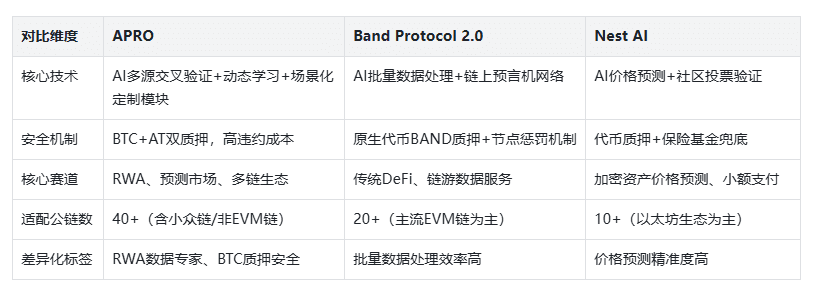
First, let's set the stage: A comparison of core parameters between APRO and similar AI oracles
Current mainstream AI oracle projects are focusing on three dimensions: 'data verification efficiency', 'security mechanisms', and 'ecosystem layout', but their emphases are distinctly different. We will select Band Protocol 2.0 and Nest AI as two typical competitors to make a comprehensive comparison with APRO:
Core differences: APRO's three differentiated advantages directly address industry pain points
From the comparison, it is not hard to see that APRO has not fallen into the homogenization trap of 'comparing parameters with competitors and competing for node quantity', but has identified three differentiated tracks and built difficult-to-replicate competitive barriers.
Advantage 1: BTC staking security mechanism crushes single token staking
This is the core differentiated advantage of APRO and is fundamentally different from similar AI oracles. Currently, competitors like Band Protocol 2.0 and Nest AI adopt a 'native token staking' security model, which has a fatal flaw: 'token price fluctuations affect security coefficients'—once the token plummets, the cost of node misconduct significantly decreases, rendering the security mechanism ineffective.
Moreover, APRO innovatively introduces **BTC+AT dual staking**: BTC, as the most consensus-driven and stable asset in the crypto space, underpins node security; AT undertakes ecological governance and behavioral constraints. The dual staking model significantly raises the cost of misconduct for nodes, providing a safety endorsement that similar projects cannot match. Especially in tracks like RWA, which have extremely high data security requirements, the trust advantage of BTC staking will be amplified infinitely.
Advantage 2: Scenario-based AI models, accurately adapting to the incremental market of RWA
Currently, most AI oracles' models are 'generic', only able to handle standardized data like cryptocurrency asset prices and cannot meet the complex needs of RWA, prediction markets, and other scenarios. For instance, the AI model of Band Protocol 2.0 excels at batch processing game item prices but struggles with real estate property data and precious metal storage data.
APRO's AI model takes the 'scenario-based customization' route, developing exclusive modules for different tracks: the 'property verification module' and 'storage synchronization module' for the RWA track, the 'public opinion analysis module' for prediction markets, and the 'extreme market calibration module' for the DeFi track. This 'precise strike' model allows APRO to occupy a first-mover advantage in the multi-trillion dollar incremental market of RWA—after all, there are very few oracle projects that can provide compliant and accurate RWA data services.
Advantage 3: Comprehensive coverage of multi-chain ecosystems, seizing incremental dividends from niche chains
Similar AI oracles mostly focus on mainstream EVM chains like Ethereum and BNB Chain, where competition is intense and the market is becoming saturated. APRO's strategy is 'mainstream chains as a safety net, niche chains for profit', supporting not only mainstream public chains but also covering Bitcoin's native chain, the Cosmos ecosystem, Sui, and other emerging niche public chains.
Although the ecosystem of niche public chains is currently not large, it is growing rapidly with little competitive pressure and a strong demand for oracle services. APRO quickly enters these segmented markets through customized data service solutions, forming a competitive advantage of 'having what others do not'. For example, providing exclusive price verification for cross-chain DeFi projects in the Cosmos ecosystem and real-time asset value transmission for gaming projects on Sui—these are areas still uncovered by similar projects.
Industry competition pattern projection: three-legged, with incremental market dominance
Combining the current track development trend, the future AI oracle industry is likely to form a competitive landscape of 'three-legged' competition:
1. Established leader: Chainlink guards the stock. Chainlink, with its years of accumulated ecological barriers, will still dominate the traditional DeFi track, but its AI transformation speed is slow, and its competitiveness in emerging tracks is insufficient, focusing primarily on 'guarding the stock market' in the future.
2. All-round players: APRO seizing incremental growth
With the security advantage of BTC staking, the technological advantage of scenario-based AI models, and the coverage advantage of a multi-chain ecosystem, APRO will become a leader in incremental tracks such as RWA, prediction markets, and niche public chains, gradually achieving penetration from 'incremental to stock'.
3. Segmented players: other AI oracles share the pie
Projects like Band Protocol 2.0 and Nest AI will occupy a place in their respective specialized fields (such as batch data processing and price prediction), but it will be difficult to break through the ceiling of segmented tracks, ultimately becoming supplements to the industry ecosystem.
Future challenges: coexistence of technological iteration and compliance pressure
Although APRO's differentiated advantages are clear, it still faces two major challenges in the future: first, the pressure of technological iteration. With similar projects catching up technologically, APRO needs to continuously upgrade its AI models to maintain its leading ability in scenario-based customization; second, compliance pressure. The RWA track involves real assets, and the uncertainty of regulatory policies may affect the project's ecological expansion progress.
Overall, APRO's differentiated route aligns with industry development trends—Web3's future goes beyond traditional DeFi; RWA and multi-chain ecosystems are the real incremental markets. As long as APRO can continue to consolidate its advantages, it is expected to stand out in the competition of AI oracles and become a new generation industry benchmark.
【Risk Warning: This article only analyzes the industry competition pattern and does not constitute any investment advice! Cryptocurrency projects carry risks such as technological iteration failures and ecological competition losses, so be sure to conduct thorough research on the project's fundamentals before investing!】 #APRO @APRO Oracle $AT



