

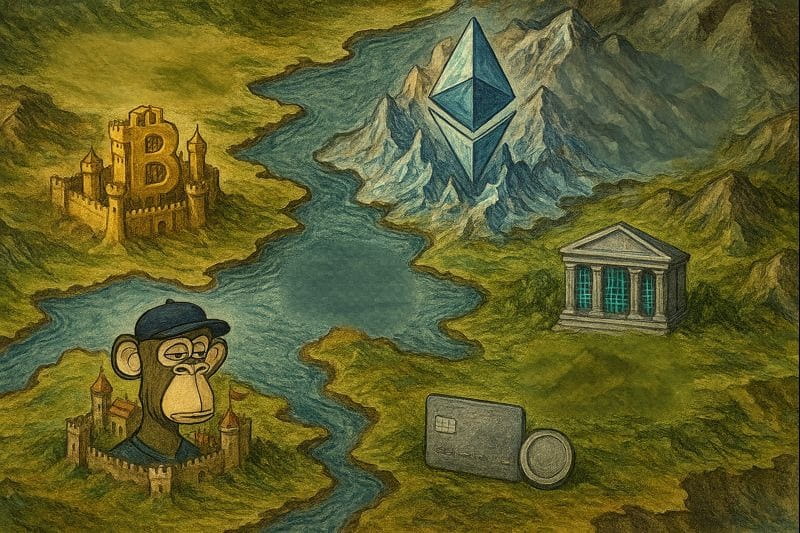
Aevo co-founder Ken Chang recently published a long article "I wasted 8 years of my life in crypto", directly pointing out that the cryptocurrency world has fallen from ideals to the largest casino of the generation, prompting reflection in the community. Castle Island Ventures partner Nic Carter responded with an article, deconstructing the cryptocurrency world into five major 'telos', indicating that pessimism stems from an obsession with a single narrative.
From ideals to disenchantment: Why do cryptocurrency creators collectively feel betrayed?
Ken Chang's article reflects the frequent occurrence of 'burnout' in the cryptocurrency field, where the expectation of creating a new financial order has instead turned into a 24-hour global casino.
He points out that the proliferation of new L1s, VC cash burning, perpetual contracts, and prediction markets are increasingly resembling casino infrastructure, while truly public-interest technological progress is extremely limited.
(Returning to the mission of cryptocurrencies: from speculation culture to founder burnout, seeing the true crisis of the industry)
Why has the ideal deteriorated? First, let’s discuss what the 'ideal' of cryptocurrency is.
Nic Carter cites the exit article of renowned Bitcoin developer Mike Hearn from 10 years ago as an example, believing that Ken's disappointment is not an isolated case, but a misunderstanding by every contributor about 'what crypto should really become':
Their details differ but their argument is the same: Bitcoin/cryptocurrency was supposed to be something (a decentralized or cyberpunk practice), but it has turned into something else (a centralized casino). Both point to the problem of 'the current outcome is not as originally imagined.'
What he implies is that they are essentially arguing about the deviation from 'the ultimate purpose or mission of cryptocurrencies.' But the question is, what exactly is our goal?
The 'Five Major Goals' of the crypto field: Are the five factions cooperating or pulling against each other?
Nic broadly summarizes the five major goals in the current crypto field, pointing out that cryptocurrencies have never been a single-direction narrative, but rather a revolutionary movement of five mixed beliefs advancing simultaneously.
Sound Currency Revival: The Obsession and Reality of Bitcoin's Utopia
First, there is the initial dream. Bitcoin maximalists believe that BTC can compete with sovereign currencies, and even replace fiat. After 15 years, Bitcoin has indeed become an important asset, but it is still far from comprehensive monetary reform.
Nic believes that its achievements should not be underestimated, but these supporters are still oscillating between hope and disappointment.
(Binance CZ debates Peter Schiff: Who wins in the battle of Bitcoin vs Gold?)
Commercial Logic Programming: The Smart Contract Revolution of Ethereum
The digital revolution camp led by Ethereum founder Vitalik Buterin proposes writing various cash flows or contract logics into code to enhance efficiency and transparency.
Current achievements have reached a certain degree of success, such as the significant growth of DeFi derivatives, but the grand goal of 'rewriting the economic order' has still not been achieved.
Nic believes this path has been opened up, but the road visible now is much narrower than imagined.
The imagination of digital property rights: NFTs start with a beautiful premise but are too early.
Some factions also argue that 'digital assets' should be able to be truly owned just like physical property, but the commercialization path of NFTs and decentralized social products has not yet been successful and has been ridiculed as a bubble by outsiders.
Nic expresses agreement: 'We will most likely defend our dominion over digital assets, possibly through blockchain, but this is an idea whose time has not yet come.'
Bringing capital markets on-chain: The most boring yet most pragmatic innovation
This is the most 'non-ideological' camp in the crypto world, advocating for the improvement of slow and inefficient traditional financial settlements through blockchain technology. While it may lack the mysterious aura of cyberpunk, it possesses potentially the greatest commercial value and is a trend that is steadily happening.
Nic said: 'You won’t see the crypto community particularly enthusiastic about these things close to traditional finance, but regardless of good or bad, it has indeed pushed part of the crypto industry forward.'
(Looking at the future prospects from Bitcoin's positioning: The BTC revolutionary mission is over, and capital is retreating towards tokenized assets)
Global financial inclusivity: Committed to meeting the needs of emerging markets
From stablecoins to self-custody wallets, to tokenized stocks and payment financial cards, crypto is providing the first equal access to the global financial system for restricted areas worldwide.
Nic believes this is currently the most successful area of development in the crypto industry, and also one of the most underrated visions.
Crypto moves from utopia to pragmatism: the revolution is not as timely as expected, and bubbles are hard to avoid.
Nic admits that many of the grand narratives from the earliest days have indeed not been realized, and the meme speculation culture, as an unavoidable side effect of technological advancement, is indeed causing real harm to the younger generation; but he emphasizes that this is not all of cryptocurrency, nor the final result.
So which camp is in the right direction? Nic believes that 'maintaining pragmatism and optimism' is more important than pursuing a specific ideology or narrative:
Whenever you find yourself feeling pessimistic about the reality of cryptocurrency casinos, you must hold on to this point. Speculation and plunder are inevitable external costs, accompanying the gradual rollout of revolutionary infrastructure.
Looking at crypto progress: Bitcoin, stablecoins, DEX, and prediction markets
If we set aside the romantic revolutionary vision, Nic believes that current crypto applications are actually clearer than ever: Bitcoin is becoming an asset with global status; the fact that stablecoins have become tools for cross-border payments and savings is unstoppable; decentralized exchanges (DEX) and prediction markets have formed truly product-market fit (PMF) innovative applications.
Though not as grand as early narratives, these are sustainable and quantifiable deep infrastructure advancements.
(Is the 'iPhone Moment' of cryptocurrencies coming? VCs and traders reveal the investment rules for the next decade in crypto)
The next step for cryptocurrencies: maintaining ideals in reality, accepting limitations in ideals
Nic's core conclusion is: the purpose of crypto has not disappeared, it is just more pragmatic and longer than imagined. Those who expect revolutionary changes or overly believe in crypto will only become unhappy. Looking ahead, the industry is indeed moving in the 'right' direction.
The real challenge is not to reject pessimism, but to maintain a rational optimism. Neither indulging in daydreams nor completely negating the entire industry due to its casino-like nature.
(Rejecting pessimism, embracing exponential growth of success cases: Why does cryptocurrency always have a 'doomsday feeling'?)
In this article, Nic Carter analyzes the five major factions in crypto: Is the revolutionary dream shattered or an inevitable path of technological evolution? Originally published in Chain News ABMedia.


