
The banks under scrutiny. Last August, President Donald Trump signed an executive order aimed at investigating the practices of American banks. The goal was to determine whether these banks had discriminated against certain clients based on their political or religious beliefs. Unsurprisingly, the crypto sector has indeed been the target of these now-illegal practices.
Key points of this article:
The Office of the Controller of the Currency revealed that major American banks have restricted access to financial services for cryptocurrencies between 2020 and 2023.
Debanking policies have also affected other sectors such as oil exploration, tobacco, and adult entertainment.
Have American banks discriminated against crypto?
On Wednesday, December 10, the Office of the Comptroller of the Currency (OCC) unveiled the preliminary results of its investigation. According to this document, nine of the largest American banks have indeed restricted access to financial services for certain industries, including cryptocurrencies, between 2020 and 2023.
In more detail, the OCC revealed that banks had implemented "restrictive policies" or "required additional reviews and approvals" before providing financial services to certain clients.
In addition to cryptocurrencies, other sectors have also been victims of this policy, such as oil and gas exploration, coal mining, firearms, private prisons, tobacco, and electronic cigarette manufacturers, as well as adult entertainment.
According to Jonathan Gould, the Comptroller of the Currency, these "debanking" policies are "harmful" and should not be used by banks to discriminate against certain sectors:
"It is regrettable that the largest banks in the country thought that these harmful debanking policies were an appropriate use of their government-granted charter and market power."
Jonathan Gould, Comptroller of the Currency – Source: Press Release
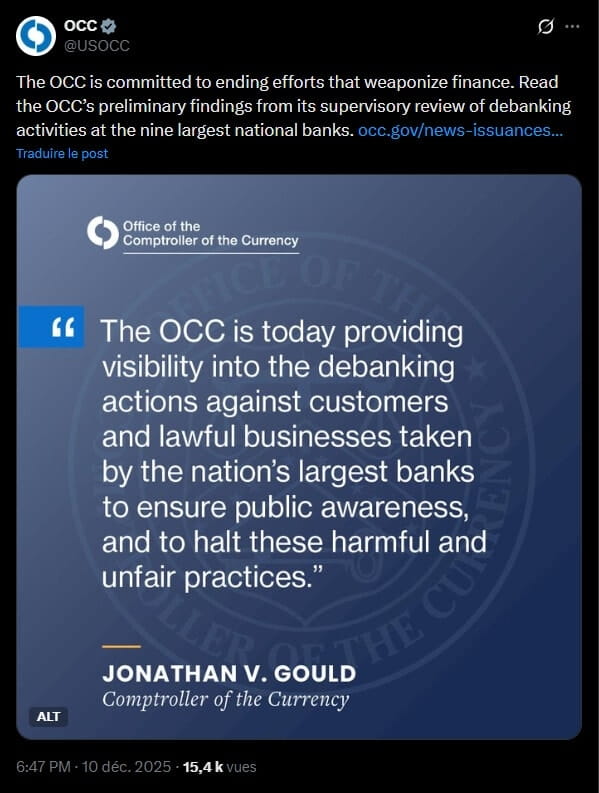 The OCC communicates on the results of its investigation and highlights the active role of major American banks – Source: Account X
An investigation that does not go far enough?
Although the OCC has shed light on these practices, some observers believe that the report does not go far enough. Thus, Nick Anthony, an analyst at the Cato Institute, stated that the OCC report "is far from satisfactory" as it does not mention "the most well-known causes of debanking."
According to him, "the role of regulators" is also to be highlighted, and it will be necessary to shed light on the various decisions made at that time. The same sentiment is echoed by Caitlin Long, founder and CEO of Custodia Bank, who spoke on social media.
For her, the "worst culprits" of cryptocurrency-related debanking under the Biden administration were indeed "the FDIC [Federal Deposit Insurance Corporation] and the Federal Reserve," and not the OCC.
She particularly emphasizes the conduct of "small and medium banks" that were more easily under the control of regulatory bodies and may have caused even more harm than the Wall Street giants.
Let us recall that in 2023, several pro-crypto banks, including Silvergate and Signature Bank, were shut down, leaving many businesses without banking partners. The sector now seems to want to take its revenge, supported and strengthened by the arrival of Donald Trump in power, who is multiplying gestures in their favor. The tide has turned in Washington, and it is finally at the back of the US crypto industry.