
It has been 8 days since the Ethereum Fusaka (Fulu + Osaka) upgrade was officially activated (December 3).
There has been no price surge, nor any network downtime. It's as smooth as upgrading a Windows system. Many people think, 'Is this it?' and even find it boring.
But this kind of 'boredom' is the most terrifying. Fusaka is designed to ensure that Ethereum not only survives but can counterattack in 2026 when faced with high-performance chains like #Solana and #Monad.
Today, let's break down: what exactly has Fusaka upgraded? Why do I believe this is the beginning of Ethereum's 'data hegemony'?
What is Fusaka?
According to Ethereum's old naming convention of 'city + star':
Osaka: Execution Layer upgrade.
Fulu: Consensus Layer upgrade.
Fusion = Fusaka.
If the previous Pectra upgrade (early 2025) was to make wallets more user-friendly (account abstraction), then Fusaka has only one core task: to drive the price of 'data' to the floor.
The core weapon of Fusaka: PeerDAS (data's Pinduoduo)
This is the absolute protagonist of this upgrade—EIP-7594 (PeerDAS).
Before Fusaka, despite having Blob (expanded during Pectra), nodes still had to honestly download a large amount of data. It's like buying a book and needing to read it from start to finish to confirm it's complete. This leads to a limit on the number of Blobs; although L2 fees have dropped, they haven't fallen to an 'insignificant' level.
What did PeerDAS (Peer Data Availability Sampling) achieve? It turned 'full download' into 'sampling.'
Current validating nodes do not need to download the complete Blob data; they only need to randomly sample a few samples. If everyone checks and finds no issues, then mathematically, the data is fine.
This means:
For nodes: The burden has decreased; you don't need to buy T-level hard drives to run.
For L2 (Arbitrum, Base, Optimism): You can stuff 8 times or even more data onto Ethereum, while costs hardly increase.
PeerDAS has completely transformed Ethereum from an 'expensive calculator' to an 'infinite capacity hard drive.'
Who is affected by this upgrade?
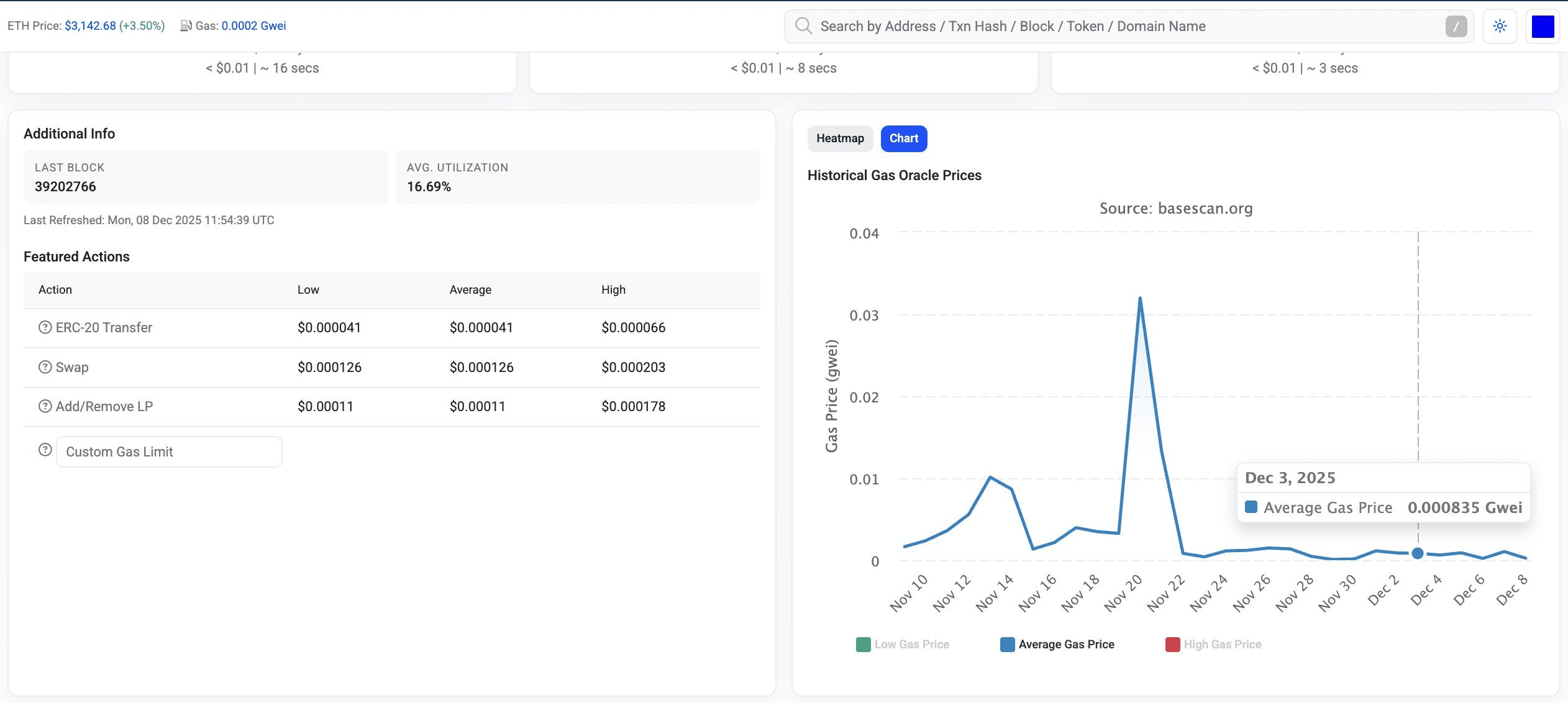
Many people criticize Ethereum for being slow and expensive. But after the Fusaka upgrade, if you look at the Gas fees for Base and Arbitrum, you will find they are approaching the edge of 'free' (around $0.00001 level).
Source: BaseScan
This is Vitalik's grand scheme: L1 (mainnet) no longer serves 'humans,' only serves L2.
Blob capacity skyrocketed: After Fusaka, both the target and maximum numbers for Blobs have been raised. This is a direct benefit for L2. Previously, L2 had to compete for Blob space, but now there's plenty of space.
Gas Limit adjustment: Although the community has debated for a long time whether to raise the Gas Limit to 150 million, this time Fusaka finally implemented a relatively conservative but steady increase (to around 60 million dynamic adjustment space) to ensure decentralization without aggressively increasing node burdens.
Future: Where did Verkle Trees go?
Last year, everyone was hyping the 'stateless client' (Statelessness) and Verkle Trees (an upgraded version of Merkle Trees), which were not fully included in Fusaka.
Fusaka only laid the groundwork. The real 'stateless complete form'—that is, being able to verify the Ethereum network in seconds on your phone—has been postponed to the next upgrade: Glamsterdam (2026, Glamour + Amsterdam).
This means that although Fusaka has resolved the congestion of data storage, it has not completely addressed Ethereum's historical legacy issue of 'state bloat.' This is also one reason why ETH's price did not surge sharply after the upgrade—because the market is still waiting for that 'ultimate form' next year.
Last
After the Fusaka upgrade is implemented, here are my observations:
The battle for L2's internal competition has begun: Since paying 'protection fees' to Ethereum has become cheaper, the profits in the hands of #L2 projects will increase. Next, it depends on who is willing to subsidize users and whose ecosystem can produce blockbuster applications. Pay attention to the tokens of #OP Stack and #ZK leading in the industry.
The positioning of $ETH has shifted: Don't expect the $ETH mainnet to be as smooth as Solana. The current positioning of ETH is as the 'settlement layer of the global digital economy.' It is increasingly resembling the SWIFT system in the United States or the TCP/IP protocol at the Internet's core. You typically don't chat directly using TCP/IP, but you can't do without it.
Long-term bullish, short-term bottoming: Technological upgrades are not just good news being fully realized, but rather the completion of infrastructure. Once the road is repaired, the cars (applications) will come.
In 2026, I look forward to the arrival of Glamsterdam, which will be the moment when Ethereum truly battles high-performance single-chain.
Recently, I plan to ambush a potential coin that is highly likely to surge strongly, expecting a space of 7-10 times is not a problem. Friends who want to catch this big opportunity, please share directly in the chatroom.#加密市场反弹 #美联储降息 #美联储FOMC会议


