Oracles are a quiet part of the web3 world that many people do not notice. These systems take information from outside blockchains and bring it into smart contracts so that programs can act on real-world facts. Without oracles, networks that deal with finance, price data, or real-world assets would be blind to what is happening outside the chain. Over the next three to five years, the way oracle networks grow could shape the future of decentralized finance and the broader Web3 economy.
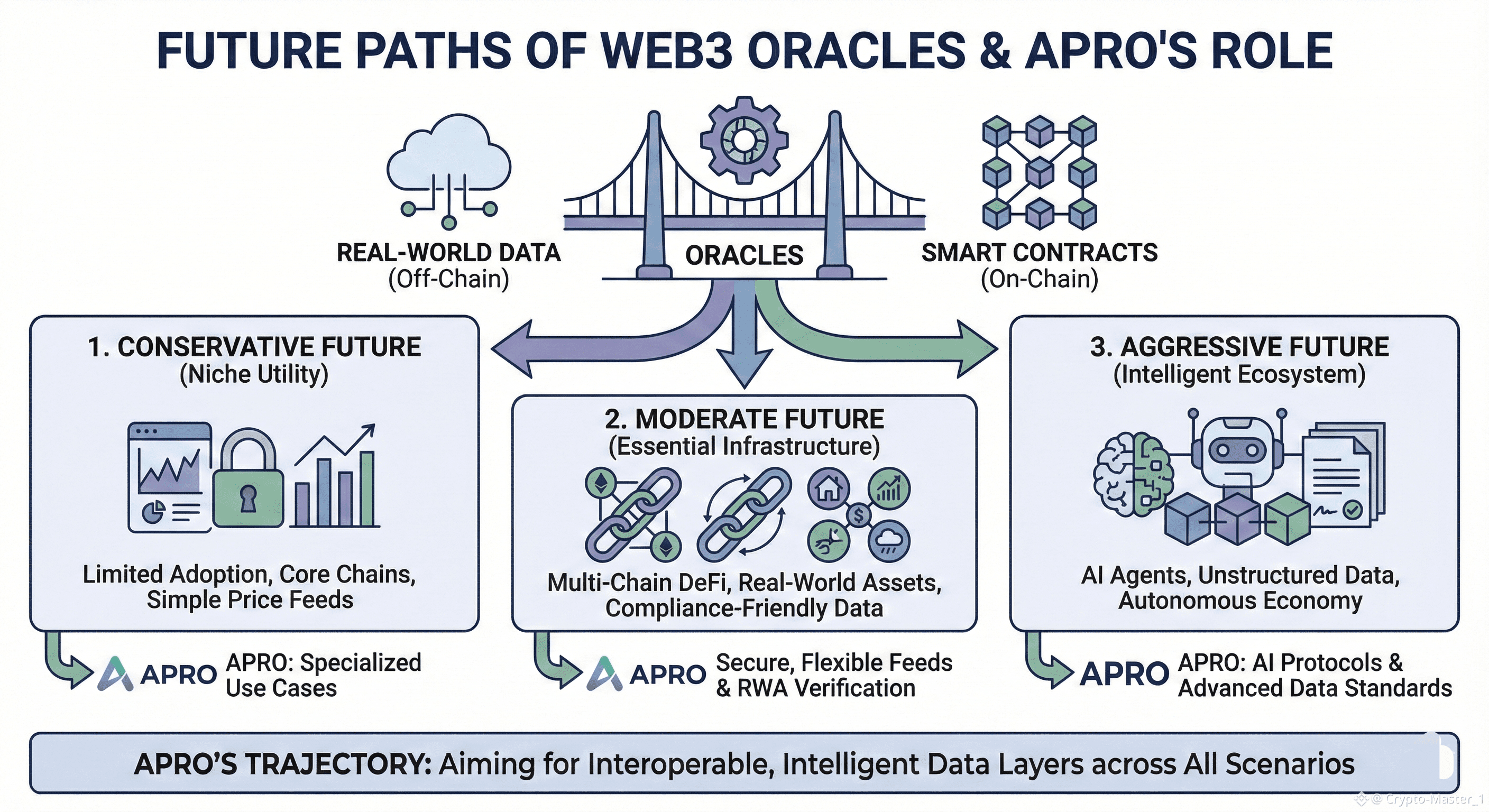
One simple way to think about the future of oracles is through three possible paths. The first path is a slow and limited growth. Oracles continue to be important, but only to a small group of developers and specialists. In this version of the future, decentralized finance remains focused on a few core chains. Oracles would still feed price data and basic external events into smart contracts, but they would not become widely used beyond existing niches. Many applications would still struggle with trust in data, and growth would be steady but not revolutionary.
In this conservative model, oracles remain a utility layer that only deep Web3 developers pay attention to. The wider world of finance and business does not yet see the full value of secure external data for smart contracts. Oracle networks would continue to provide price feeds and verification for existing decentralized finance applications, but large institutions still rely on traditional systems for most of their data work. The challenges here involve adoption and trust. Networks must prove they can deliver secure, accurate information before traditional systems will rely on them.
A second scenario is a moderate approach where oracle systems become essential infrastructure for a much broader set of decentralized applications. In this world, oracles help power multi-chain finance in a way that truly broadens the usefulness of smart contracts. As decentralized finance grows to support more lending, derivatives, and composability across chains, oracle networks must deliver secure data across many environments. This kind of expansion would see oracle services become a core layer for most decentralized applications. Real-world data feeds, schedule results, weather events, and asset prices would be routinely used by a growing range of financial services built on blockchains.
Under this intermediate scenario, oracles help lower the barriers between decentralized finance and regulated finance. They begin to provide audit quality and compliance-friendly data feeds that institutions can trust. This would make it easier for real-world assets such as bonds, property shares, private funds, and other tokenized assets to be managed through decentralized contracts. Initiatives that support better bridges between traditional systems and decentralized protocols would be critical. The success factors here include standardization, better governance of oracle systems, and deeper integration with emerging financial regulation.
A third, more aggressive future sees oracles becoming central not only to finance but to the entire digital ecosystem that blends artificial intelligence and decentralized systems. In that world, oracles do much more than feed price data. They support networks of AI agents that understand and verify unstructured data such as legal documents, images, or logistics records. Oracle systems act as an interface between intelligent software and smart contracts, allowing advanced autonomous agents to make decisions that move real-world assets on chain. In this future, oracles are part of a new infrastructure layer that supports real-world asset tokenization at scale, complex prediction markets, and AI-driven economic systems.
This aggressive model depends on breakthroughs in secure automated data verification and protocols that allow many different systems to trust and use the same data feeds without heavy manual oversight. Oracles in this vision support not only basic data but also qualitative information about events, documents, and outcomes. If this happens, oracles could be a cornerstone of a future where decentralized systems are not just financial tools but foundational layers for many kinds of economic activity outside traditional finance.
Looking at APRO’s technology against these possible futures helps clarify where it might fit. APRO is building an oracle service that combines traditional price and event feed delivery with artificial intelligence enhancements and real-world asset data verification. It uses protocols that let AI agents securely exchange data and anchor high-confidence information on chain, with support for a wide variety of blockchains and data types. This means APRO is already targeting features that match both the intermediate and aggressive futures. Its design assumes that oracles need to do more than feed simple numeric data. Instead, they must handle complex data sets and verification methods that institutions and automated systems can trust.
In a conservative oracle future, APRO’s capabilities might be ahead of the wider market, making it more useful in specialized applications such as prediction markets or complex finance but still limited in broader adoption. The technology could support early adopters and innovators who push beyond simple price feeds.
In a moderate future where oracle networks become central to multi-chain decentralized finance, APRO’s focus on secure and flexible data feeds could make it a core provider for many kinds of chains and services. The ability to feed real-world asset data and verification protocols into financial contracts would put it at the heart of many emerging DeFi applications.
In the aggressive scenario, APRO’s integration of AI agent protocols and rich data handling positions it well to participate in the next generation of oracle services. It could help define standards for how intelligent systems interact with decentralized contracts and how real-world assets can be reliably represented and moved on chain. The key success factors in this world are trust, interoperability, and adoption by the broader developer and institutional community.
Across all these paths, oracles will continue to matter. Their impact depends on how they evolve and how broadly they are adopted. APRO’s current direction suggests it is aiming not just to support existing decentralized finance but to play a role in a future where automated systems and real-world data meet decentralized protocols in ways that can support complex economic systems.
In every scenario, risks remain. Oracle systems must solve data integrity issues and resist manipulation. They must build tools that the broader world trusts. Success will depend not just on technology but also on meaningful adoption and integration with systems outside of blockchain. The next few years will show whether oracle networks remain niche, become a core infrastructure layer for DeFi and real-world bridges, or evolve into intelligent data layers that power a much broader spectrum of decentralized computing and economic activity.