

@Injective The idea that you can stake a native blockchain asset inside a traditional finance app without paying a fee would have sounded unlikely a few years ago. Staking lived on-chain, behind browser wallets, bridges, and a learning curve that filtered out most people. Now you can open the same app you use to buy stocks, tap a few buttons, and start earning staking rewards on INJ with zero fees charged by the platform itself. That shift isn’t just about convenience. It’s a sign that the lines between crypto and traditional finance are quietly dissolving in ways that matter.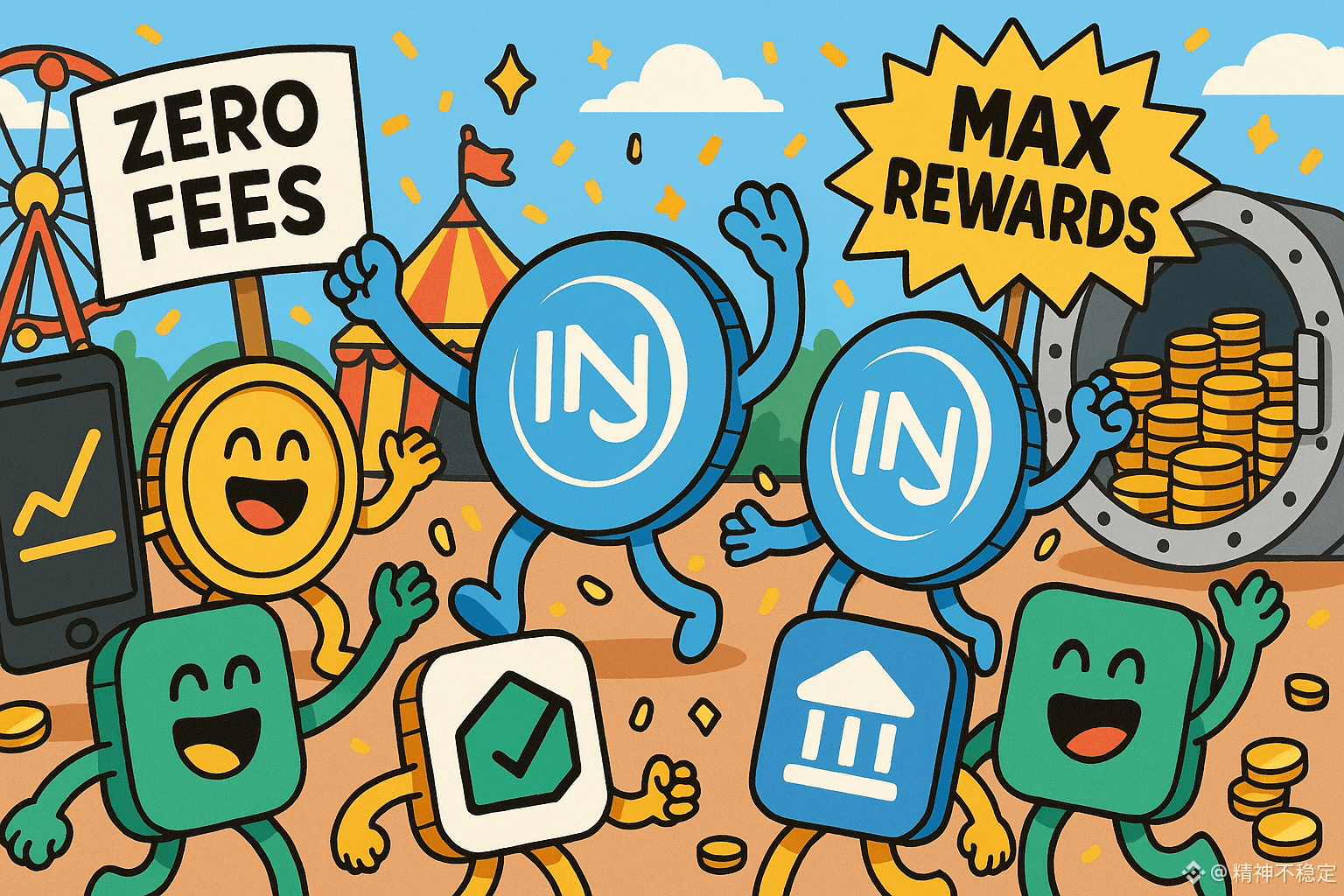
INJ sits at an interesting intersection.INJ is the main token on the Injective blockchain, which is used for trading and finance.
The system is protected when users stake their tokens with validators.
In the past, joining this wasn’t easy. You had to:
Move your tokens into your own wallet
Pick a validator on your own
Learn staking rules like delegation and unbonding
Live with any mistakes you made
So even though it was powerful, it felt pretty intimidating for most people. Opening staking to everyone through familiar TradFi apps essentially abstracts all of that away while still connecting users to the same underlying economics.
Zero-fee staking is the twist that changes user behavior. Most centralized platforms that offer staking take a commission on the rewards, sometimes quietly. It’s framed as an operational cut: they handle the infrastructure, risk, and management, so they skim a percentage from what’s earned. When a platform decides to pass through staking rewards without taking a fee, the relationship flips. Instead of monetizing the yield itself, the platform treats staking as a feature embedded in a wider product experience—trading, custody, and other services—rather than a profit center of its own. For users, that means the advertised APR actually looks like what lands in their account, which sounds basic but is surprisingly rare.
Opening staking to everyone on TradFi apps changes the profile of who participates. Instead of crypto-native users who are comfortable navigating DeFi interfaces, you suddenly have people who think in terms of portfolios, allocations, and risk buckets. They may not care about validator uptime or slashing parameters, but they care deeply about liquidity, lock-up periods, and how staking fits into an overall strategy that includes equities, cash, and maybe a few other digital assets. Making INJ staking accessible in that environment forces a different kind of clarity. The question stops being “How do I do this on-chain?” and becomes “What role does this yield-bearing asset play alongside everything else I own?”
That reframing is healthy. Staking rewards are not free money. They are compensation for the risk of tying your capital to the security of a network. In Injective’s case, staked INJ helps secure a chain designed for high-performance financial applications. You are effectively backing the infrastructure that powers order books, derivatives markets, and other protocols built on top. The reward rate reflects both network-level economics and the behavior of validators. When staking comes packaged in a polished TradFi app, the challenge is to preserve that reality rather than bury it behind a simple “earn” button. The platforms that do this well tend to surface basic concepts like lock-up periods, unbonding timelines, and potential risks without overwhelming users with jargon.
There’s also a subtle change happening on the regulatory and risk side. Traditional finance apps are heavily scrutinized. When they add staking support for a specific asset like INJ, it’s not a casual listing. Someone has looked at the underlying network, distributions, liquidity profile, and operational footprint of staking. That doesn’t magically remove risk, but it adds a layer of institutional due diligence that doesn’t exist when you’re staking directly from a random browser wallet through a newly launched interface. For many users, that comfort matters as much as the yield. They’re willing to experiment with staking because the environment feels familiar, even if the technology underneath it is new.
From Injective’s perspective, broader staking access through TradFi apps does something important for the network itself. Proof-of-stake security improves as more tokens are delegated and as staking participation becomes more distributed. If staking is only accessible to technically confident users, you tend to get concentration: large holders, early adopters, and a relatively narrow set of validators. When the channel widens to include everyone who can tap a staking button in an app they already use for their investments, participation patterns shift. More small holders can delegate. More people become indirectly aware of validator selection, even if the app abstracts the choice behind curated options or a managed staking setup. Over time, that can lead to a healthier stake distribution and a more resilient network.
Zero-fee staking also feeds back into market structure in less obvious ways. If it becomes costless for users to stake and unstake, INJ starts to behave more like an active, yield-bearing asset than a purely speculative token. A portion of holders will keep their INJ staked by default, simply because there’s no reason not to. That reduces the immediately tradable float, which can influence liquidity and volatility at the margins. At the same time, if unbonding periods are reasonable and the TradFi app offers a smooth exit experience, the barrier to moving between “earning yield” and “ready to trade” remains low. That combination—sticky staking with practical optionality—tends to attract a different profile of holder: less focused on intraday moves, more interested in participating in the network’s growth over time.
The narrative around “max rewards” can easily slide into hype, but the more interesting story is about alignment. Staking lets holders align with network health and activity, and zero-fee access on mainstream apps removes frictions that previously filtered out most of the potential base. You don’t have to be deep in DeFi to benefit. You just need enough curiosity to allocate a portion of your portfolio into an asset whose yield is tied directly to the functioning of a live, specialized blockchain. For INJ, which sits at the core of an ecosystem built for trading and financial primitives, that alignment is particularly tight. Network usage, protocol growth, and staking rewards are all connected.
Of course, none of this absolves anyone from doing real homework. The fact that a TradFi app makes staking simple doesn’t mean it’s risk-free, and “zero fees” can’t be the only lens through which decisions are made. It’s still on each participant to understand at least the basics of what they’re opting into: how the network works, what slashing means, how long capital is locked, and what could change the reward profile over time. The difference now is that the doorway is wider. Instead of being gated by technical friction, participation is gated only by interest and understanding.
That’s the quiet shift this moment represents. INJ staking becoming available to everyone on traditional finance apps, with no platform fees on rewards, signals a world where crypto-native mechanisms are no longer off in their own corner. They’re being pulled into the mainstream investment stack, side by side with stocks, bonds, and cash. The details still matter. The risks are still real. But the direction of travel is clear: staking isn’t just for the crypto-obsessed anymore, and the networks that understand how to meet users where they already are will be the ones that quietly, steadily grow.
@Injective #injective #Injective $INJ

