

When a mortgage company moves billions of dollars’ worth of loan data onto a public blockchain, it stops being a thought experiment and becomes a stress test for how modern finance is actually going to evolve. That’s what Pineapple Financial is doing right now as it begins migrating its multi-billion dollar mortgage portfolio onto the @Injective blockchain, turning a historically opaque asset class into something far more observable, programmable, and ultimately more liquid than the legacy rails ever allowed. 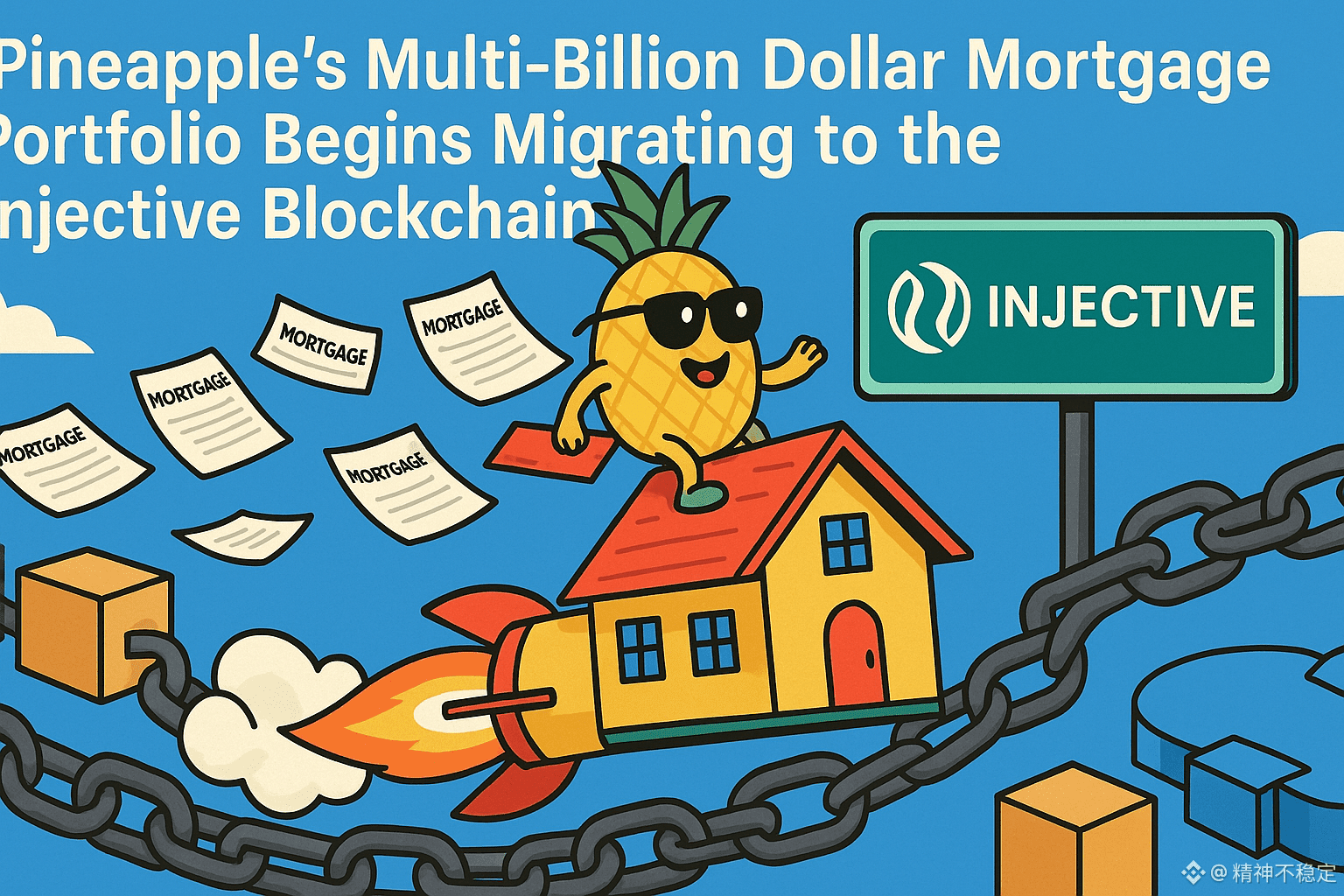
Pineapple is not a crypto-native startup experimenting at the margins. It’s a Canadian fintech listed on the NYSE American under the ticker PAPL, with a mortgage book that totals roughly 29,000 funded loans and about $10 billion in value, or C$13.7 billion. That scale matters. The mortgage market is enormous, but it’s also slow, fragmented, and bogged down by systems that were never designed for real-time data sharing. Pineapple’s move is significant because it doesn’t just add “blockchain” as a feature; it restructures how mortgage data itself is stored, accessed, and used.
At the center of this shift is Pineapple’s new mortgage tokenization platform built on Injective, a layer-one blockchain optimized for finance with low fees and high throughput. Instead of treating each mortgage as a static PDF buried in an internal database, Pineapple now mints an on-chain record for each loan. That record is not a simple pointer. It includes more than 500 unique loan-level data points—everything from borrower profile elements to property attributes and payment performance—structured specifically for auditing, analytics, and institutional workflows.
Only a fraction of the portfolio has moved so far, but even that fraction is meaningful. Pineapple has already tokenized more than 1,200 mortgage files, representing about $412 million in funded volume. Those are not pilot-sized numbers. They are early proof that a high-volume, highly regulated asset class can be reconstructed on a public chain without losing the discipline of traditional risk management. And the plan is not to stop there. Over the coming months, Pineapple expects to migrate its full historical portfolio and then keep the pipeline open, pushing new originations on-chain as they’re funded.
The real problem Pineapple is solving is that mortgage data is all over the place.
It sits in different tools and teams—where the loan starts, where it’s serviced, with custodians, auditors, in paper records, and in email chains.
Every handoff creates friction: people redo work, wait for others, and spend time reconciling numbers instead of moving quickly. The tokenization platform turns that inside out by anchoring a single structured record for each mortgage on Injective, and letting internal and external systems read from that shared source of truth. Instead of manually piecing together a story about a loan, counterparties can query its history, terms, and performance in real time, subject to appropriate access controls off-chain.
The immediate benefits are operational.
Making loan terms and statuses machine-readable (not just scanned documents) makes it much easier to verify them automatically.
Changes to a mortgage can be recorded on-chain in real time, so audit history is always up to date and doesn’t require a big push before reviews.
Risk teams can then study clean, standardized data for thousands of loans, instead of trying to combine and fix different reports by hand.. In a market where basis points matter, even modest efficiency gains across underwriting, servicing, and secondary trading can translate into meaningful value.
But the deeper story is about what becomes possible once mortgages are expressed as programmable, data-rich on-chain objects. Injective was built for financial applications, with infrastructure tuned for trading, derivatives, and real-world assets. A mortgage recorded there is no longer just documentation; it’s a building block. Over time, these records can underpin new forms of securitization, dynamic collateralization, and more transparent secondary market structures. Instead of bundling loans into opaque pools that investors must analyze indirectly, tokenized portfolios can expose loan-level attributes and performance in a standardized way, while still respecting privacy and regulatory constraints.
Pineapple has been quietly laying the groundwork for this pivot. Earlier this year, the company completed a $100 million private placement to establish a dedicated Injective digital asset treasury, becoming the first publicly listed company to anchor its corporate reserves in INJ. It has already executed open-market purchases of more than 678,000 INJ, with the goal of building one of the largest staked INJ positions globally. Staking yield from that treasury is not just a financial side bet; it is designed to support the economics of running mortgage tokenization and related real-world asset products on Injective, effectively tying the company’s balance sheet to the infrastructure that powers its technology roadmap.
That alignment between treasury strategy and product strategy is unusual in traditional finance but increasingly common in on-chain markets. For Pineapple, it means the company is not just a user of Injective’s infrastructure but a participant in its security and governance. For Injective, it means a real-world institution with billions in mortgage exposure is actively stress-testing the chain’s ability to handle regulated, data-heavy workloads and long-duration assets.
Of course, none of this removes the hard parts of mortgages themselves. Credit risk still exists. Underwriting judgment still matters. Regulatory requirements are not magically simplified because records live on a blockchain. What does change is the substrate on which all that complexity is managed. When each loan carries more than 500 structured data fields on-chain, modeling risk across a portfolio becomes less about hunting for clean data and more about choosing the right analytical lens. When auditability is built into the system design, compliance teams can spend more time on interpretation and less on collection.
Skeptics will reasonably ask whether the industry will follow. Mortgage markets are conservative by design, and many institutions still view public blockchains with suspicion. That’s precisely why Pineapple’s move is so closely watched. It offers a working example of how tokenization can be introduced without tearing down existing regulatory structures or abandoning established investor protections. The mortgages don’t suddenly become speculative tokens drifting freely on retail exchanges; instead, the blockchain functions as infrastructure—a more efficient ledger that can plug into familiar capital markets mechanics.
If the experiment succeeds at full portfolio scale, the implications extend far beyond one company’s balance sheet. A functioning on-chain mortgage stack would show other lenders, servicers, and institutional investors that real-world assets can live natively in a crypto-enabled environment without sacrificing the rigor that traditional finance demands. It would also demonstrate that public chains like Injective can carry regulated, data-sensitive workloads in production, not just as pilots or proofs-of-concept.
For now, Pineapple is in the early chapters of that transition: a few thousand loans migrated, billions more to go, and a sizable on-chain treasury backing the bet. The direction of travel is clear. Mortgage finance has been waiting for an infrastructure overhaul for decades. By moving a $10 billion portfolio onto Injective and reimagining mortgages as structured, auditable digital records, Pineapple is effectively saying that the overhaul has started—and that it will happen not in one big leap, but one carefully modeled, thoroughly documented loan at a time.
@Injective #Injective #injective $INJ

