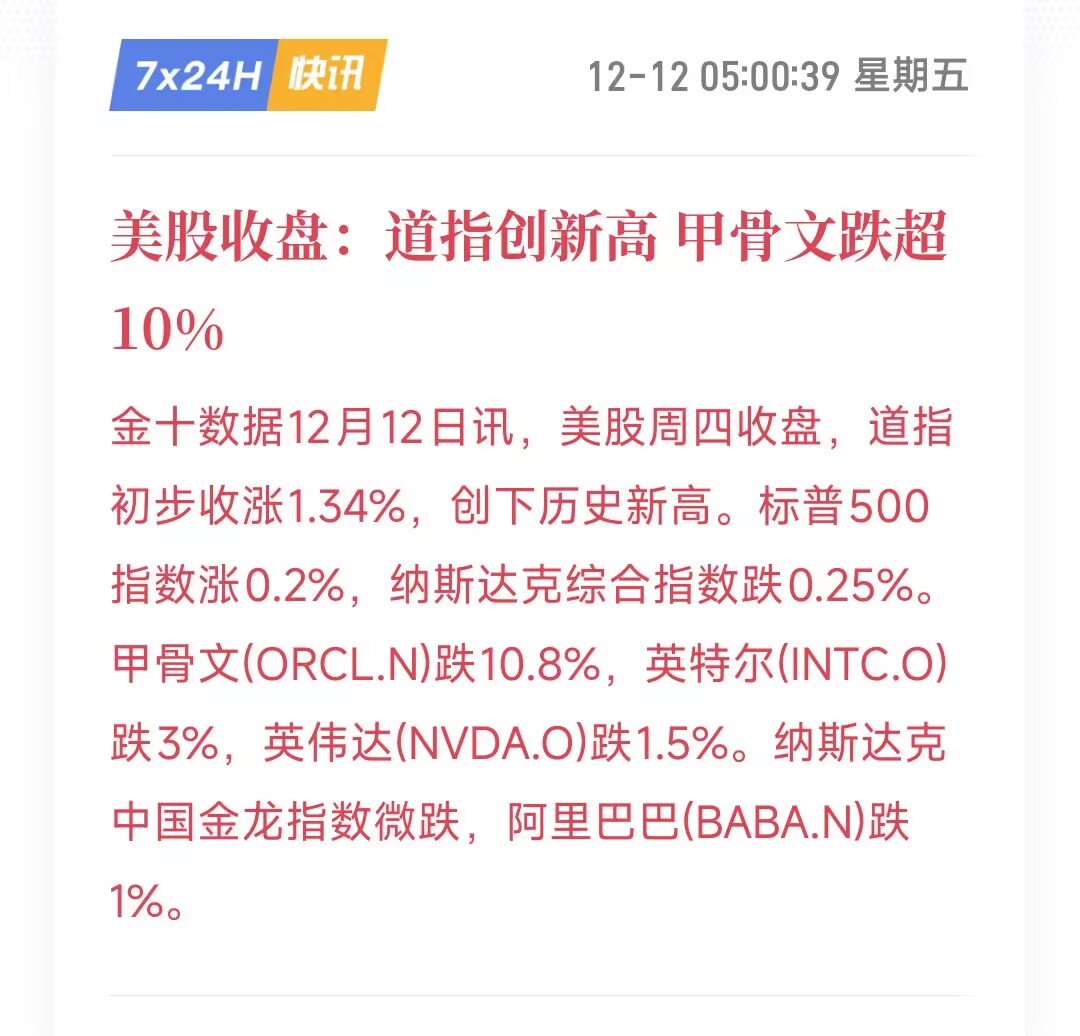
The game of chess in the US stock market, the Dow is 'jumping high,' and tech stocks are 'slacking off'—last night's market was like someone welded the word 'divergence' to the screen.
Zhang Tianshi's personal opinion:
Last night, the US stock market closed, and the Dow Jones Index jumped to a historical high, rising by 1.34%—this is like having a usually steady 'top student' in class suddenly scoring full marks, genuinely getting the market excited. But the other two indices weren't so lucky: the S&P 500 only rose by 0.2%, and the Nasdaq actually dropped by 0.25%, a typical case of 'some eat meat, some drink soup, and some are left with nothing.'
It's important to mention the 'diving competition' of tech stocks: Oracle dropped directly by 10.8%, which means if you entered the market with 100 bucks, you’d be left with just over 89 bucks at the close—this level of decline would be considered 'high volatility' in the crypto space, let alone in a relatively stable environment like the US stock market. Intel fell by 3%, and Nvidia dropped by 1.5%; the tech sector has clearly been 'doused with cold water' this time.
Personally, I believe that the essence of this matter is 'capital picking a direction': the rise of the Dow indicates that traditional industries (like consumption and manufacturing) are gaining momentum, suggesting that the market is seeking 'stability'; while the drop in tech stocks is likely due to previous excessive gains, and funds are taking the opportunity to 'sell high'—similar to how a mainstream coin in the crypto space might rise for a week and then suddenly experience a big bearish correction, which fundamentally is just profit-taking and not a collapse of fundamentals.
For instance, Oracle's recent drop may not necessarily indicate that the company is failing; it is more likely that it had risen too sharply before (for example, a 20% increase in the past month), and yesterday's earnings report or performance did not meet expectations, leading to a direct sell-off—this logic is akin to the crypto space where 'good news can quickly turn into bad news'.
Master Zhang concludes:
The recent 'seesaw' market in US stocks has actually served as a wake-up call for the crypto world: when the market starts to 'pick and choose' its gains, it often signals a divergence in capital. Should I help you analyze how this wave of US stock market differentiation will impact the short-term trends of Bitcoin and mainstream coins?