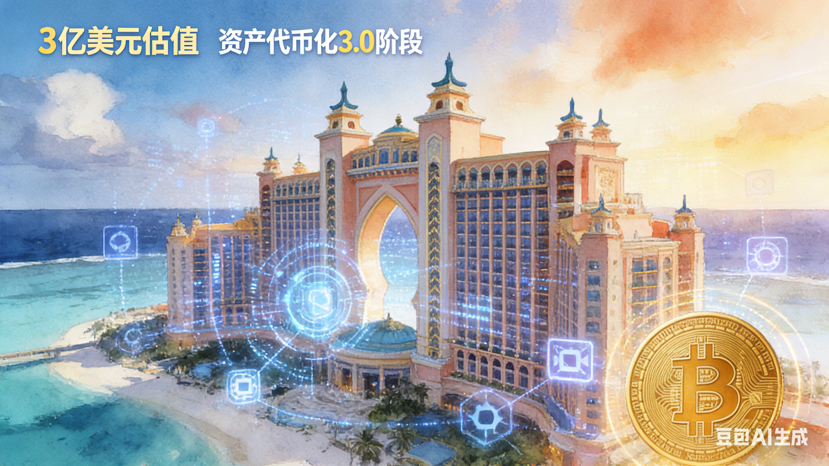
Recently, a collaboration announced by the Trump Organization and the London-listed company Dar Global has sparked widespread attention in the industry—both parties will jointly develop the Maldives Trump International Hotel through blockchain tokenization. This project, valued at $300 million and planned to include 80 beachfront and overwater villas, is not only the world's first tokenized financing project for a hotel under construction but is also seen as a landmark event in the leap of asset tokenization from 'activating existing stock' to 'front-end financing,' opening up new imaginative spaces for the integration of real estate development and blockchain technology.
01 Core breakthrough: From 'activating existing assets' to 'incremental financing' intergenerational leap.
Before this Maldives project, real estate tokenization had already been attempted globally, but the vast majority of cases focused on 'existing assets'. Whether it's commercial office buildings, operational hotels, or residential properties, the traditional model often involves tokenizing ownership after the assets are built and generating stable returns, attracting investors to participate. The core value of this model lies in 'activating existing assets', making stagnant real estate assets more liquid, essentially belonging to the 2.0 stage of asset tokenization.
The innovation of the Maldives Trump International Hotel project lies in the fact that the tokenization nodes are positioned at the 'early construction stage'. Investors do not need to wait for the hotel to be completed and operational; they can obtain corresponding ownership rights by purchasing tokens, with funds directly used for project development. This transformation upgrades tokenization from a mere 'asset liquidity tool' to a 'front-end financing tool', achieving a critical leap from 'activating existing assets' to 'supporting incremental growth', marking the formal entry of asset tokenization into the 3.0 era, centered on 'development stage financing'.
From the perspective of the project's fundamentals, its $300 million valuation, the configuration of 80 high-end villas, and the planning to open by the end of 2028 provide a solid asset foundation for tokenization financing. The brand influence of the Trump Group and the listed company background of Dar Global also somewhat reduce the project's credit risk, providing confidence for investors to participate in early financing. 02 Industry value: Restructuring real estate financing logic and investor entry thresholds.
The implementation of this tokenization financing project has profound restructuring significance for both the real estate industry and the investment market. In traditional real estate development, financing channels are highly concentrated in institutional paths such as bank loans and trust plans, making it difficult for small and medium investors to participate in the development phase of large projects like high-end hotels. They can only participate indirectly by purchasing properties or fund shares after the assets are completed, with high investment thresholds and compressed profit margins.
Blockchain tokenization achieves a refined division of asset ownership through technical means. Investors can purchase corresponding amounts of tokens based on their financial strength, significantly lowering the minimum investment threshold and truly achieving 'inclusive investment'. At the same time, tokenization relies on the immutable and traceable characteristics of blockchain, making ownership clear and transparent, and transaction processes more efficient, avoiding problems such as complex property verification and long transfer cycles in traditional real estate transactions.
For developers, this financing model also opens up new funding channels. Against the backdrop of tightening global credit conditions and rising traditional financing costs, tokenization financing can quickly gather social idle funds, alleviating the financial pressure at the early development stage of the project, while also accumulating potential customer resources for the hotel through widespread investor participation, laying a foundation for subsequent operations.
03 Potential challenges: Regulatory adaptation and risk prevention remain key propositions.
Although the project demonstrates immense innovative value, asset tokenization, especially 'development stage tokenization', still faces numerous challenges that need to be addressed, among which regulatory adaptability and risk prevention are the most critical. Currently, there is no unified regulatory framework for real estate tokenization globally, and different countries and regions have variations in defining the nature of tokens, investor protection rules, and transaction process standards. As the project location, the Maldives needs to further clarify its regulatory policies regarding blockchain financing and foreign investment in real estate development, as well as whether subsequent token transactions comply with the regulatory requirements of the London capital market.
From a risk perspective, ongoing projects themselves face development risks such as delays, cost overruns, and changes in the market environment, and tokenization directly passes these risks to a large number of small and medium investors. Compared to institutional investors, individual investors have relatively weak risk tolerance and risk identification abilities. How to establish a sound risk disclosure mechanism and set reasonable risk hedging tools to avoid group incidents triggered by project risks is a core issue that project operators must solve. In addition, risks at the technical and operational levels, such as the security of blockchain technology and the compliance of token trading platforms, also need to be controlled through technological upgrades and institutional design.
04 Conclusion: Innovation and regulation go hand in hand, opening new explorations in the industry.
The implementation of the Maldives Trump International Hotel tokenization financing project undoubtedly provides a valuable practical example for the integration and development of real estate and blockchain. Its push of asset tokenization into the 3.0 era is commendable. However, any financial innovation must be conducted within a regulated framework. Only by properly addressing core issues such as regulatory adaptation, risk prevention, and investor protection can this innovative model achieve sustainable development.
In the future, as the global regulatory framework gradually improves and blockchain technology continues to mature, there may be more real estate projects adopting the 'development stage tokenization' model, injecting new vitality into the real estate industry. The subsequent progress of this Maldives project will also provide valuable experience references for the industry, promoting steady advancement of asset tokenization in the balance between innovation and regulation.
The above content has no harmful guidance#web3.0 #美联储降息 #加密市场反弹 #web3空投