
In three years of trading experience, I gradually discovered that the real reason retail investors fail when trying to catch the bottom is not due to "bad luck," but rather because they often fall into several psychological traps that prevent them from accurately understanding the true state of the market. Today, I will delve into these psychological traps and propose solutions.
Misconception 1: Over-reliance on historical highs - using the wrong "reference frame"
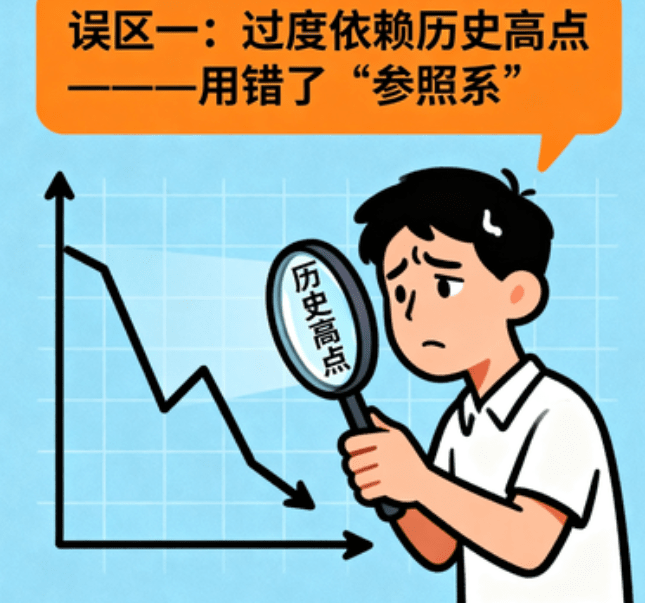
When the price of Bitcoin dropped to $90,000, many investors' first reaction was often: "A 29% drop from $120,000, isn't that cheap?" or "It was still $126,000 in October, if I don't buy it at $90,000 now, when will I buy it?" This is a typical manifestation of over-reliance on historical highs. Most people tend to use historical highs as the basis for determining whether to "catch the bottom," but the market does not care about past prices, only the current supply and demand dynamics and emotional fluctuations.
For example, in 2022, when Bitcoin dropped to $35,000, many people thought, 'Dropping 50% from $69,000 must be the bottom.' However, the result was that the market continued to decline, and the price eventually fell to $15,800. This is because retail investors use 'relative price discounts' as the basis for buying, but the actual market price is determined by supply and demand, liquidity, and macroeconomic factors.
Solution: Forget historical highs and focus on the current market situation. The most effective reference point is the cost concentration area, which can be viewed through on-chain data to check the average holding cost of large funds (currently around $72,000). Additionally, analyzing market liquidity and cyclical positions is also key. If these factors do not show clear bottom signals, then even if the price drops from $120,000 to $90,000, it cannot be determined that the market has bottomed out.
Misunderstanding 2: Overly worried about missing opportunities - emotional decisions replace rational judgment

There is a classic experiment in psychology: among two choices, most people tend to choose the option with higher certainty. For example, 'certain gain of $500' vs. '50% chance of gaining $1000,' most people will choose the former. However, when faced with losses, the choice is exactly the opposite - people tend to 'take a gamble' to avoid confronting the reality of 'certain loss'.
In trading, this psychological phenomenon manifests as 'fear of missing out on a rebound'. Investors often intervene prematurely in uncertain situations out of concern for missing opportunities, thinking, 'If I don't buy, I'll regret it when the market rebounds.' The result is that when the price drops from $90,000 to $85,000, investors hesitate to sell and only cut losses when it drops to $72,000. Then, as the market rebounds from $72,000, they miss the opportunity again.
Solution: Divide your decision-making into two phases. First, analyze the market state to determine whether it is really at the bottom. If there are no clear reversal signals, do not enter the market for now. Next, consider a phased building strategy. If you believe the market may continue to decline, you can buy in phases. For example, invest 10% at $90,000, then another 10% at $85,000, and so on. This strategy can help you lower your average cost and not completely miss out when the market rebounds.
Misunderstanding 3: Information bias - only looking at signals that support one's own viewpoint

When retail investors start to become bullish on an asset, they often ignore any information that contradicts their views and only focus on signals that can validate their perspective. This psychological bias is called information bias. For example, some investors may see whales increasing their Bitcoin holdings and think, 'This means the market is about to reverse,' but they ignore that the whale's accumulation may just be a 'phased building' strategy, not direct bottom fishing. Similarly, when the technical aspect shows an oversold condition, investors may mistakenly believe a rebound is imminent while ignoring that the market may still undergo a deeper adjustment.
Solution: Actively seek opposing viewpoints and engage in thought collision. You can list three main reasons supporting your bullish view and force yourself to list three main reasons for a bearish view. By comparing the logic of both sides, you can more comprehensively assess market risks. If the reasons supporting the bullish view are not sufficient, then temporarily abandon the bottom fishing; if the bearish reasons do not hold up, then you can try to build a small position.
How to identify real bottom signals

1. Volume signal: Trading volume gradually shrinks, followed by a long bullish candle or long lower shadow. This indicates that selling pressure has basically been digested, and new buying may begin to take over.
2. Sentiment signal: Market sentiment shifts from 'greed' to 'extreme fear'. When it drops below 25 and stays there for over a week, it usually indicates that the market has entered a panic phase.
3. Liquidity signal: Changes in the Federal Reserve's monetary policy or a rebound in macro liquidity indicators. These are usually signs of a market bottom.
When these signals have not yet emerged, the most rational strategy is to remain patient and wait for the market to provide more confirmation signals.
Many investors tend to rush to buy when they see the market decline due to the emotion of 'fear of missing out on a rebound'. In fact, mature investors understand that the best strategy is not to rush into bottom fishing, but to build positions in batches under controllable market risks. This way, you can lower your cost when the market further declines and steadily profit when it rebounds.
Remember, the core of bottom fishing is not to accurately predict the lowest point, but to gradually position yourself within a reasonable risk range to capture opportunities when the market rebounds.
If you want to receive more market analysis, trading psychology insights, and practical experience, please follow me and share this article. I will periodically share content on how to improve trading skills and how to manage market sentiment, so we can steadily move forward on the investment path together. You can also interact with me in the comments section, raise your questions, or share your views so we can delve deeper together!

