
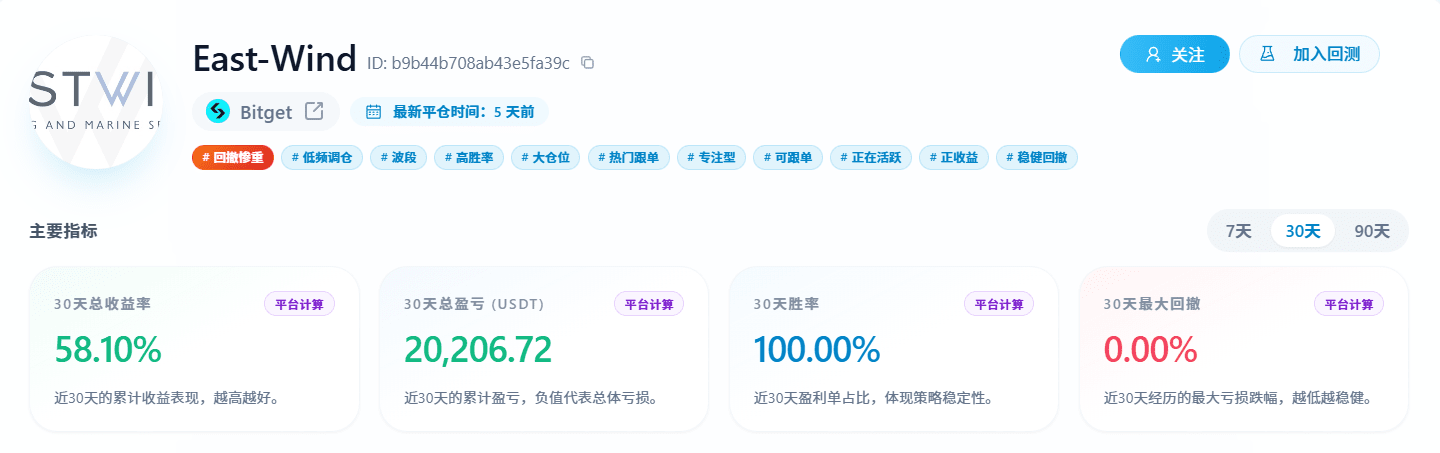
The signal provider East-Wind has taken the spotlight with '180 days ROI 10100.36%, 17 trades 100% win rate' of perfect data, with 502 followers accumulating profits of 1564.98 USDT — but behind this impressive achievement is a high-risk strategy of counter-trend scaling and long-term holding. Below, we objectively break down this signal provider's true nature from data characteristics, trading logic, risk points to following suggestions.
1. Core Data: The underlying logic of 'Perfect Performance'
Performance: Achieved over 100 times returns in 180 days, with total profits exceeding 20,000 USDT, all 17 closed trades profitable, with no losses;
Trading characteristics:
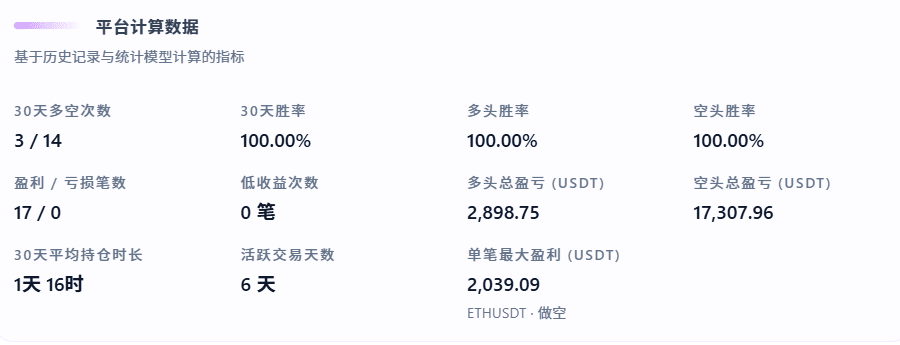
Only trading ETHUSDT, 100% focused on a single asset, 82% of trades are short, prefer medium to short-term swings (average holding period 1 day 16 hours);
The average profit of followers is only 3.1USDT, with a significant gap compared to the lead trader's earnings (possibly due to small follow-up funds and late entry times);
Current margin is 0USDT, real-time positions are not displayed, trading information is not transparent.
Two, behavioral insights: the secret to 100% win rate — counter-trend increasing positions + concentrated closing positions
East-Wind's 'undefeated record' is not based on precise entries but relies on a set of high-risk strategies:
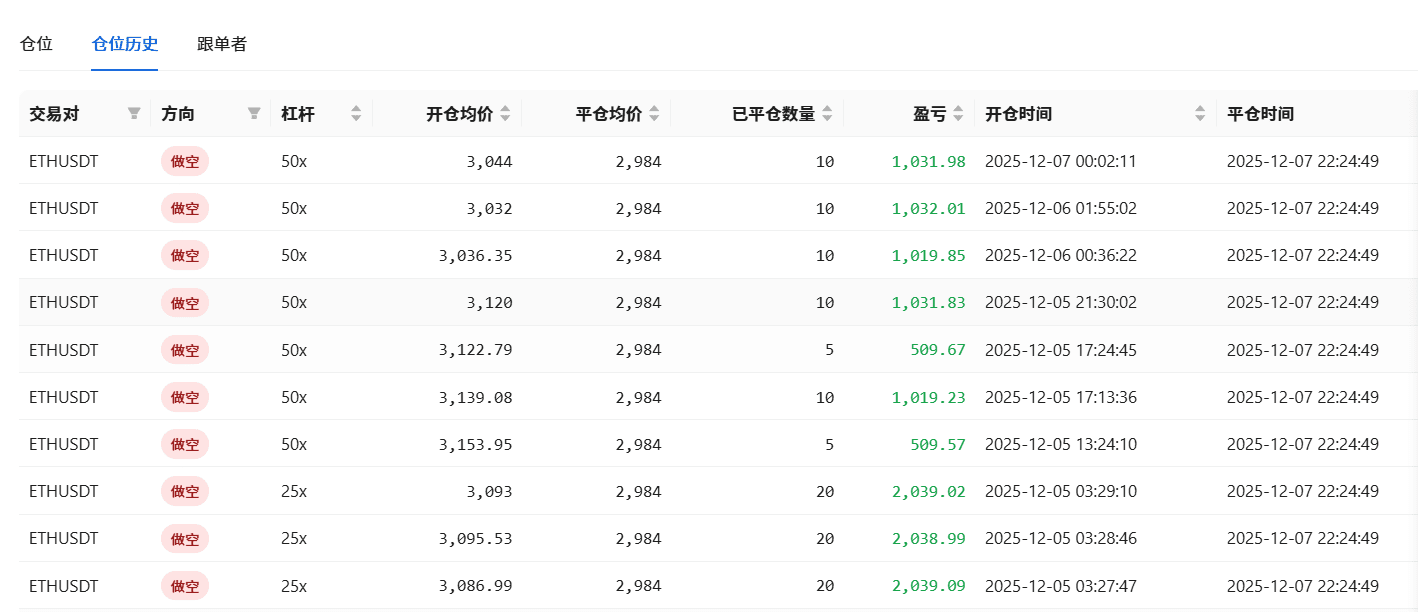
Grid / staggered counter-trend layout: When the market is opposite to expectations, continuously increase positions to dilute costs until the market reverses and then concentrate on closing positions. For example, from December 5 to 7, 2025, he opened 10 short positions in the ETH 3032-3153.95USDT range, ultimately closing uniformly at 2984USDT for a profit — relying on enduring short-term floating losses for eventual profits.
Patiently wait, do not trade frequently: Trading is concentrated from late November to early December, waiting in empty positions when there are no opportunities, reflecting a certain discipline, but the core profit logic still relies on 'holding positions'.
Three, the four core risks that must be vigilant about
Extreme drawdown + liquidation risk: a 100% win rate is achieved by 'holding floating losses to profit', if encountering unidirectional extreme market conditions for ETH (such as continuous surges or drops), positions increased against the trend will face huge floating losses, and once exceeding the limits of capital and leverage tolerance, it will trigger collective liquidation, causing devastating losses (this situation has not yet occurred).
Zero-stop-loss risk gap: inferred from trading behavior, it is highly likely that no stop-loss is set — this is the key to maintaining a 100% win rate, yet it exposes followers to the risk of 'potential losses being unlimited in a single trade' until the account is liquidated.
Information opacity risk: current positions are not displayed + margin is 0, followers cannot judge their position accumulation rhythm and overall position risk, can only follow passively, unable to timely avoid risks.
Small sample bias risk: only 17 successful trades, just coinciding with the recent ETH volatile market; if entering unidirectional trending markets, counter-trend increasing position strategies will completely fail, and past performance is not indicative of long-term reference.
Four, following trading suggestions
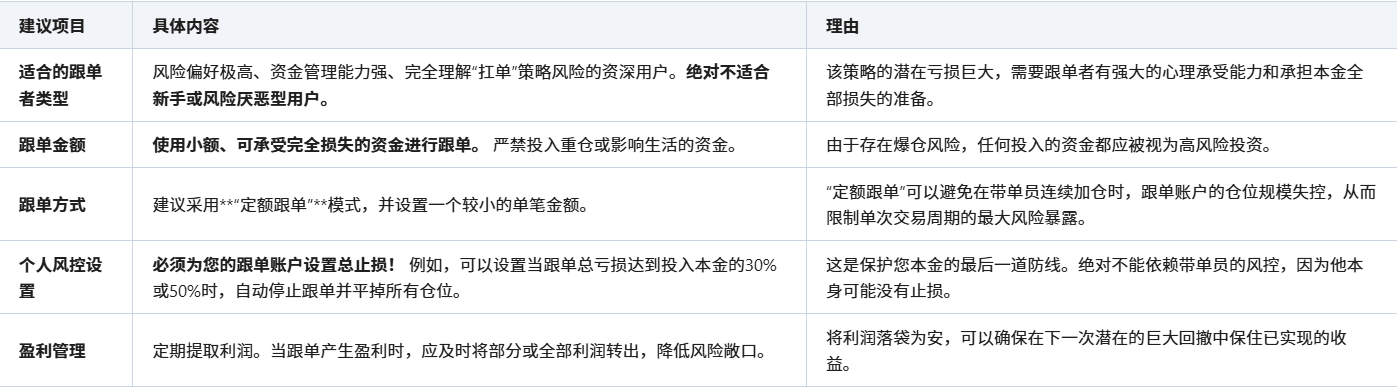
Adapted audience: ✅ Investors with extremely high risk tolerance, understand the essence of holding strategies, and can accept total loss of principal; ❌ Beginners, risk-averse individuals, and users seeking stable returns (directly avoid, this is high-risk speculation rather than investment).
Practical rules (if determined to follow trades):
*Capital management: only use small amounts of idle money (1%-2% of total investment), never invest living expenses or heavy capital;
*Follow-up trading model: choose 'fixed amount following', set the single transaction amount to the platform's minimum tier, to avoid position control issues from increasing positions;
*Mandatory stop-loss: set a total stop-loss for the following account (if losses reach 30%-50% of invested capital), manually close positions and exit, do not rely on the lead trader;
*Profit realization: once a profit is generated, promptly transfer out part/all of the profits to reduce subsequent risk exposure.
Core reminder: East-Wind's 'perfect data' is based on the premise of 'not encountering extreme market conditions', and its strategy is essentially 'using floating losses to exchange for win rates', rather than true low-risk profit. The core of following trades is not to chase 100 times returns, but to be mentally prepared for 'total loss of principal'.
Source: Weishi Chart
Summary:
East-Wind's trading strategy demonstrates strong profitability in a volatile market, but its extreme holding and zero-stop-loss characteristics pose a risk of liquidation. Whether to follow trades is essentially an assessment of one's own risk tolerance — if one cannot accept 'losing everything in one mistake', the most rational choice is to observe; if choosing to participate, it is essential to prioritize risk control.
The report is based on publicly available data analysis and does not constitute investment advice. Investors need to make rational decisions based on their own risk preferences and financial conditions, always prioritizing the safety of their principal and not being misled by short-term huge profits into blindly following trends.
[This report is a simplified version, the complete analysis report can be obtained using the small tool on the homepage]

