

@Injective In a year when most of the crypto market feels like it’s exhaling after too many months of holding its breath, Injective (INJ) has been carving out its own, slightly strange path. Strange in the sense that it doesn’t behave the way a typical Layer 1 token does during risk-off conditions. And maybe that’s exactly what makes it interesting. I’ve watched INJ for a while now, and every time I revisit its token design, I find myself asking the same question: how does a deflationary Layer 1 hold up in a market that has become more cautious, more selective, and frankly more skeptical of grand narratives?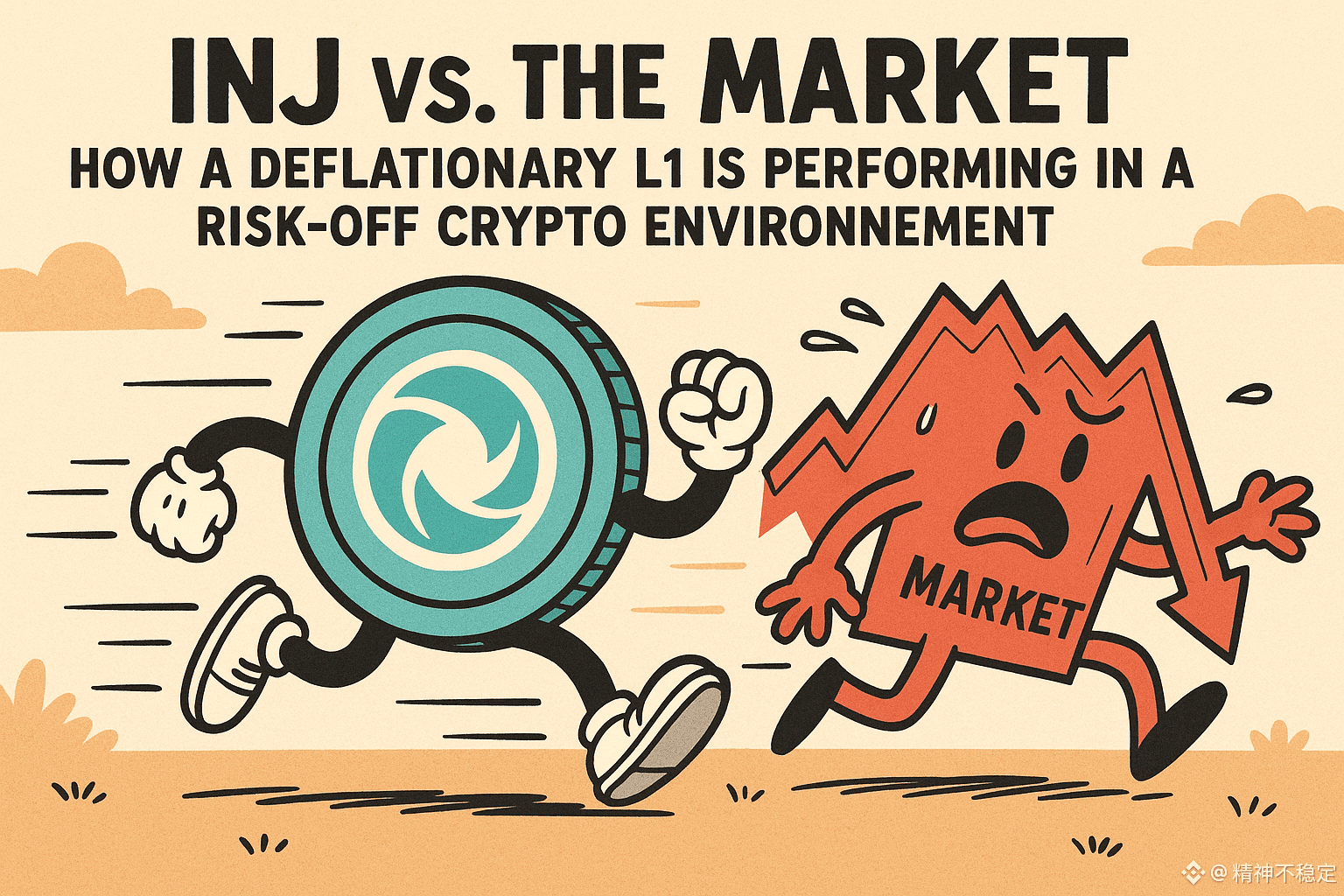
There’s something refreshing about a token economy that isn’t built around endless emissions. INJ takes a different angle by leaning into deflation. Fees from the ecosystem are used to buy back and burn tokens, and over time this slowly shrinks supply. On paper, this should give the token a kind of resilience during downturns—but markets rarely move according to spreadsheets or tidy white-paper logic. They move according to sentiment, liquidity, and whatever happens to be scaring or exciting investors on any given week.
Still, the deflationary design stands out because it forces you to think about value differently. Most Layer 1s try to offset dilution with ecosystem growth, hoping users won’t notice how quickly circulating supply balloons. INJ instead takes the opposite path: it shrinks as usage grows. I’ve always liked the conceptual simplicity of that. But I also know simple ideas often meet complicated realities, especially when the industry shifts into risk-off mode, as it has across much of the past year.
What’s striking is that INJ has sometimes managed to outperform even while broader sentiment dips. Not in a dramatic, headline-grabbing way, but in a steady kind of “people aren’t selling this as quickly as everything else” way. It makes you wonder whether deflation gives holders a sense of long-term grounding—something to hold onto when everything else feels slippery. Or maybe it’s less philosophical than that. Maybe it’s just supply pressure doing its job. When fewer tokens exist, it doesn’t take much demand to keep prices from falling off a cliff.
The ecosystem itself also plays a role. Injective is built with a laser focus on finance: derivatives, order books, predictable transaction behavior. It’s not the loudest or most charismatic chain, and maybe that’s part of the appeal. When the market pulls back, the projects that don’t rely on hype cycles tend to look more stable. I’ve always felt that Injective has this quiet confidence in how it presents itself. It doesn’t try to be everything. It tries to be one thing really well. I respect that.
Still, the performance of a token—any token—can’t be judged solely by engineering choices. Markets care about narratives, and the INJ narrative is still evolving. A deflationary L1 is not something we see every day, and investors are still figuring out what that means in practice.
Is this thing basically digital plumbing or a savings asset? And will it naturally get more valuable as everything expands, or is the deflation just for show? Those are open questions, and it may take years before the answers are obvious.
One thing that does feel clearer is the relationship between INJ and risk appetite. In high-fear environments, assets that show structural scarcity tend to draw curiosity. I’ve seen it firsthand in my own analysis—when markets turn ugly, people look for assets that won’t drown in inflation. INJ sometimes benefits from that. But deflation also has its own challenges. If users believe tokens will always be worth more tomorrow, spending slows down, and ecosystems can stagnate. That’s the tightrope Injective has to walk. It must keep INJ scarce enough to feel valuable but not so scarce that the token becomes something people hoard rather than use.
What stands out to me lately is how well Injective has navigated expectations. The team doesn’t oversell progress, and the market seems to appreciate the consistency. In risk-off periods, consistency becomes a kind of currency. Flashy announcements lose power. What matters is whether a chain can keep building, keep integrating, keep attracting teams that want predictable infrastructure. By those measures, INJ is doing better than many of its peers.
Still, I remind myself that performance in down markets can be misleading. A token that falls less than others isn’t necessarily strong; sometimes it’s just less liquid or held by a smaller, stickier group of believers. INJ has real activity, but its market profile is still developing. It isn’t yet at the scale where deflation alone determines its fate. It lives at the intersection of supply mechanics, niche adoption, and a community that seems unusually patient.
Where does that leave INJ compared to the rest of the market? In an odd, almost paradoxical position. It is both resilient and unproven, both structured for long-term value and still early enough that nothing is guaranteed. I find that ambiguity compelling. It leaves space for imagination but also forces discipline. Investors can’t simply rely on “number go up” logic; they have to understand the mechanics and believe in the ecosystem itself.
Maybe that’s why INJ feels different in a risk-off cycle. It isn’t trying to outrun panic with promises of explosive growth. It’s doing something quieter: reducing supply little by little, strengthening its infrastructure, and trusting that long-term behavior will matter more than short-term volatility. Whether or not that pays off depends on far more than market cycles. It depends on whether Injective becomes a place where real financial applications want to build and stay.
Even after all the time I’ve spent looking at this market, I still feel a kind of cautious optimism when I think about experiments like INJ. Deflationary designs aren’t magic, but they create interesting incentives. And in a landscape where so many tokens fade as soon as liquidity dries up, a model built around gradual scarcity and steady utility feels like a welcome counterpoint. INJ isn’t trying to be a hero token—it’s trying to be a durable one. That might end up being just as valuable.
@Injective #Injective #injective $INJ
