

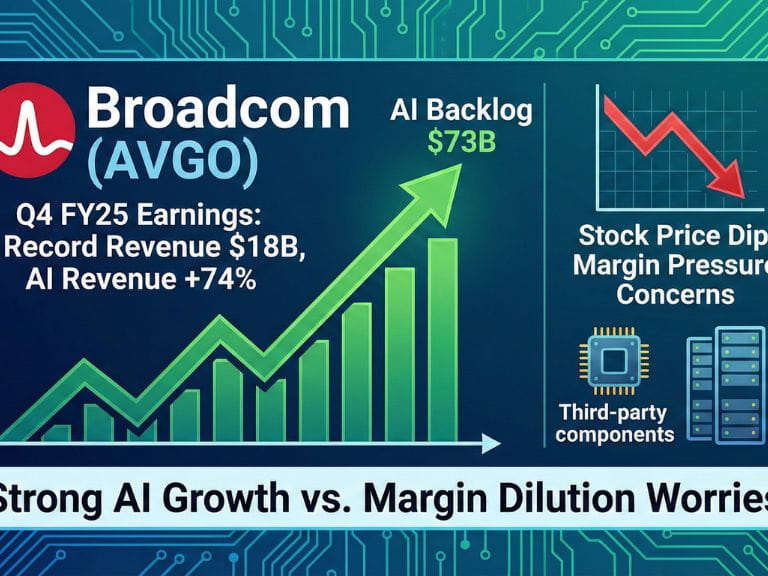
Google's key partner in developing TPU, Broadcom (NASDAQ: AVGO), has reported an impressive financial performance, with fourth-quarter revenue reaching $18 billion, exceeding the expected $17.49 billion, a year-on-year increase of 28%, setting a historical high. The adjusted earnings per share (EPS) were $1.95, a year-on-year increase of 37%, surpassing the expected $1.86. However, CEO Chen Fuyang stated that it is inconvenient to provide a revenue forecast for AI in 2026, triggering market panic, and the stock price fell by 4.6%.
Broadcom's Q4 financial performance is impressive, with revenue and EPS both exceeding expectations.
In the fourth quarter of 2025, Broadcom delivered an impressive performance, with fourth-quarter revenue reaching $18 billion, exceeding the expected $17.49 billion, a year-on-year increase of 28%, setting a historical high. The adjusted earnings per share (EPS) were $1.95, a year-on-year increase of 37%, surpassing the expected $1.86.
CEO Chen Fuyang (Tan Hock Eeng) revealed astonishing AI demand data during the conference call, with Q4 AI revenue reaching 6.5 billion dollars, a year-on-year increase of 74%. Holding up to 73 billion dollars in AI-related orders (including customized chips XPU, switches, DSPs, etc.), the overall order backlog reached 162 billion dollars, expected to be shipped within the next 18 months; the backlog order for AI switches alone exceeds 10 billion dollars. Delivery is expected within the next 18 months.
Chen Fuyang also confirmed for the first time during the conference call that the rumored mysterious major customer is the AI startup giant Anthropic. The two parties signed a multi-billion dollar order involving Google TPU (Ironwood project), and an additional order of 11 billion dollars has been added this quarter. It was also announced that the fifth customized chip (XPU) customer has been signed, with the first order reaching 1 billion dollars.
There are concerns in the external environment regarding the revenue structure trend: high revenue, low margin.
Analyst Stacy Rasgon asked about gross margin data during the conference call, and Broadcom's CFO Kirsten Spears frankly admitted that as the company begins selling complete AI server cabinets that include third-party components such as memory and cooling, future gross margins will face pressure.
Although this can lead to higher total revenue and absolute profit amounts, the lower profit margin of the hardware assembly business compared to chip design will result in a decline in overall gross margin percentage. The market is sensitive to this kind of high revenue, low margin structural change.
The long-term risk that the industry is most concerned about is customer internalization. Broadcom's major customers (such as Google) have strong resources, and the market is worried that these tech giants will eventually fully master chip design capabilities or turn to collaborate with other design companies, thereby abandoning Broadcom.
In response to this skepticism, Chen Fuyang strongly replied that the idea of customers fully turning to self-developed tools is an overblown hypothesis. He pointed out that the technological evolution of customized AI accelerators (XPU) is very rapid, and Broadcom possesses exclusive IP (such as SerDes, high-speed transmission interfaces) and packaging technology. For customers, collaborating with Broadcom can achieve stronger chip performance faster than going it alone. He emphasized that this is a long-term strategic journey, and Broadcom's technological moat is difficult to cross easily.
The key reason for the stock price turning from rising to falling despite the earnings report exceeding expectations is that Broadcom did not provide a forecast for AI revenue in 2026. Chen Fuyang stated, "The market is changing rapidly, and it is difficult for me to predict what 2026 will look like; it is inconvenient to provide guidance."
This article Broadcom's (Broadcom) Q4 earnings report exceeded expectations! Securing a multi-billion dollar order from Google TPU, the stock price fell by 4.6%, first appearing in Chain News ABMedia.