
The DEFI ecosystem is becoming increasingly large, and many friends are gradually starting to encounter on-chain and DEFI-related content, often hearing some terms they don't understand. Today, let's explain what LP and pools are.
This is a fundamental and also the most important concept in decentralized finance (DeFi). Understanding 'pool' and 'LP' is to understand the core of DeFi liquidity.
What is a 'pool' (Pool)?
In the context of DeFi, a 'pool' (Pool, also known as a liquidity pool) specifically refers to a collection of crypto assets locked by a smart contract.
It is not an account controlled by any centralized company, but rather an automated code running on the blockchain.
Core Function
Liquidity pools are at the core of decentralized exchanges (DEXs), lending protocols, and many other DeFi applications. Its main purpose is to replace traditional order books, enabling automated trading and lending of assets.
Operating Principle (Taking DEX as an Example)
Asset Pairing: A liquidity pool typically consists of two or more assets, such as an ETH/USDC pool.
Automated Pricing: The pool uses a mathematical formula (like Uniswap's X * Y = K) to determine the exchange price of the two assets.
Counterparty: When a user wants to exchange ETH for USDC, they are not buying from another trader, but directly trading with the assets in the pool. The pool automatically acts as the counterparty for the transaction.
What is LP (Liquidity Provider)?
LP is short for Liquidity Provider. They are the source of funds that allow the liquidity pool to operate.
Core Function
LPs are those who deposit their held crypto assets (usually two tokens of equal value) into the liquidity pool. By providing assets, they supply the market with the liquidity needed for trading.
Incentives and Risks
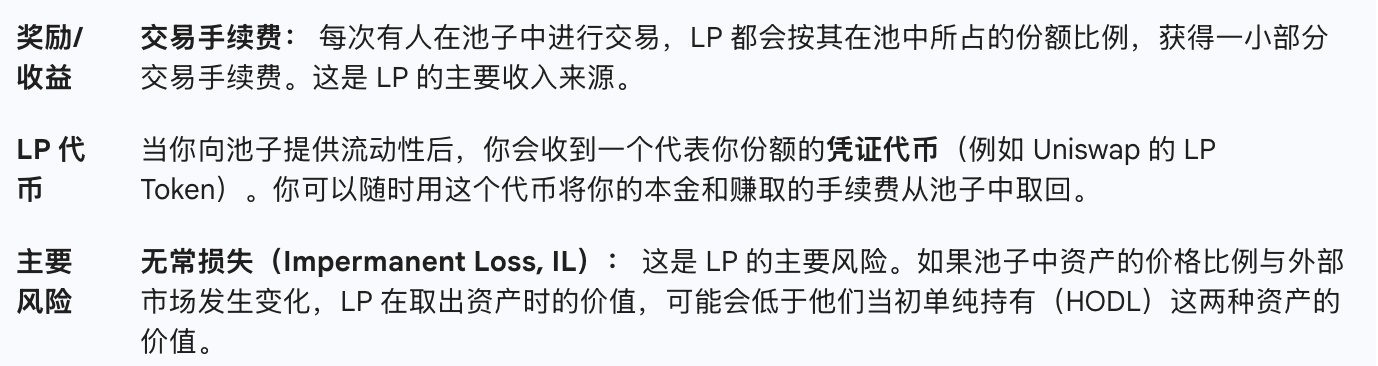
Relationship between the Pool and LP

In simple terms: LPs put money into the pool, which uses this money to provide all users with automated, instant trading services, and LPs earn commissions from it.


