

You'd better ask yourself honestly: Which camp are you on? Do you like cryptocurrency?
Article by: Evanss6
Article source: Foresight News
At any point in the past, when discussing cryptocurrencies, this has likely been good advice: hold onto Bitcoin, or any major coin, do some staking, try out new rewarding products, and avoid liquidation when trading futures contracts. This likely leads to profits. Underlying this are two core beliefs: Bitcoin will become a more mainstream non-sovereign store of value; and smart contracts will become the infrastructure of finance.
I won't go into detail about how these judgments were verified, because we need to talk about this "cage." I'll just cite two facts:
Bitcoin ETFs saw inflows of $49 billion, Ethereum ETFs saw inflows of $4.3 billion, and many more altcoin ETFs are just getting started. Michael Saylor himself has bought over $40 billion, and many companies are also gradually buying in.
Robinhood has just announced that it will use Arbitrum's technology stack to build an EVM chain as the backend financial infrastructure for its platform, and will also launch the most popular product in cryptocurrency: perpetual contracts.
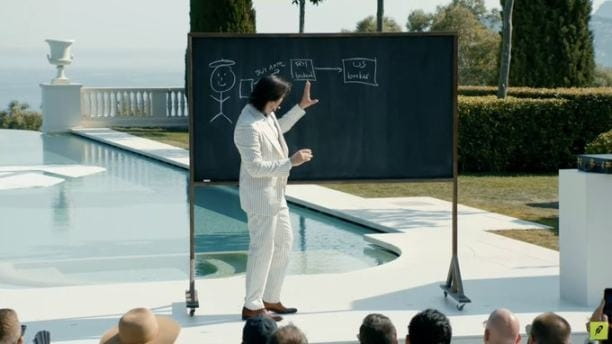
Cryptocurrencies are increasingly resembling traditional finance. They were bought by the previous generation in brokerage accounts, marketed by Larry Fink, and used as technology by companies like Robinhood. What many of us imagined a decade ago is becoming a reality.
What exactly is the "sunk cost cage"?
Simply put, it's about persisting in something because of past investments. This can happen in many ways: your skills, your existing investments, your relationships, a job you're afraid to quit, or spending all your time on cryptocurrency.
"I don't want to leave her because our past is too deep."
"I don't want to change careers because I've already spent too much time on this."
"I don't want to sell Ethereum because I bought it early on, and it has treated me well."
These are all sunk cost fallacies. Not realizing you're thinking this way is self-destructive, making you continue doing things you know deep down are no longer beneficial.
The sunk cost trap is a modern version of Plato's allegory of the cave.

The prisoner only recognized the shadow on the wall, but did not know where the shadow came from, nor did he know that there was a bigger world outside.
In Plato's parable, the prisoner remained in the cave because he mistook the shadow for reality, unaware of the "more real" world outside. In the modern version, we stay not out of ignorance, but because we've invested too much in the shadow. The job that's no longer suitable, the profession we no longer believe in, the identity built through long hours and silent endurance—these are all costs incurred. The more time, education, and reputation invested, the harder it is to leave. Illusion is no longer merely external; it's internalized as responsibility, logic, and "reasonableness."
But freedom is not cheap. Escaping the cage of sunk costs means acknowledging that what you've built may no longer benefit you. Past efforts cannot be a reason to stay. Like a prisoner turning to face the light, this requires not only courage but also betraying the self that was overly loyal in its self-investment. The hardest part is not seeing the truth, but saying goodbye to the self that lingered too long, believed too deeply, and paid the price for the cage.
My experience
I myself spent a long time in that cage.
I fell in love with poker when I was a teenager. In the back of high school classrooms, I would always be calculating my expected bankroll in my notebook, neither paying attention to the lesson nor taking notes. Within two years, I went from playing small games of $0.01/$0.02 to high-stakes games. As time went on, I disliked playing more and more, treating it only as a way to make money. At that time, I always thought, "I'll quit in two or three years."
Ten years have passed, and nothing has changed. I'm still playing, still winning, but I always feel like I don't have enough money to "do something else." Worse, I don't even know what I can do, and I see it clearly: poker is a declining game, and I have to work harder and harder to keep up. But I tell myself I should continue because I've spent so much time getting better, it pays off more than other options, I have no other viable path, and I don't have time to think about how tiring it is to be a consistent winner in high-stakes online games: researching strategies, finding suitable games, protecting against cheating and hacked platforms…
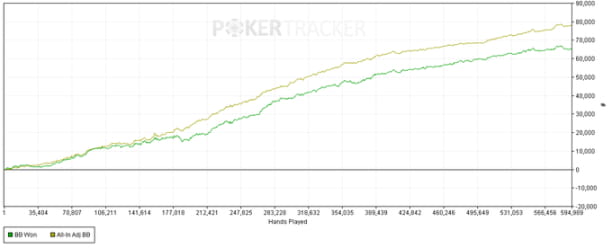
To be honest, this kind of "can't easily switch careers because it's profitable" is a luxury. But when it became increasingly difficult for me to find a better industry, I knew my days were numbered.
Introduction to Cryptocurrency
I first encountered cryptocurrency through my previous job. In 2012, I first read about Bitcoin on a poker forum called TwoPlusTwo. At that time, the Bitcoin section of the forum had already been running for over a year.
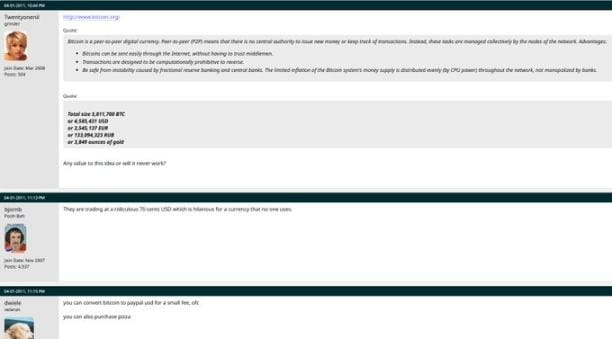
The first reply was hilarious: "This thing is worth 70 cents now. A currency nobody uses can be worth that much? LOL." The second reply said it could actually be exchanged for dollars or used to buy pizza—this was an early use of the later $2 trillion in assets. Scroll down a few more:
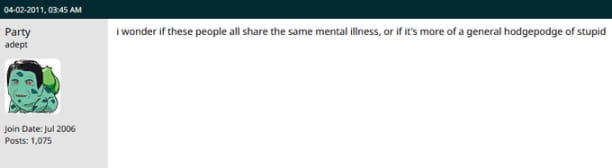
"What a missed opportunity." Anyway, I noticed it because some poker websites started using it. At the time, I thought its $2 billion valuation was outrageous. If it could only be used in the black and gray markets, maybe it was worth that price; if it could become mainstream, its value would increase many times over.
By 2016-17, as my investments had become substantial, I was spending more and more time on cryptocurrencies (especially ICOs). This diversion of time was my first step in escaping the cage. But I didn't really jump in until DeFi emerged in 2020 and actually started making money.
At that time, I knew absolutely nothing about trading and could only learn as I went. I studied economics and mathematics in college, but the only thing I really knew how to play was poker. Fortunately, poker is an excellent training ground for learning trading: it gives you ruthless real-time feedback on your decisions, forces you to manage risk, price correctly, and develop overall strategies, and it also helps you develop emotional resilience and soft skills to weather bad periods—all of which are necessary for independent trading.
Finally, I'm grateful and fortunate to have spent a lot of time exploring these curiosities between 2013 and 2019, which put me in the best position when opportunities arose. I might have played better if I had focused more on poker during those years, but I was really lucky to have followed my intuition in developing transition/exit plans.
How did this "cage" come to be applied to today?
Over the past few years, financial nihilism has become increasingly apparent in the cryptocurrency world. More and more people no longer believe in the rosy ideals they had when they first entered the market. The goal has become "making money," with everyone throwing themselves into it, working tirelessly, and then "quitting" once they've made enough.
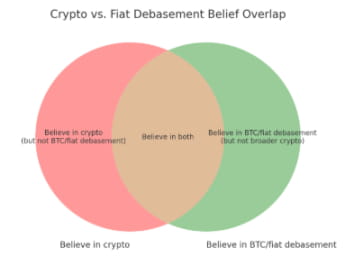
There are roughly four camps:
The pro-independence camp (believes in Bitcoin, not other cryptocurrencies)
The Red Camp (believes in cryptocurrencies, not Bitcoin)
Brown camp (both believers)
The White Camp (does not believe in either).
Adding two more scenarios to each faction makes it eight:
(a) I believe there is still room for further gains, and it's worth the risk.
(b) It is believed that the upside potential has already been captured by early buyers.
I believe only those in category 2(a) should dedicate all their time to cryptocurrency. If you're in categories 1(b), 2(b), 3(b), or 4(b), you'd better start allocating your time and making an exit plan. If you're in category 1(a) or 4(a), just hold onto your Bitcoin and don't worry too much about anything else. Category 3(a) can hold some Bitcoin and other assets, spreading their time and energy between cryptocurrencies and non-cryptocurrencies. If you've looked at my account and posts, you can probably see that I was in category 2(a) for most of 2015-2023, and now I'm somewhat oscillating between 1(a), 3(a), and 3(b).
Let's talk about the Red Camp again. The past few years here have been quite painful.
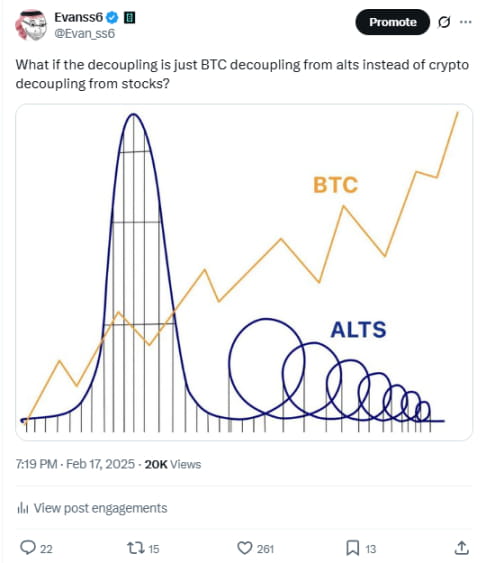
We're basically in a situation where Bitcoin's dominance continues to rise, despite the overall increase in cryptocurrency adoption. Even if you accurately predicted the Ethereum ETF would see over $4 billion in net inflows, predicted giants like Robinhood would use its technology, predicted Trump's victory, SEC reform, the end of OCP 2.0, and the creation of a supportive environment for cryptocurrencies, your Ethereum investment would still be down since the ETF's launch. Today, Ethereum is around $2600, meaning investors from 2015 would have seen their investments increase by 2000 to 8600 times.
Therefore, the answer is...
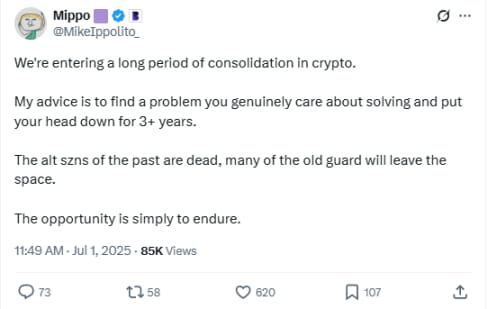
I doubt whether "patience," as Mippo mentioned in the tweet at the beginning of this article, is the right path or the greatest opportunity. Everything you dream of has either already happened or is on its way. In 2017, if Robinhood had announced its development on Ethereum, the price would have immediately jumped 10%, but that's changed now. The current strategy is to buy Robinhood stock. I believe there are still opportunities in cryptocurrency, but the trend of these opportunities being taken by non-crypto assets (stocks) or insiders (teams/private investors, look at Celestia Finance) is not very friendly to dreamers. If you really want to "patience," you should invest in these projects early or do it yourself. So Mippo is right; solving real problems in cryptocurrency still presents an opportunity. But don't assume that just because cryptocurrency technology has become more widespread, the current price will necessarily rise (especially compared to other assets you can invest in).
Unless you are a true die-hard supporter of the Red Camp 2(a), "patience" means choosing to stay in the cave and watch the shadows on the wall, while the people outside are already working on AI and robots.
You'd better ask yourself honestly: Which side are you on? Do you like cryptocurrency? In any case, try to develop some skills that can be used elsewhere, so you have a backup plan if things don't work out. At least you won't be unhappy because you're wasting all your time on something you're already tired of. And if things go wrong, you'll have a soft landing.
The door to the sunk cost prison isn't locked; what traps you is only your own thoughts. All you need to do is open the door every now and then and step out. Life is beautiful, and the world is full of possibilities.

