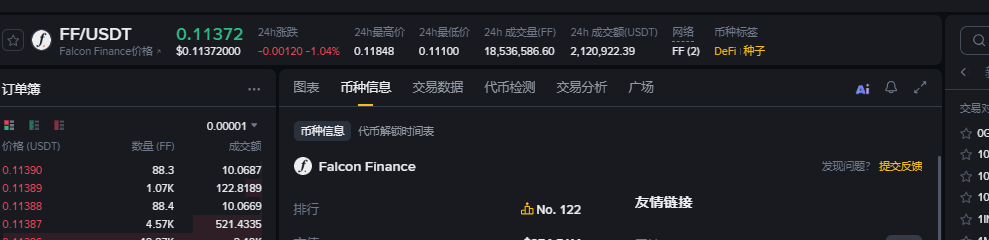
Let's be honest: the stablecoin market is already chaotic enough. Some claim to have 100% reserves but don't disclose their books, while others directly de-peg during market crashes. However, Falcon Finance is quietly doing something solid in this chaotic market—its synthetic dollar USDf and yield vault sUSDf are gaining the trust of more and more traders, institutions, and smart money.
No viral marketing, no celebrity endorsements, only real profits and transparent collateral. Today, let's talk about why this low-key project is worth your attention.
Simply understand Falcon: what exactly is it doing?
You can think of Falcon as two things: asset mixer + yield savings jar.
Step 1: Mint USDf with assets
You can use BTC, ETH, or even tokenized government bonds or corporate bonds as collateral to generate USDf stablecoins. The key is that the value of the collateral is always higher than the generated USDf (for example, using $1.5 worth of BTC to generate $1 USDf). This 'over-collateralization' is the safety net that keeps USDf pegged even during market crashes.
Step 2: Deposit into the sUSDf vault to earn returns
After obtaining USDf, you can deposit it into the sUSDf vault. The vault will automatically run low-risk strategies (such as basis trading and options arbitrage) to generate an annualized return of 8-12%. This is not a fleeting high APY, but rather sustainable real returns.
Falcon's core logic is clear: not relying on printing money to create bubbles, but making your existing assets earn interest more efficiently.
Why are more and more people choosing Falcon?
After experiencing various 'blowups' and 'black boxes', crypto users have become smarter. Falcon wins on two points:
1. True stability
USDf is not pegged to the dollar 'just by faith.' Its collateral is diversified: cryptocurrencies + real-world assets (government bonds, corporate bonds, etc.). Just like a house with multiple load-bearing pillars — if one shakes, the others remain stable. Falcon has even set up insurance pools and hedging mechanisms to cope with extreme market conditions.
2. Fully transparent and verifiable
Remember those projects that said 'we have reserves' but provided no evidence? Falcon is the complete opposite:
All collateral assets are traceable on-chain
Using reliable oracles like Chainlink for pricing
Regularly audited by top-tier firms
For institutions, this level of transparency is not an 'add-on' but a 'necessity.'
Key upgrade: entry of real-world assets (RWA)
Falcon's most important recent advancement is the introduction of a large number of tokenized traditional financial assets:
Mexican short-term government bonds (CETES): provide stable interest, attracting Latin American funds
AAA-rated corporate bonds (such as those issued by Coca-Cola and Microsoft)
Safe-haven assets like gold and US Treasury bonds
This is not just about 'increasing collateral varieties.' By combining crypto assets with traditional low-risk assets, Falcon allows USDf to have profitability, stability, and compliance simultaneously. For corporate finance, it's like a crypto fund that can be redeemed at any time and still earn interest.
$FF token: governance rights, not a speculative asset
$FF is not a MEME coin that makes you 'rich'; it is the governance certificate of the protocol:
Total supply of 100 billion, currently circulating about 20 billion
Holders can vote to decide which new assets to add and adjust parameters, etc.
After recent upgrades, some protocol earnings are distributed to stakers in USDf form
On-chain data shows that large sums are being withdrawn from exchanges and long-term staked in $FF — this is a typical signal that smart money is 'quietly positioning'.
Why are institutions starting to take it seriously?
Traditional financial institutions do not care about 'crypto hype'; they care about:
✅ Verifiable compliance: can prove fund safety to regulators
✅ Convenient fiat channels: integrated with top custodians like Fireblocks
✅ Composable financial tools: can build your own products based on this
Falcon is not 'seeking institutional entry' but building crypto financial infrastructure that meets their standards.
Risks that must be understood
There is no perfect protocol, and Falcon carries risks as well:
Smart contract risks: no matter how many audits, there may still be unknown vulnerabilities
Oracle Failure: Price data errors may affect collateral rate calculations
Token Unlock Pressure: There are still some $FF unlocks in the future, which may affect the price
Macro Shock: Severe changes in interest rates may affect the value of bond collateral
Remember: USDf is a complex financial product with real returns, not a risk-free bank deposit.
Future direction: more RWA, more trust
Falcon's roadmap for 2026 is clear: introduce more sovereign bonds, expand corporate credit tokenization, deepen institutional cooperation. The goal is not to become the 'largest stablecoin,' but to become a reliable pipeline connecting traditional yields and DeFi liquidity.
In conclusion: In this noisy market, sometimes silence is more powerful.
Falcon does not chase headlines; it only does three things:
Ensure stability with over-collateralization
Win trust through transparent audits
Retain users with real returns
In a market cycle that gradually returns to rationality, this low-key, solid, problem-solving approach may be the true foundation that can weather bull and bear markets.
It may never trend, but those who prioritize capital safety and sustainable returns will eventually discover its value.
In the crypto world, the most enduring victories are often not the loudest but the most trustworthy.
@Falcon Finance #FalconFinance $FF