

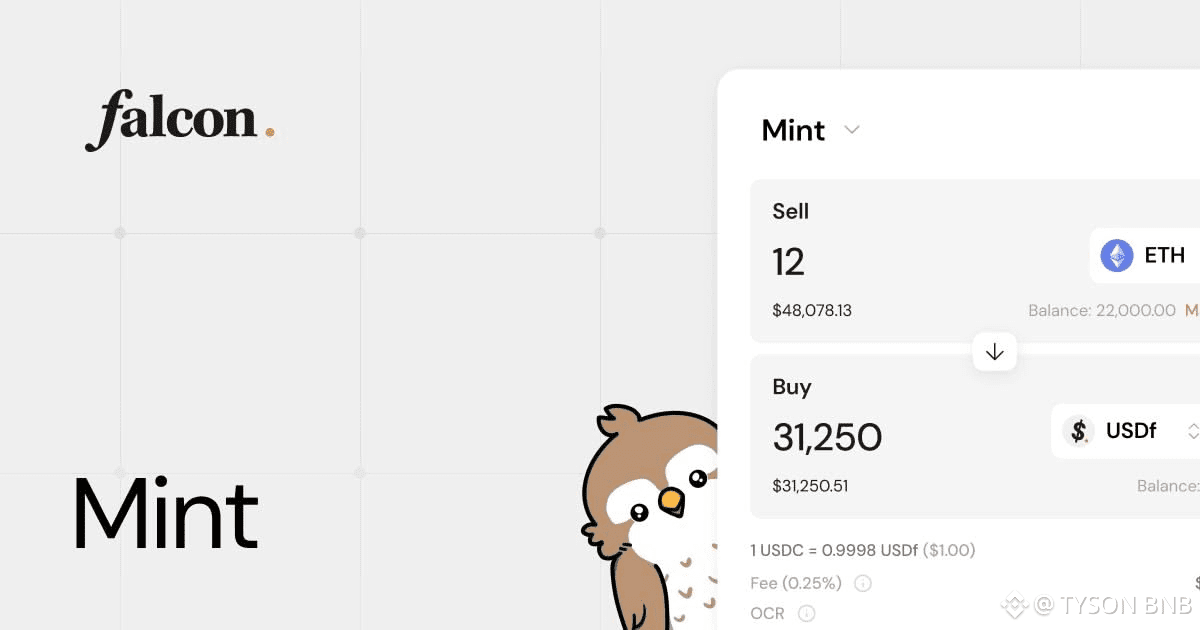
 Beneath the numbers, Falcon Finance reads the market like a nervous city—every footstep, every stalled taxi, every bright storefront tells a story about where capital wants to go and how it should be steered. Falcon’s promise is simple-sounding but powerful: unlock liquidity from virtually any liquid asset and let that liquidity become fuel for on-chain markets rather than dead weight sitting in custodial vaults. The protocol’s own site describes it as a universal collateralization infrastructure that mints USDf against a broad spectrum of assets, letting users preserve yield while freeing capital for trading, lending, or treasury needs.
What makes Falcon feel less like a single product and more like an engine is its insistence on measurement. The updated whitepaper lays out an architecture built around continuous telemetry: asset-level risk profiles, yield capture opportunities, funding and basis spreads, and real-time collateral health indicators are not afterthoughts but core inputs to how USDf is minted, priced, and managed. That approach turns the protocol into a feedback system—on-chain signals inform risk parameters, which in turn modulate capital flows across vaults, minting lanes, and yield strategies.
Imagine a lender’s dashboard that doesn’t just show how much is lent, but reads borrower behavior: which collateral baskets are concentrated, which yield-bearing positions are being used as margin, where liquidation pressure is building. Falcon’s product stack and docs point to developer APIs and modules designed to surface exactly this kind of telemetry—time-series of collateralization ratios, movement of wrapped yield assets, and the distribution of USDf across staking and active liquidity pools. Those streams let automated risk managers nudge incentives: raise margin requirements where concentration grows, deploy rebalancing flows when funding rates diverge, or open capacity where freshly tokenized real-world yield appears attractive.
There is an emotional, human side to this data-first ethos. For a protocol user—an institutional treasury, a market-making desk, or an active trader—uncertainty is the tax on participation. Falcon’s analytics don’t remove market risk, but they reduce the psychic tax: clearer signals about collateral health and funded positions mean stakeholders can move with intention instead of guesswork. When TVL and circulation figures are public and paired with transparent yield sources, confidence rises; community behavior changes from hoarding to active capital allocation, and markets become deeper and more resilient. Recent coverage notes Falcon’s rapid traction and significant USDf circulation and adoption metrics—real numbers that translate to more predictable liquidity provisioning across DeFi.
Operationally, the protocol channels analytics into three concrete levers. First, pricing and minting logic: by tracking basis, funding, and cross-exchange spreads, Falcon can calibrate how much USDf to allow against different collateral types without sterilizing the underlying yield those assets produce. Second, collateral health automation: on-chain monitors flag deteriorating positions and trigger staged rebalancing or margin adjustments rather than blunt liquidations, reducing market shocks. Third, yield routing: as the whitepaper and product updates explain, USDf and sUSDf act not only as stable units but as conduits—staked USDf converts into diversified yield strategies, with analytics deciding allocation weights to capture resilient returns. Those same mechanisms enable the protocol to act like a market maker of last resort when funding dislocations happen.
Data also changes governance. When token holders and strategy teams can see on-chain proofs—flow charts of capital, realized vs. theoretical yield, concentration indices—they govern with context. Falcon’s fundraising and expansion into broader collateral types (including tokenized RWAs) show how market participants prefer systems where metrics and decision-rules are auditable and automated rather than opaque. Institutional backers and strategic funds have taken notice; public reports of strategic funding rounds reflect appetite for a protocol that blends the auditability of on-chain data with active yield engineering.
But analytics alone are not a panacea. Data feeds must be high-quality, oracles robust, and incentive mechanisms aligned so that capital doesn’t chase transient arbitrage into fragility. Falcon’s documentation and community discourse emphasize multi-layered risk controls and diversified yield engines—an admission that an engine built on measurement must also measure its own failure modes. In practice that means conservative sizing for new collateral classes, phased exposure to real-world yields, and transparent dashboards that make stress-testing visible to everyone who supplies or borrows liquidity.
In the end, thinking of Falcon as a “data-driven DeFi engine” captures both a technical truth and an aspiration. The technical truth is that on-chain analytics—when designed into the protocol rather than bolted on—allow capital to be routed more intelligently, preserving yield while expanding usable liquidity. The aspiration is social: to change behavior so that users think of their assets as active participants in a financial ecosystem, not static deposits trapped behind friction. When capital begins to flow where data says it should, markets breathe easier, and the protocol becomes less an experiment and more infrastructure—one that reads the city, understands its rhythms, and helps money move with purpose.



