

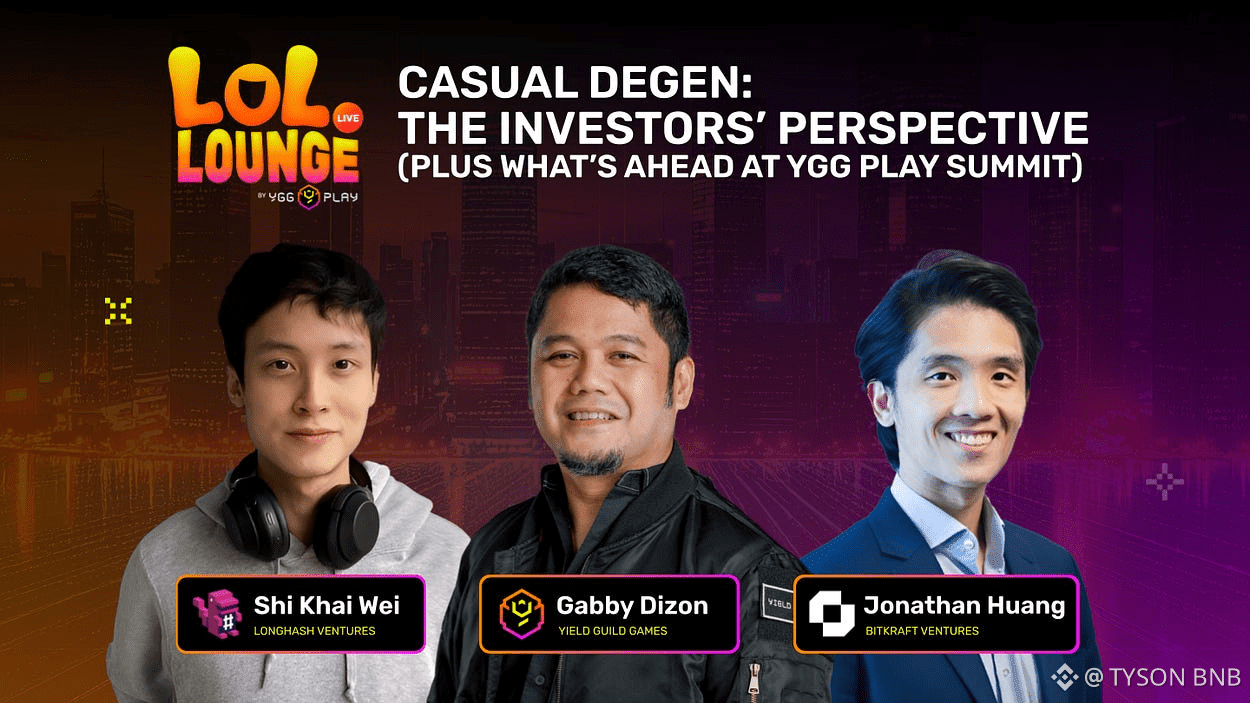
 YGGPlay quietly rewired a simple truth about on-chain entertainment: you don't need triple-A commitment to build a loyal crypto gaming audience. What YGG calls the "casual degen" is not a contradiction but a market insight — players who already live in wallets, Discords, and token charts, but who want short, joyful plays that fit between trades, memes, and real life. Instead of chasing mainstream gamers with long sessions and heavy learning curves, YGGPlay builds for people who want snackable mechanics, frequent rewards, and the familiar thrill of something that might moon tomorrow. This shift — from convincing normies to learn Web3, to giving Web3 natives better ways to play — is at the heart of YGGPlay's strategy and explains why a Launchpad, quest engine, and light mobile/browser titles are central to its roadmap.
There is a particular tenderness to the casual-degen product: it understands attention as a scarce, fragile thing and designs for tiny wins. YGGPlay's quest system and points model let players stack bite-sized objectives into a visible progression path that translates to reputation, access, and sometimes token allocations — a structure that turns short sessions into meaningful growth without asking for hours of grind. That matters because the casual degen's wallet already carries cognitive load: swaps, gas, NFT drops, and market noise. Design that slices through that noise with a clear, friction-light feedback loop is what converts novelty into habit. The technical scaffolding — cross-game quests, soulbound badges that serve as portable proof of experience, and a Launchpad that ties engagement to early token access — is not flashy; it's deliberate infrastructure for retention.
The product hooks into a very human thing: the small, repeatable dopamine of a completed task plus the social currency of being "first" or "known" inside a niche. YGGPlay amplifies that by letting micro-achievements carry weight across titles — your badge collection becomes a shorthand resume you can show when a new game opens its gates. For a casual degen, that badge is both brag and utility: it says "I played this, I earned that," and it can unlock better drops, priority access, or quest bonuses. This hybrid identity—part collector, part quick-play competitor—creates a tight loop where the emotional payoff (pride, status, potential upside) and the product payoff (access, rewards) reinforce each other. That social vector is precisely why Yield Guild Games is packaging publishing, discovery, and token launches into one unified YGGPlay experience.
On the distribution side, YGGPlay's Launchpad mechanic reframes token issuance as participation optics rather than pure speculation. By letting engaged players earn points and pledge for allocations through quests or staking, YGGPlay makes token launches into a continuation of gameplay — you participated, you showed up, you get first dibs. This lowers the barrier to entry for games that want an on-chain economy but need a dependable audience at launch, and it reduces the "random allocation" noise that often turns launches into FOMO lotteries. The first waves of projects rolling through YGGPlay — titles like LOL Land and GigaChadBat — show how light mechanics and recognizable communities can create meaningful prelaunch engagement without asking players to learn complex economies in a single sitting.
For studios and builders, the appeal is practical and emotional. Practically, YGGPlay funnels an audience that already knows how to click accept on a wallet prompt; emotionally, it offers a way to build lasting relationships with fewer promises and more gradual trust building. Studios can test mechanics with small releases, tune reward curves, and measure retention without the pressure of converting casual browsers into hardcore players overnight. For the YGG ecosystem, that means more predictable discovery, less reliance on paid UA hacks, and a feedback loop where game teams and players co-construct the roadmap. In short, the casual degen thesis turns discovery into a product feature rather than an unsustainable marketing sprint.
There are obvious risks — casual experiences can be copyable, token dynamics can distort fun into farming, and a market defined by speculation will always tempt builders toward short-term reward inflation. But YGGPlay's move to anchor identity (with badges), structure participation (with quests), and coordinate launches (with a Launchpad) reads like a pragmatic attempt to make rewards sustainable and community signals reliable. If done well, this creates a gentle onboarding ladder: curiosity → short play → repeat engagement → reputation → deeper involvement. For the casual degen, that ladder is the perfect compromise: it keeps the thrill of on-chain upside while respecting time, attention, and the human need for small, clear victories.
It bets that there are millions of people who already understand crypto but don't want to become full-time gamers — players who prefer a five-minute match that might pay in badges, tokens, or bragging rights. The rise of the casual degen is not a retreat from ambition; it's an admission that inclusion, cadence, and emotional reward are the true primitives of a sustainable on-chain gaming economy.

