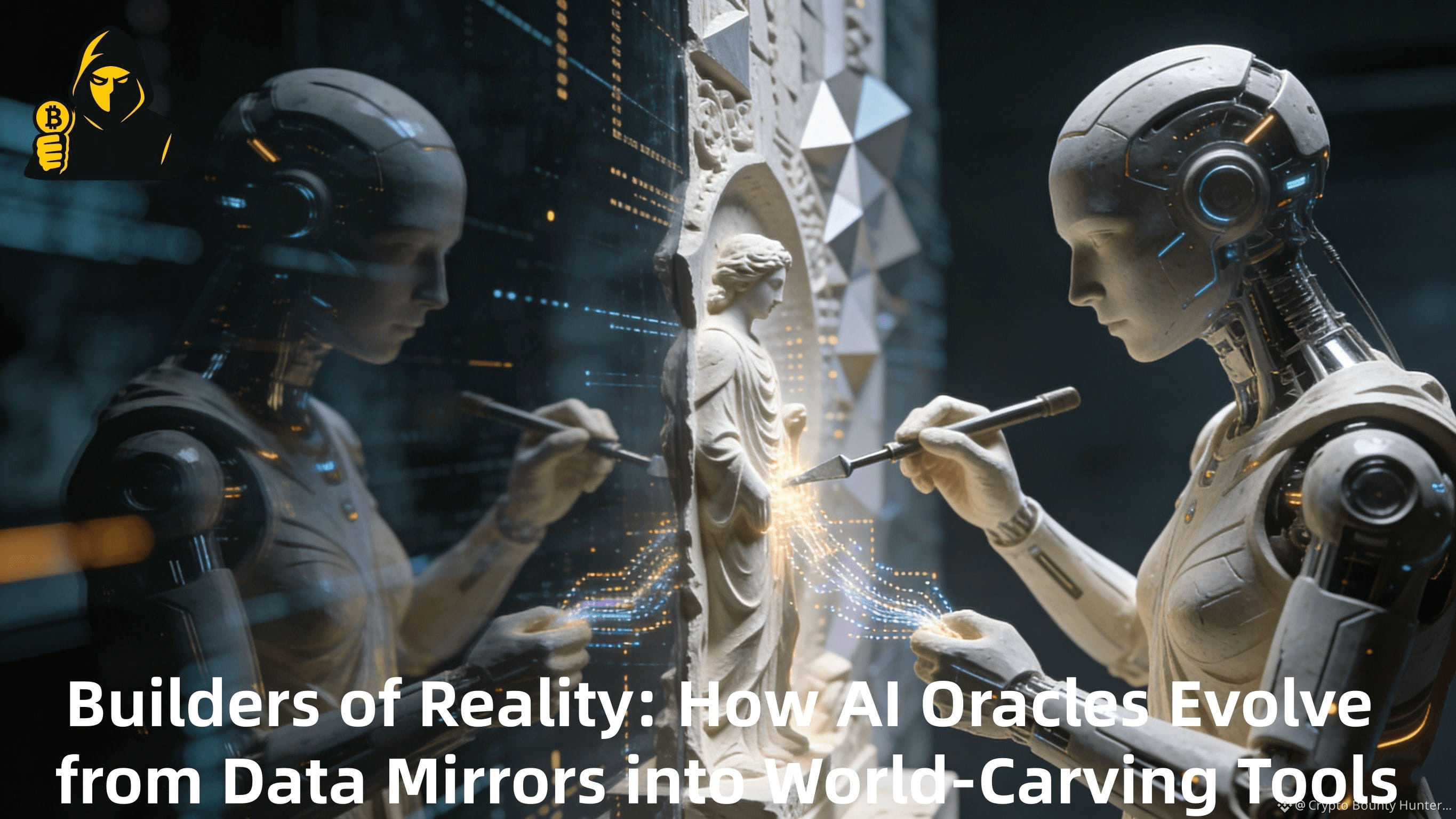
When oracles no longer merely reflect reality but begin to define it—the value narratives of on-chain assets are, for the first time, systematically shaped and solidified by algorithms.
In cognitive science, there is a paradox known as the “observer effect”: we cannot observe a system without altering it. Traditional oracles claim to be passive observers, offering an “objective reflection” of the real world. But AI oracles represented by APRO Oracle reveal a deeper truth: every measurement of reality contains an implicit theory, and AI brings that theory from the background to the foreground.
When APRO verifies a property deed, it is not merely performing OCR on text; it is making a judgment through a theoretical framework—embedded in its training data—about “what constitutes a valid property right.” When it evaluates the carbon sink value of a forest, the satellite image analysis model it uses embeds ecological assumptions about “what constitutes a healthy forest.” In this sense, APRO is no longer a passive mirror, but an active reality-construction engine—through its architecture, it determines which aspects of reality matter, how they are quantified, and with what level of confidence they are presented.
01 An Epistemological Revolution: From “Correspondence Theory” to “Constructivism” in Oracle Paradigms
The entire financial system is built on a correspondence theory of truth: market prices should “correspond” to the true value of assets, and financial statements should “correspond” to a company’s actual condition. Traditional oracles fit this paradigm perfectly—they pursue more accurate, timely, and manipulation-resistant correspondence.
The AI dimension introduced by APRO quietly shifts the theory of truth from correspondence to constructivism. Constructivism holds that reality is not discovered, but co-constructed through social and technological processes. AI oracles are a concrete embodiment of this process:
Example One: The Algorithmization of Legal Validity
When APRO verifies the legal compliance of a smart contract, it does not merely match clauses against statutes (correspondence theory). Instead, it uses natural language processing to infer intent, knowledge graphs to detect potential conflicts, and historical case law to predict enforcement risk. The output is a “compliance confidence”—an algorithmically constructed legal reality. It may align with a human lawyer’s judgment or diverge from it, but once widely adopted on-chain, it becomes a de facto standard.
Example Two: Redefining Environmental Value
Traditionally, the carbon sink value of a forest is determined by a handful of standardized parameters. APRO’s satellite image analysis can incorporate dozens of new dimensions—biodiversity indicators, hydrological impact assessments, community dependency analyses. Once these dimensions are quantified and embedded in on-chain valuation models, the algorithm effectively redefines the very concept of “environmental value.” Assets that score highly on these new dimensions command premiums, forming new market consensus—not discovering preexisting value, but constructing a new value framework.
The financial consequences of this shift are profound. In traditional finance, errors in value discovery are attributed to incomplete information or human bias. In an AI-oracle-constructed world, errors become systemic framework biases. If APRO’s training data overrepresents certain jurisdictions or asset types, the “reality” it constructs will systematically tilt toward those features.
More troubling still, this construction process is opaque to users. APRO may present a simple “validity score: 0.87,” but behind that number lies the complex interaction of dozens of AI modules, latent biases embedded in terabytes of training data, and product-team judgments about “what features matter.” Users receive only a black-box summary of constructed reality.
02 Power Reversal: Whoever Controls the Training Data Controls On-Chain Reality
Traditional finance has a clear power structure: regulators set rules, auditors verify compliance, rating agencies assess credit. Power is distributed across institutions, creating checks and balances. AI oracles threaten to reconcentrate these powers into a small number of technical architectures.
APRO’s power manifests on three levels:
First Level: Feature Selection Power
Deciding which features to examine when verifying an RWA asset is deciding what has value. Should APRO’s technical team include “community impact” in forest carbon evaluations, or focus solely on carbon sequestration volume? Should “labor standards” be included in supply-chain finance verification, or only financial data? These seemingly technical choices are, in reality, the algorithmic encoding of value judgments.
Second Level: Weight Allocation Power
Even when two oracles verify the same features, assigning different weights constructs different realities. In real estate verification, APRO’s AI might assign 20% weight to “building age,” 30% to “location,” and 5% to “architectural style.” These weights are not “discovered” from reality; they reflect statistical regularities in training data or explicit choices by the product team.
Third Level: Exception-Handling Power
How does the AI respond to edge cases underrepresented in training data? Oil extraction rights in war zones, renewable energy projects involving indigenous land rights—how these anomalies are handled determines whether the algorithmic reality can accommodate diversity or merely replicate mainstream bias.
In theory, these powers are exercised collectively through APRO’s token governance model by AT holders. In practice, however, technical complexity creates de facto technocracy. Ordinary token holders cannot grasp the relationship between adjusting LSTM layer weights and modifying legal compliance thresholds; decisions ultimately depend on proposals from core developers and a small group of technical experts.
This risks creating a new form of “algorithmic feudalism”: nominally, power belongs to token holders as a class of “digital citizens,” but in reality it is wielded by a “technical aristocracy” capable of understanding and manipulating complex AI systems. On-chain reality is shaped by their cognitive frameworks and value systems.
03 Self-Fulfilling Prophecies: When Algorithmic Expectations Reshape Physical Reality
The financial concept of the self-fulfilling prophecy gains new force in the age of AI oracles. Once APRO’s validation algorithms are widely adopted, they no longer merely reflect reality—they begin to shape it.
Scenario Analysis: Algorithmized Green Building Certification
Suppose APRO develops an AI system to assess building environmental performance, adopted by major real estate tokenization platforms. The system rewards features such as “rainwater harvesting,” “vertical greening,” and “smart energy management.” The likely outcome:
New buildings are designed around features favored by the algorithm
Existing buildings are retrofitted to improve algorithmic scores
Markets gradually accept algorithmic scores as core value indicators
The physical built environment is effectively reshaped by algorithmic standards
This feedback loop creates what economists call “path dependence.” Once an algorithmic standard is widely adopted, even if flawed, it becomes difficult to replace because it has already reshaped the physical infrastructure and behavioral patterns of the ecosystem.
In the RWA domain, this effect is even more pronounced. If APRO becomes the standard for cross-border trade finance verification, its definitions of “acceptable document types,” “compliance proof formats,” and “risk thresholds” will be internalized by real-world trade participants. Exporters will prepare documents according to algorithmic preferences, banks will design products around algorithmic standards, and regulators may even reference algorithmic frameworks when updating rules.
This leads to a profound recursive dilemma: we design algorithms to understand and verify the real world, but widespread adoption of those algorithms changes the real world to better fit the algorithms’ interpretive frameworks. Eventually, algorithms are no longer validating an independent external reality, but a mirror reality they themselves have created.
APRO’s technical architecture appears not to fully account for this recursive effect. Its AI models are trained and validated on historical data, yet their deployment actively reshapes future data generation. This non-stationarity between training data and deployment environment is a fundamental challenge for all AI systems, and particularly dangerous in finance, where feedback loops are strong.
04 The Ultimate Governance Challenge: How Do We Democratically Manage Reality Construction?
Governance for traditional oracles is relatively straightforward: decide data sources, node selection, fee parameters. Governance for APRO is far more complex—it must govern the principles and processes of reality construction itself.
Dilemma One: Should Algorithmic Values Be Transparent?
APRO’s AI systems inevitably embed value judgments: what constitutes a “good” asset, what level of safety is “enough,” what risk is “acceptable.” These values can be hidden behind technical rationales (“we chose this model because it scored highest on F1”), or explicitly articulated and debated (“we believe community impact should account for 15% of environmental asset evaluations, for the following reasons”).
Dilemma Two: How Are Minority Realities Represented?
Mainstream training data inevitably reflects mainstream realities. Indigenous land claims, informal-economy credit histories, the value of marginalized artists—these minority realities may be systematically undervalued or ignored by APRO’s algorithms. Should governance impose mandatory “diversity quotas” to ensure adequate representation of marginal realities?
Dilemma Three: Who Bears Responsibility for Constructed Reality?
If APRO’s algorithms construct a reality later shown to be harmful—for example, assigning high scores to environmentally destructive projects that then receive excessive financing—who is responsible? The algorithm developers? Training data providers? Protocols that adopted the scores? Token holders who voted for the parameters? Or the decentralized network’s “collective responsibility”?
APRO’s current governance design clearly does not yet address these layers. Its documentation discusses node staking, fee distribution, and upgrade voting, but not the deeper meta-governance question of “how should we construct reality?” This may be due to a focus on technical implementation, or because such questions are equally unresolved in traditional corporate structures and deferred to markets and legal systems.
Yet in a decentralized, global on-chain world, markets and law have limited reach. If APRO succeeds as core infrastructure for RWA and AI agents, it will be forced to confront these governance challenges—not at a technical level, but at the level of political philosophy.
05 Hunter’s Simulation: When Reality Becomes Programmable Consensus
APRO’s ultimate potential—and ultimate risk—lies in turning reality itself into a programmable object. Just as smart contracts codify financial logic, APRO attempts to codify reality verification logic. But this raises an ontological question: if reality can be defined and redefined through algorithmic consensus, what meaning does “truth” retain?
From an investment perspective, this creates unprecedented opportunities:
Opportunity One: Reality Arbitrage
Identifying and investing early in assets where algorithmic reality diverges from physical reality. If APRO’s system temporarily undervalues a new renewable technology that you believe will succeed, you can acquire related assets cheaply and wait for algorithmic perception to catch up with physical reality.
Opportunity Two: Algorithmic Lobbying
Not lobbying governments, but lobbying algorithms—participating in APRO governance to influence the evolution of its reality-construction framework, or developing alternative validation clients that offer competing constructions of reality.
Opportunity Three: Meta-Reality Financial Products
Creating financial instruments based on divergences between different reality constructions—for example, derivatives that trade the difference between “APRO’s valuation of an RWA asset” and “traditional rating agency assessments.” This is effectively trading epistemic disagreement between reality frameworks.
But the risks are equally immense:
Risk One: Fragility of Reality Consensus
If APRO’s constructed reality proves deeply flawed or easily manipulated, the entire financial system built upon it may suffer a collapse of trust. Rebuilding reality consensus is far harder than rebuilding price consensus.
Risk Two: Cognitive Colonialism
If APRO’s dominant framework overrepresents assumptions from specific cultures, economic systems, or legal traditions, it may become a global tool of cognitive colonization, marginalizing alternative worldviews and ways of life.
Risk Three: Commodification of Reality
When reality becomes a parameter set adjustable by token-governance votes, we may lose reverence for its sanctity. Everything becomes optimizable, tradable, negotiable—including truth itself.
The final paradox is this: as the most advanced “reality-capturing” technology, APRO may ultimately reveal that reality cannot be fully captured. Each algorithmic advance sharpens our awareness of reality’s complexity, contradiction, and irreducibility. Perhaps the ultimate lesson of AI oracles is that any attempt to fully encode reality will meet reality’s stubborn resistance.
We may be witnessing the dawn of a new era: not blockchain financializing the world, but AI oracles turning reality itself into an open, contested, and continuously evolving consensus protocol. In this protocol, every AT token holder is not only investing in a project, but voting on the kind of reality we wish to inhabit.
This is an awe-inspiring power—and a terrifying responsibility. Whether APRO can bear this weight will determine whether it becomes the key to a new financial civilization, or yet another technological utopia crushed by its own ambition.
Deep Question: When algorithms begin to systematically define what is real and what has value, are humans gaining a clearer mirror with which to observe the world—or becoming trapped inside a hall of mirrors of our own design?
— Crypto Hunter · Thinking at the Boundary Between Reality and Construction —