
20% APY? Boring. 50%? Most likely a Ponzi scheme. But what if it were the 'on-chain version of 12% risk-free return endorsed by JPMorgan's strategic logic'? On December 13, 2025, while retail investors are nervously mining through various meme coin projects, fearing the project team will run away by the next morning, Lorenzo Protocol's OTF (On-chain Traded Fund) is quietly consuming high-quality assets in the DeFi world. This is not just a simple aggregator; it's a 'financial wholesale' movement. By searching on Google 'structured yield products crypto vs tradfi 2025', you will find that Wall Street has long played with yields using ETFs—like JEPI (annualized 8-9%) through covered call options, SVOL (annualized 12%) through shorting volatility. And Lorenzo is trying to package these complex financial Legos—from delta-neutral arbitrage to volatility harvesting—into a simple token, allowing even someone with only $100 to harvest the market like BlackRock.
The core of this social experiment lies in breaking down the invisible walls of 'qualified investors'. Technically, Lorenzo utilizes its core architecture—the Financial Abstraction Layer (FAL)—to connect over 30 DeFi protocols (such as Aave, Compound) and CeFi strategies (such as Binance sub-account arbitrage). An OTF token is essentially a smart contract container that may simultaneously include Aave's lending interest, Ethena's funding fee income, and Deribit's options premiums. Economically, this structured product reduces the risk of a single protocol being hacked through diversified investment while smoothing the yield curve with a combination effect. For retail investors with less than $10,000, replicating such strategies used to require paying expensive gas fees and management costs of up to thousands of dollars, but now it only requires buying an OTF token.
However, the shadow of regulation always looms over the 'basket of assets'. The data dilemma lies in whether a token that is anchored by a bunch of complex derivatives constitutes an 'Asset-Referenced Token' (ART) under the EU MiCA regulations or a 'mutual fund' in the United States. In Q3 2025, the SEC initiated an investigation into similar aggregation protocols, requiring disclosure of the detailed composition of underlying assets. On a societal level, this has led to a natural distrust of 'blind box financial products' among users—if I do not know where my money is specifically, how can I know it is safe? Lorenzo's strategy is to meet transparency requirements through on-chain real-time disclosure—every position of the underlying strategy can be checked on-chain, although this exposes commercial secrets, it also brings temporary tolerance from regulators.
The execution process is an automated harvest. When users deposit assets, the FAL router distributes funds to different Simple Vaults based on preset weights (e.g., 30% low-risk lending + 50% Delta neutral + 20% volatility strategy). The smart contract periodically harvests profits from various sub-strategies and automatically exchanges these fragmented tokens (such as CRV, COMP, AAVE, etc.) through DEX into base currency (such as USDT or BTC), and then reinvests or distributes dividends according to preset logic. This process is like an unflagging harvester, working 24 hours a day in the fields of DeFi. The slippage and fees of each link are infinitely diluted by the scale effect of FAL.
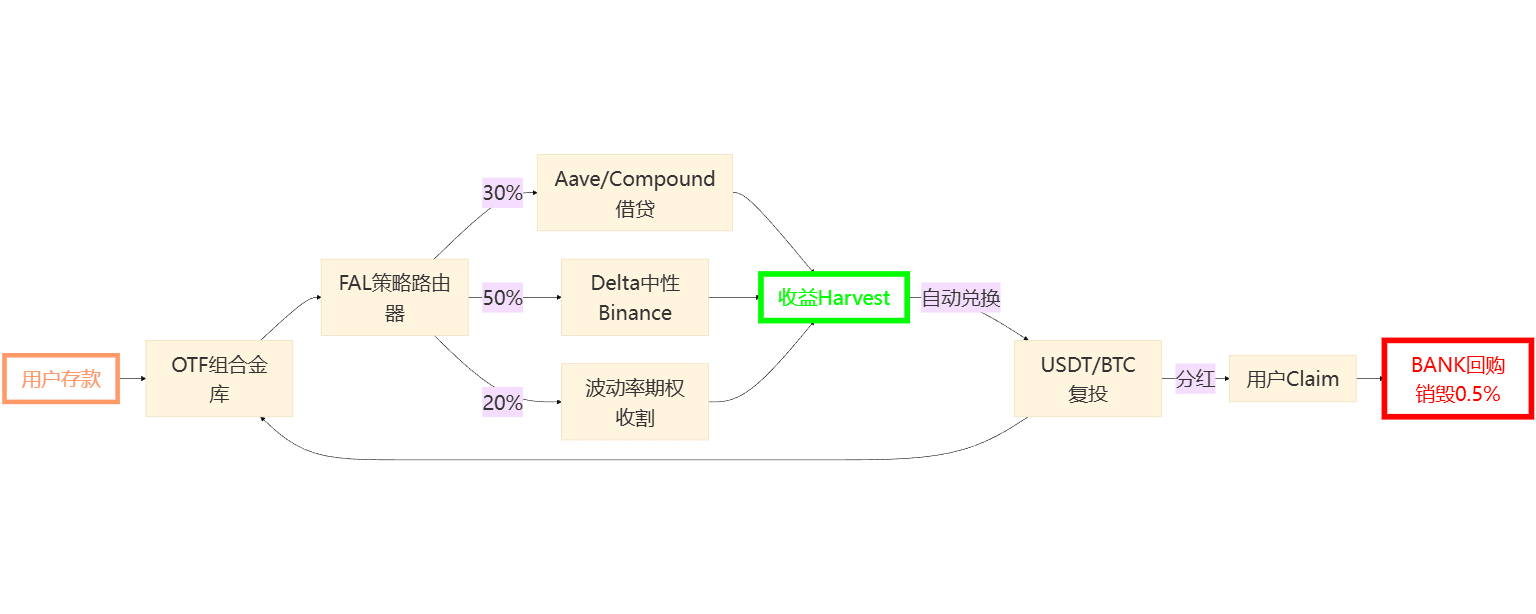
The result is an astonishing 'dimensionality reduction strike'. Lorenzo's flagship OTF product outperformed the simple holding of BTC by about 14% in 2025, with a volatility only half that of the latter. Institutional funds have started to allocate crypto assets in this way because they value this 'Risk-Adjusted Return'. Data shows that over 65% of TVL flowed into this Composed Vault instead of a single strategy vault. Social stratification reappears: those who understand are buying OTFs to enjoy passive income, while those who do not understand are still manually trying to beat the market.
Compared to other yield aggregators, Lorenzo's advantage lies in its hybrid architecture. Pure on-chain aggregators like Yearn are limited by on-chain gas fees and slippage, making it difficult to execute high-frequency Delta neutral strategies; while CeFi platforms like Nexo offer high yields but are completely opaque. Lorenzo, through the FAL architecture, leverages the liquidity depth of CEX while retaining on-chain transparency and self-custody features. This 'middle path' has proven to be the most resilient in the 2025 market—it avoids the performance bottlenecks of pure DeFi and also sidesteps the trust crisis of CeFi.
I looked at those friends who are still manually mining and thought of the gold miners of the 19th century. True wealth has never belonged to those who wield the shovel, but to those who sell shovels or even industrialize the gold mining process. Lorenzo's OTF is this industrialized excavator. In 2026, when DeFi yields return to rationality, you will find that having a 'container' that can automatically capture the entire market's Alpha is much more important than having some skyrocketing token. OTF is not just a token; it is a financial container that is reshaping the standards of value transport. In this container, there is no distinction between retail and institutional investors, only holders and bystanders.
I am a boat-carving sword seeker, an analyst who looks at the essence and does not chase noise. @Lorenzo Protocol #LorenzoProtocol $BANK


