
Do you think that if you click 'approve' on the DAO website,
the funds in the treasury will be automatically transferred by the smart contract?
Unfortunately, in most DAOs today, the 'decentralized voting interface' you see on that page,
More often than not, it's just an expensive opinion poll—
The real 'nuclear button' still lies in the hands of a few multisigners who hold the private keys.
I am like a boat seeking a sword, and YGG is one of the very few projects that clearly explains this matter in its white paper:
Before fully automated on-chain governance arrives, the entire industry is in a 'half-human, half-code' hybrid governance stage.
01 Snapshot: Breaking down idealism into a practical front-end
In the technological context of 2021, DAOs faced a very real challenge:
If every vote has to be recorded on the blockchain
A single, ordinary proposal could burn through tens of thousands of dollars in gas.
turn out:
Either there's no voting at all, and the "core team makes the decisions";
Either implement on-chain voting, leaving only large token holders with the incentive to participate.
Ordinary users' participation is squeezed out by costs, and governance power is highly centralized.
YGG chose a pragmatic approach:
Use Snapshot as the governance front end;
Move the voting process off-chain.
By using signature-based voting, the gas cost at the voting level is reduced to zero.
What is the cost?
The inevitable cost is the creation of a "trust air gap":
The voting took place in Snapshot, an "off-chain ledger of public opinion."
The execution takes place within a multisignature wallet like Gnosis Safe;
The key lies in "people"—the core team, multiple signings, and community opinion.
Voting and execution were physically separated into two layers, with Snapshot becoming the "front end" of DAO governance.
However, it is not "a smart contract that is bound to the blockchain in real time and executed on the blockchain".
02 "Proposal - Signal - Execution": YGG's Three-Stage Governance Process
In Phase 2 of YGG's technology roadmap,
The governance process of "DAO voting begins on Snapshot" has been clearly initiated.
This hybrid governance approach is designed as a relatively rigorous three-stage process:
Proposal
Community members who hold YGG tokens can initiate governance proposals on Snapshot;
The proposals can include parameter adjustments, fund allocations, or major business decisions.
Signal
All token holders can participate in voting by signing through their wallets, without incurring gas costs.
When the vote reaches the preset quorum and majority threshold, a clear "off-chain consensus result" is formed.
Execution
After the proposal is approved, YGG's multiple signees or core team members,
Based on the voting results, on-chain transactions will be initiated and signed sequentially in Gnosis Safe;Only when the multiple-visa threshold is met (e.g., n-of-m),
Operations such as fund transfers and contract parameter modifications will actually occur on Ethereum or other target chains.
This path can be summarized in one diagram:
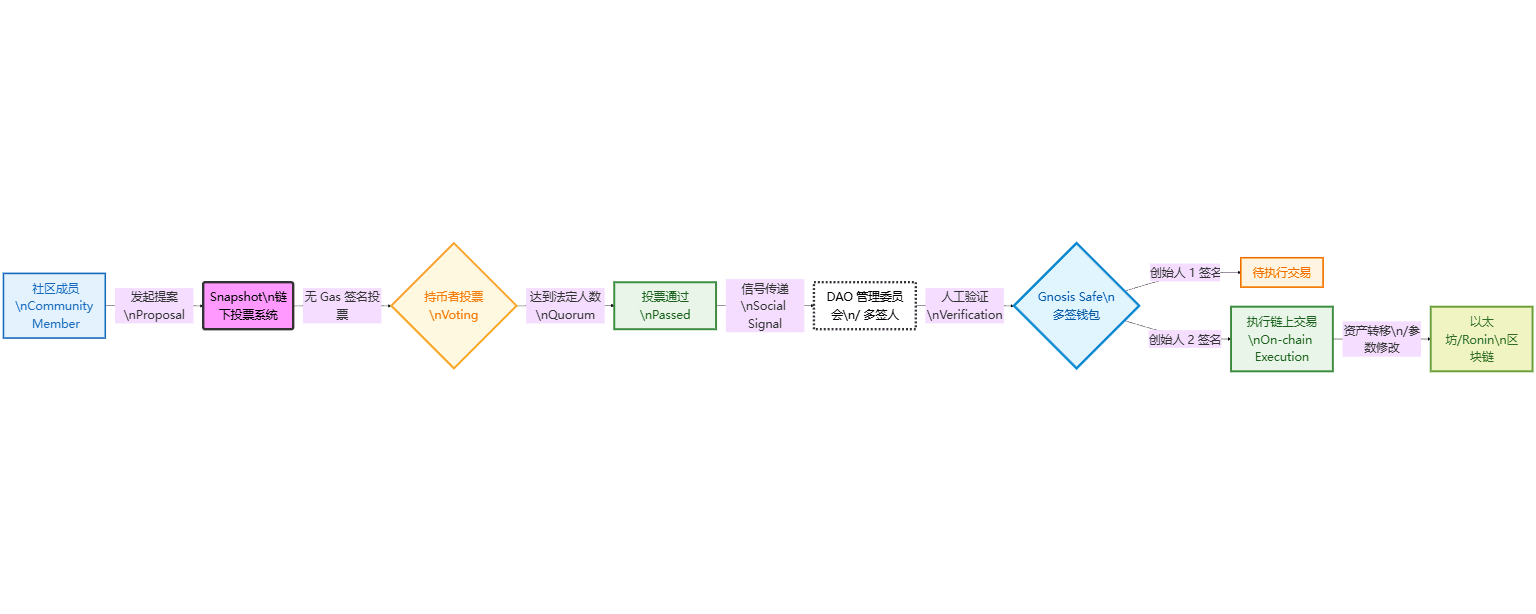
This is a typical "soft governance (voting) → hard enforcement (multiple signatures)" model:
Snapshot is responsible for aggregating public opinion, while Multi-Signature is responsible for pressing buttons.
03 The White Paper's Candor: This is a "Distributed System" in Transition
There's a detail in YGG's white paper that's worth pondering repeatedly:
Governance will be "progressively decentralized";
Decisions are based on a "majority vote";
Execution is accomplished by a "distributed system".
At this stage, this so-called "distributed system"
It's basically a combination of Snapshot and multisignature wallet.
YGG did not envision a completely "on-chain governance utopia" for the community.
Instead, it directly admits:
Fully on-chain governance is not feasible at the moment due to technical and cost constraints.
Before this, an auditable and tamper-proof public opinion ledger is needed to constrain those who sign multiple signatures;
Any multi-signature operation that clearly contradicts the Snapshot voting results,
These will all become evidence for community discussion and auditing.
in other words:
In YGG's governance model,
The "reputation" of those who sign multiple contracts is one of the most crucial constraints at this stage.
If multiple applicants repeatedly ignore the snapshot results,
Not only will it face skepticism from the community,
They may also pay a price in subsequent incentive, role and permission adjustments.
04 Compared to a "pure protocol-based DAO", why did YGG design it this way?
Comparing YGG with pure protocol-based DeFi projects like Compound and Uniswap will help to better understand this choice.
Protocols like Compound and Uniswap employ on-chain governance contracts similar to Governor Alpha and Bravo.
Proposal, voting, queuing, and execution are all completed on the blockchain;
Almost every state change requires an on-chain transaction.
YGG's identity is more like that of an "operating entity + asset management organization":
What needs to be done is to buy land, invest in projects, sign contracts with teams, and organize events;
Many decisions are difficult to describe with a single parameter, and are even less suitable as pure contract states.
For YGG, the core advantage of Snapshot lies in:
Larger bandwidth for governance
The community can vote on "non-code decisions":
Which blockchain should we invest in?
Which virtual land should I buy?
Which event or team will you sponsor?
These all fall under the category of "social coordination," rather than simply "contract parameter tuning."
The barrier to entry is almost zero.
Holding cryptocurrency grants voting rights; signing a document completes the voting process.
With no gas costs, the opinions of small-scale cryptocurrency holders can be more fully incorporated.
Implementation is still subject to real-world constraints.
Ultimately, many things need to be documented in the company, foundation, contract, and invoice.
This part could never be 100% on-chain in the first place.
Instead of pretending to "automatically execute across the entire chain," it's better to be honest about the hybrid governance structure.
YGG calls all of this Social Coordination:
In the gray areas that smart contracts cannot cover
Using human consensus, reputation, and cooperation
Connect the blockchain to the real world.
05 After the Snapshot is "activated": Voting is no longer just a symbol
A single free voting platform is insufficient to create binding force.
One of YGG's designs is to increase engagement through token incentives:
Addresses participating in governance have the opportunity to receive additional rewards, airdrops, or reputation points;
The proposers and the addresses that continue to participate in voting will gradually form a group of "main force in governance participation";
Snapshot has transformed from a "decorative suggestion box" into a highly interactive community forum.
As more and more token holders continue to voice their opinions on Snapshot:
The disregard for the voting results by those who sign multiple signatures will immediately translate into pressure at the community level;
The community can use subsequent proposals to request "adjustments to the list of multi-signers" and "modification of the permission structure";
Governance is no longer just a one-way process of "voting → being implemented".
Instead, it has formed a closed loop of continuous competition and iteration.
06 For token holders: A vote + a pair of eyes monitoring the market.
Understanding the separation between Snapshot and on-chain execution has two implications:
Your tokens represent actual votes, but not "automatically activated commands."
When you click "Like/Dislike" on a Snapshot,
You are sending a "governance signal";This signal needs to be "manually translated" by multiple signatories.
Only then will it become a real transaction on the blockchain.
Supervision and participation are equally important
If no one checks whether the results are implemented after the vote...
Then the vote really was just a ceremony;When you participate in voting and also pay attention to multisignature wallets and official progress disclosures,
You have truly fulfilled the dual role of "participating in governance + supervising implementation".
YGG has reserved a significant portion of its tokens for the community.
Its core meaning is:
In the short term, enforcement power will be primarily exercised through a multi-signature mechanism;
In the long run, governance power and direction depend on communities with sufficiently high levels of participation.
The vote you cast under each proposal,
It's not just about deciding on a budget or an investment.
This is also pushing YGG from the "hybrid governance phase".
A small step toward a higher degree of automation and rule-based governance.
Risk Warnings and Statements
The above content is a personal study and interpretation based on publicly available information and common DAO governance models, and is intended for information sharing and learning purposes only. It does not constitute any investment advice or legal opinion.
DAO governance involves execution risks, governance attack risks, and regulatory uncertainties. Before participating in any voting, proposal, or funding decision, please conduct your own research (DYOR) and act prudently based on your own risk tolerance.
I'm like someone who clings to outdated methods, someone who focuses on the essence of things and doesn't chase noise. @Yield Guild Games #YGGPlay $YGG

