
In this era where anything can issue tokens on the chain, 'governance tokens' have almost become a derogatory term.
The vast majority of Governance Tokens only do two things:
Give you a Snapshot voting power, creating a bit of the illusion that 'I am a shareholder';
After liquidity mining ends, they are ruthlessly dumped by the team and early miners.
The result is that old saying: agreements make real money, while tokens head towards zero.
What the Lorenzo Protocol wants to do is the opposite - since everyone will eventually face cash flow discount models, why not design BANK from the beginning as a 'value black hole' that consumes income and spits out deflation.
The collective collapse of governance tokens: protocols making money, tokens going to zero
The fatal issue for most DeFi protocols today is not the business model, but rather that the Tokenomics design has completely severed the 'utility' from 'value':
Protocol side: As TVL grows larger, transaction fees, interest spreads, and liquidation income are all real money.
Token side: No dividends, no repurchases, the only use is 'may rise in the future'.
A typical case is UNI: Uniswap itself is a great infrastructure, but UNI does not participate in the protocol's cash flow distribution, serving more as a brand symbol and governance point.
For primary and secondary capital, the valuation story of such tokens cannot withstand a full cycle—if there is no real value returning, all inflation will ultimately be realized as selling pressure on the K-line.
Lorenzo is facing the same big test:
FAL (Financial Abstract Layer) captures considerable cash flow daily through cross-chain routing, RWA interest spreads, and CeFi strategies;
If these profits do not reflect in BANK, Lorenzo is at most a successful tool, not an asset worth holding long-term.
The question itself is very simple and crude:
'The money earned by the protocol, does it go into the team's pocket, or into the BANK holders' pocket?'
Lorenzo's solution: Make BANK a 'value black hole'
The answer given by Lorenzo is to write a flywheel in the protocol layer:
As long as FAL is running, BANK is being repurchased and destroyed.
This is completely different from the traditional 'buyback at will' approach, but rather a cash flow distribution system enforced by smart contracts—where the team cannot go back on their word, and the DAO cannot casually default.
There are only two core ideas:
All distributable profits must first pass through the 'black hole'
Routing fees generated by the FAL strategy, RWA/CeFi performance fees, borrowing interest spreads...
All must be uniformly summarized into the protocol treasury income aggregator, rather than going directly into team wallets.
From day one, the 'shareholder repurchase logic' is written into the contract
A portion of the profits is forcibly used for secondary market repurchases and permanently destroying BANK (deflation);
A portion of the profits is allocated to locked veBANK (real earnings);
The remainder is left for the insurance fund and operational expenses.
In other words, BANK is not just 'sticking a governance icon on', but designed to be a 'quasi-equity asset' of Lorenzo:
The more the protocol earns, the larger the repurchase;
The more it destroys, the less it circulates;
The higher the real earnings, the stronger the motivation for long-term locking.
The specific operation of the income black hole: from FAL to repurchase and destruction
The execution path of this flywheel on-chain can be illustrated in a simplified flowchart like this:
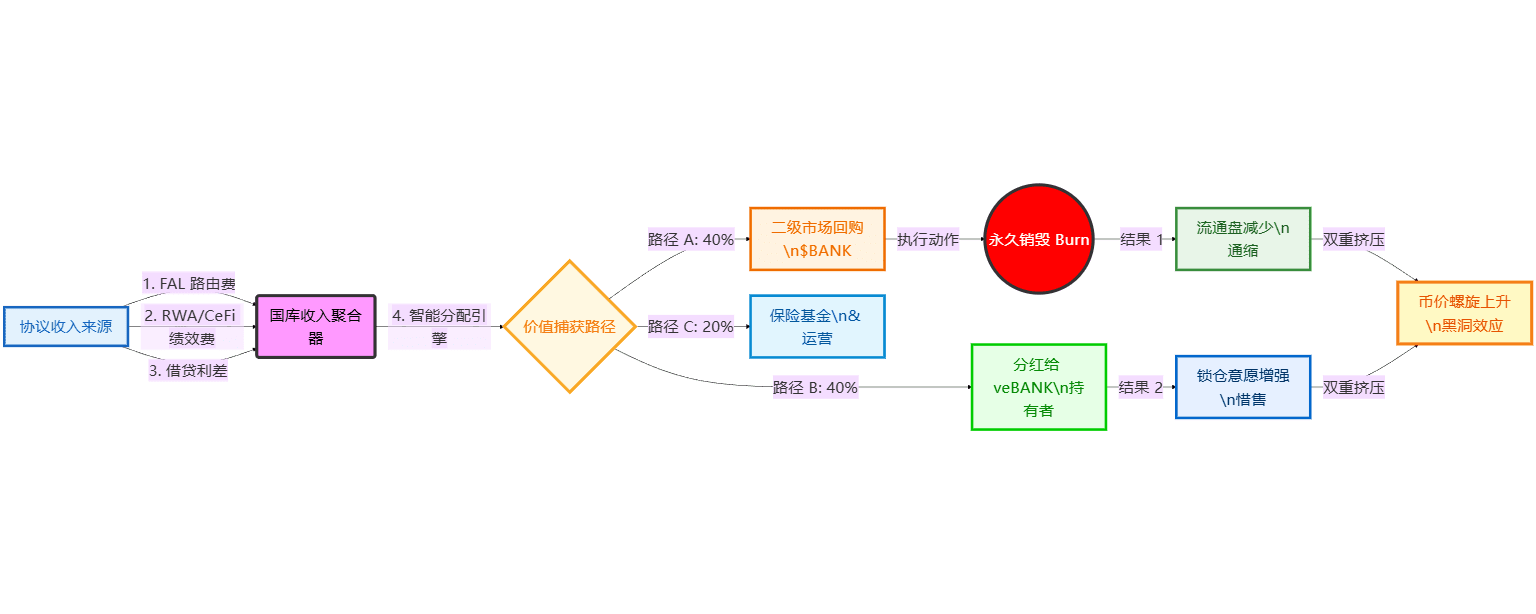
Breaking it down reveals three things:
Path A: Forced repurchase + permanent destruction
The protocol will not hoard BANK in the treasury, but will regularly repurchase on the secondary market and then directly send it to the black hole address.
This means:Every new user coming in, every new strategy added, helps to increase the unit equity value for existing holders;
For miners/early selling pressure, there is always a 'buyer who won't stop placing orders' in the counterparty— the protocol itself.
Path B: Real earnings dividends from veBANK
veBANK is not an empty 'voting point', but a distribution certificate of real-world cash flow.The longer and more you lock, the larger the share of the pie you receive;
For long-term capital, this is the real cash flow that can enter the DCF model, rather than a 'story'.
Path C: Insurance Fund & Operating Budget
This actually adds a 'safety cushion' to the entire flywheel:The insurance fund guarantees that the strategy will not collapse in extreme market conditions;
The operating budget ensures that Lorenzo can continue to iterate and acquire resources without relying on additional token issuance.
Summarized in one sentence:
Protocol income is not shared equally, but rather designed to prioritize 'feeding BANK first, then nurturing the ecosystem'.
Data Echo: How BANK outperforms the market during downturns
No matter how well the mechanism is explained, it ultimately comes back to the market and the data.
Currently, several key signals can be seen from the on-chain and data aspects:
Valuation compression has given BANK ample safety margins
Lorenzo's current P/S is around 4.x range,
In comparison to similar infrastructures:LDO is close to a double-digit P/S;
AAVE and other established protocols are in the teens range.
This means:Based on every $1 of protocol income, BANK is currently valued lower by the market,
For medium to long-term value investors, this is a 'wrong kill' opportunity.
Continuous destruction is squeezing the circulating supply
In a single quarter, about 2.8 million BANK have been destroyed, accounting for about 1%+ of the circulating supply.
This rhythm is crucial:It is not a one-time showy 'large destruction announcement', but a continuous programmatic repurchase;
For anyone who wants to manage positions long-term, time is on your side.
Downward Beta has been significantly weakened
In the past few systematic corrections of Bitcoin at the 10% level,The market DeFi governance tokens often drop -15%, -20%;
BANK's pullbacks are often controlled within the -3% to -5% range.
This is not mysterious:
When others only have selling pressure without buying interest,
There is always a 'relentless but stable programmatic buyer' in BANK's counterparty—Lorenzo's protocol itself.
In contrast to traditional 'mining and selling': linear inflation vs exponential deflation
Putting BANK back into a larger industry context will make the differences clearer:
Traditional model:
High inflation issuance → high APR attracting TVL → output dumping → price continues to decline;
The token itself has no 'holding value', and everyone naturally chooses 'mining and selling'.
Lorenzo model:
Every dollar earned by the protocol is systematically divided into 'deflation + dividends';
The larger the ecosystem grows, the stronger the repurchase effort, and the steeper the deflation slope.
If compared to stocks:
Most DeFi tokens are like a lousy company continuously issuing stocks as salaries;
Whereas BANK is more like a cash cow enterprise with stable cash flow, large-scale repurchases every year, and a shareholder-friendly culture.
The difference is not in 'whether there is a story', but in:
While others are telling stories, Lorenzo is already using profits, using real money to endorse BANK's value.
Investor perspective: Treat BANK as Lorenzo's 'cash flow equity'
If you are among those who seriously study on Binance Square, consider looking at BANK from a different perspective:
Do not treat it as a 'governance token' that will rise and fall;
Treat it as a certificate of Lorenzo's entire ecosystem 'cash flow equity':
Every transaction fee from the FAL routing;
Every drop of excess profit from the BTCFi strategy;
Every basis point from RWA interest spreads;
—will ultimately be gradually piled up here in BANK in the form of repurchases or dividends.
For you as a BANK holder, what you really need to focus on is not the next K-line, but three things:
Is TVL climbing?
Is protocol-side income continuing to rise?
Are the numbers on the repurchase and destruction addresses steadily increasing?
As long as these three curves are moving upward, no matter how the short-term price fluctuates, it is all noise.
In the long run, what you hold is not a lottery ticket, but a share of a cash flow machine with a 'repurchase program' written into it.
I am like a boatman looking for a sword,
After seeing too many stories of 'protocols making money and tokens going to zero',
I cherish Lorenzo's type even more—
Dare to write real earnings into contracts,
Dare to let BANK coexist and perish with itself, a rare species.



