
What is USDT (泰达币), and what causes the price fluctuations of USDT?
For anyone new to the cryptocurrency world, whether trading coins or doing anything else, 99% will first come into contact with USDT. USDT (泰达币) is familiar to those in the circle, but it is quite unfamiliar to newcomers. Today, Uncle Wen will discuss USDT (泰达币) with beginners who are entering or want to enter the cryptocurrency world.
 Currently, there are various stablecoins on the market such as USDC, DAI, TUSD, FDUSD, etc. USDT is one of the stablecoins issued by Tether, a company based on blockchain technology. The English name is Tether, the token number is USDT, and the Chinese name is 泰达币. Its value is pegged to the US dollar at 1USDT=1USD.
USDT is the most widely circulated stablecoin on the market.
Tether officially claims to guarantee with equivalent USD and provides a service where 1 USDT can be exchanged for 1 USD. The intention behind this is that before stablecoins appeared, all currency pairs during trading were affected by bilateral exchange rates, such as Ripple at that time.
Its price is pegged to Bitcoin, and at that time, the highest trading volume and market capitalization was Bitcoin. However, Bitcoin's price is highly volatile, making it unsuitable as a pegged currency. Thus, stablecoins emerged to solve the problem of bilateral exchange rates.
 As long as it is exchanged for stablecoins, it can be unaffected by market fluctuations, which has a very obvious hedging effect for funds and has gradually become a rigid demand in the market. When you use fiat currency to purchase official USDT, your fiat currency will automatically convert to USD.
Deposited in the official account, the amount of USD stored in this account represents how much USDT is circulating in the market. Tether reserves at a 1:1 ratio; for every USDT issued, there will be an additional $1 in the official account. This is the basis for why USDT can maintain a stable price.
On the contrary, when users exchange USDT back into USD, the official will simultaneously destroy an equivalent amount of USDT to ensure that the official account's reserves and circulation remain consistent.
To improve transparency, on the Tether official website, you can check the latest official USD reserve amount, as most exchanges support USDT as a pricing trading pair due to the USD guarantee!
 Because 1 USDT = 1 USD (US Dollar), the price of USDT will also be affected by the USD exchange rate. Recently, the price of USDT dropped from over 7 to over 6, which is because the Federal Reserve started to ease and cut interest rates, increasing the amount of circulating USD, leading to the depreciation of the dollar.
The price fluctuations of USDT caused by normal monetary cycles of interest rate hikes and cuts are considered normal.
The occurrence of a significant drop in USDT is definitely due to some sudden event causing USDT to deviate from USD, leading to panic and resulting in a significant drop in USDT prices locally or globally!
Essentially, it is still the spread of panic emotions, leading to an imbalance in the supply and demand relationship of USDT in the market.
Historically, the price of USDT has experienced several sharp declines, and Tether has faced several trust crises, being accused of insufficient reserve funds, which caused the price of USDT to deviate significantly from its peg for a short time, but it quickly recovered.
In 2020, a certain exchange announced that some of its private key managers were cooperating with public security investigations and were currently missing, causing the inability to complete authorization, and suspending withdrawals, resulting in market panic. Many merchants and retail investors sold USDT in large quantities.
This led to a significant drop in the off-exchange price of USDT, with severe negative premiums inside exchanges, and it took several weeks to recover.
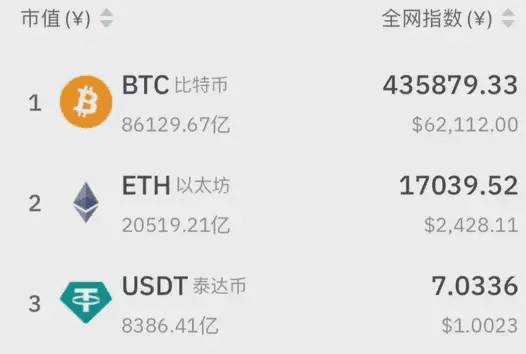 Although there have been multiple trust crises, as of October 2024, the market capitalization of USDT is $120 billion, ranking third in the cryptocurrency market, only behind Bitcoin and Ethereum, and it remains the largest stablecoin in market share.
 The off-exchange premium of USDT refers to the ratio of the off-exchange bid price to the US dollar. Excessive demand for digital assets often drives this indicator above 100%, meaning demand significantly exceeds supply, leading to prices being above the normal price range for a short or long time, which is called positive premium.
Conversely, when demand in the cryptocurrency market is sluggish and supply is abundant, when supply exceeds demand, lower bid prices will cause prices to fall below the fair value of 100%, resulting in lower bid quotes, which is called negative premium.
According to the rules of the cryptocurrency market, off-exchange premiums for USDT during a bull market are generally positive premiums, as funds rush to enter the market, leading to high demand. In a bear market, the situation is reversed, and USDT prices are generally at negative premiums. However, it’s not always the case; local market explosions can also cause short-term positive and negative premiums for USDT.
For newcomers to understand this rule, in practice, when to sell the U in your hand and when to buy can be acted upon according to this logic, which also helps to save your own holding costs.
Thank you for watching. I am Xiaofei, very pleased to meet everyone. Xiaofei focuses on Ethereum contract spot ambush, and the team also has quick positions, leading you to become the dealer and a winner. #加密市场观察 $ETH$BTC

